

The inability to communicate one’s inner state and feelings is at the core of Stroma Cairns‘ emotionally eloquent debut feature, premiering at TIFF and now running in San Sebastian’s New Directors slate. After building a strong reputation with short films and music videos, the British director embraces the long form with a clearness of expression and confidence quite different from the hidden insecurities of her young male protagonists. Trapped in a life marked by aimless apathy and riddled with self-doubt, restless Londoner Jonah (Jonah West) meets another local from Scotland’s Northeast coast who shares his insecurities – albeit in a personally and socially rather different context.
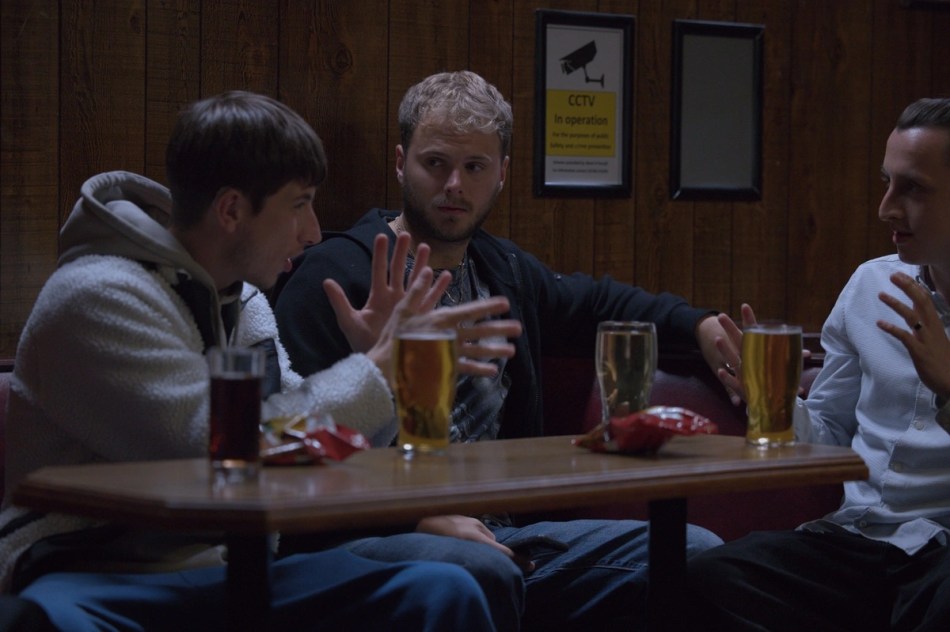
Partly to take care of a family matter, partly to escape his self-destructive routine of drug and drink fueled excesses and broken promises to himself to recover, Jonah makes an impromptu trip to his parents’ home town. There he and his best friend Lee (Stanley Brock), whom Jonah persuaded to come along, encounter Charlie (Connor Tompkins). The Deaf young man has a hard time dealing with his twin Luke (Lewis Tompkins) who is prone to shutting off his feelings much like Jonah. The latter forms an unexpected bond with Charlie who, despite the majority of people’s inability to understand signing, proves much better at conveying his emotions.
Jonah listens and learns, though not in a vocal-acoustic way. In Charlie he discovers an emotional honesty and unbiased openness to others that he first can’t quite process. But soon he begins to grow through the friendship with someone who – unlike Jonah himself – doesn’t direct all his fear and frustration inwards. Secrets, old scars, and the rough climate test the trio’s tentative friendship. Building a story around an able-bodied person getting a new direction in life thanks to an inspiring disabled individual is a premise prone to condescending clichés and (often enough not-so-)subtle sidelining of the physically or mentally challenged person.
However, Cairns and co-writer Imogen West are both aware of these paternalistic patterns and careful to avoid them. While Jonah remains at the unpretentious story’s center, Charlie is a complex character in his own right, facing his own struggles. Whereas his new friend is afraid to openly admit his loneliness and loss of direction, Charlie is misunderstood due to an ableist society’s refusal to properly listen to people challenged with vocal language. As he explains to Jonah and Lee as they invite him to London, the world of the hearing is like a closed community reluctant to make even the slightest effort to communicate.
His encounter with a dismissive receptionist and a shared childhood memory give painful examples of society’s casual disregard towards disabled people. Resisting naive sentimentality, the narrative focuses on the subtle dynamics of the characters’ interaction. Awkward pauses give way to the wordless intimacy of shared silence. Small gestures become enough to convey complex feelings, and the urge to run away from discomfort remains palpable, even as Jonah slowly regains his footing in life. As a key plot line about a rather allegorical accident illustrates: people can survive even harsh falls if there’s someone to help them up. Though these symbolic overtones can take overhand, they add a lyrical touch to the scenic landscape.
Solid performances imbue Charlie’s and Jonah’s relationship with an unsentimental authenticity. In the same way, the camera captures the rugged beauty of the Scottish coastline without reducing it to postcard perfection. The cold environment echoes the character’s inner landscapes, grounding their volatility in elemental forces. Rough weather and uncertainty remain in the air, but they don’t have to face them alone.
Discover more from Cineccentric
Subscribe to get the latest posts sent to your email.
 Cineccentric
0 comments on “The Son and The Sea ★★★”