
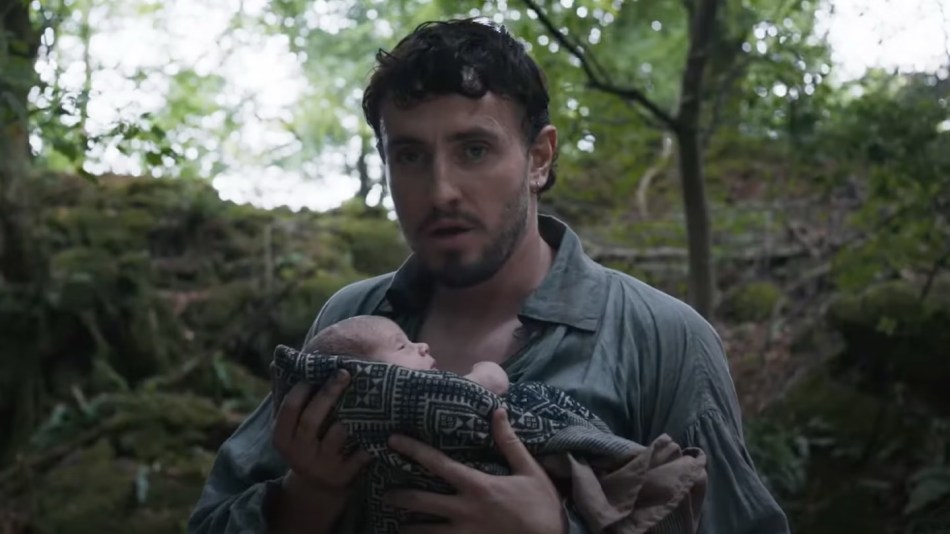
There has been much praise for Chloé Zhao’s new film, Hamnet, an adaptation of author Maggie O’Farrell’s novel. The plaudits are justified, and the film is a great work of art in that it evokes many different thoughts and feelings for its audience, some of which may be quite personal. One thing that was apparent in the film is the power of absence.

The story centres on a profound absence in William Shakespeare’s life that scholars believe inspired him to write Hamlet. Little is known of William & Agnes Shakespeare’s only son Hamnet, and his death at the age of eleven, but O’Farrell and Zhao, in their own respective works, have created both a novel and a film that feels unfeigned, even if the story is fictionalised as we know it.
There are many understated absences before the passing of young Hamnet that are quite significant in the lead-up to his passing. The first of which is Agnes Shakespeare’s mother. It is clear that young Agnes (Faith Delaney) had a strong attachment to her mother, learning much of what she knows from her at their homestead, as seen in flashbacks throughout the film’s first act. As an adult, Agnes (Jessie Buckley) has a distinct bond with nature. Agnes’s skills of foraging and embracing the foliage and elements that the audience often see her surrounded by are where she seems most content. Zhao also puts a strong focus on this, often displaying scenes of woodland with an absence of action and music, and only wind or diagetic sound is heard. The tenderness and devotion Agnes later shows to her own children appear to derive from her own mother, who was much the same. This displays the positive effects of this parenting approach.
However, William Shakespeare (Paul Mescal) has a relationship with his father that contrasts with Agnes’s and her mother’s. His father scolds him for his efforts and shows no affection, which does not stop William from becoming a loving father and husband to his own family, but does make him feel unrest in the lack of professional achievement, resulting in him leaving for London to find work. As the physical distance between Agnes and William grows, the passing of their only son exacerbates the emotional detachment they have from each other, with credible confrontations acted out by Buckley and Mescal. Agnes seems to vent her grief on her husband because of the lack of a visible presence at their home, particularly when tragedy hits.

Before the tragic death of Hamnet, there is a scene in the film where the audience witnesses the Shakespeare family burying Agnes’s hawk, which she had when she and William first met. It is a scene that is sincere for anyone who has had a pet, and how we can handle the probable passing that we will have to bear as we form an emotional attachment with an animal. Agnes explains to her children how the spirit of her dear friend will live on.
Losing a child is something no parent should have to witness, so it is understandable that no parent would ever be prepared for it. What Zhao does well in Hamnet is exhibit many joyful and playful experiences the Shakespeare family shares. This is ultimately what one misses when we lose a loved one, and mourn that we will never have those experiences again, when we should embrace those memories positively and be glad we had them as they make us who we are. The film evoked many memories I have with loved ones, both with people and pets, regardless of whether they’re alive or deceased, or a relationship has broken down with a person, or even with people I was formerly close with I now rarely see. The fact that I have or had these beings in my life and had those shared experiences, which are now kept as memories, is something to behold. As the director Chloé Zhao has said: ‘All my films start with characters who’ve lost what defined them: dreams, home, purpose, faith. They grieve who they thought they were in order to become who they truly are.’
Discover more from Cineccentric
Subscribe to get the latest posts sent to your email.
 Cineccentric
0 comments on “The Theme of Absence in Hamnet”