
This year sees Richard Linklater direct two historical dramas set at pivotal points in the lives of their subjects. Nouvelle Vague depicts the shooting of Breathless, Jean-Luc Godard’s debut film that helped launch the French New Wave film movement while Blue Moon shows Lorenz Hart (Ethan Hawke) on the opening night of Oklahoma! written by his former collaborator Richard Rodgers (Andrew Scott). Oklahoma! would later become known as the first Rodgers and Hammerstein musical while marking a transformative moment in musical theatre. Its success would also surpass anything that Rodgers and Hart had created in their twenty-plus years of collaboration. Hart, after attending a performance of Oklahoma!, recognizes this immediately. It is crushing.
Unlike Godard in Nouvelle Vague, Hart is at the twilight of his career. Linklater makes sure we know this, showing Hart collapsing in the opening minutes of the film in an alleyway that would ultimately lead to his death. We’re pulled back in time to the opening night of Oklahoma! (with its inane exclamation mark) where Hart leaves the theatre and finds refuge at the bar in Sardi’s, the classic New York Theater District restaurant. He is an alcoholic and we know this before Hart can even take a drink – he is close with the bartender Eddie (Bobby Cannavale) who is hesitant to start serving Hart drinks on a night he knows is difficult for Hart.
Hart wavers between grief and acceptance, attempting to distract himself with conversation on the merits of Hollywood cinema and the writing of Casablanca. He pulls the pianist into the conversation as Hart expresses that the musicality of words placed together in a certain order can create transcendence when spoken, elevating the impact of words above their meaning on a page. Hart shows himself as a brilliant lyricist, with a great appreciation of writing and prose. Yet this conversation is about something more. Hart’s focus on Rick’s line in Casablanca, “nobody ever loved me that much” indicates that Hart has a preoccupation even beyond his fledgling career. Hart feels an emptiness in his heart, one that he tries to fill with alcohol and affection from Elizabeth Weiland (Margaret Qualley), a twenty-year-old student at Yale. Decades his junior, Weiland is a poet who becomes a muse to Hart after the two had shared a weekend, albeit platonic, in Vermont. The time since, marked by separation as Weiland returned to college, has also built up to this night where Hart is convinced the two will consummate their relationship.
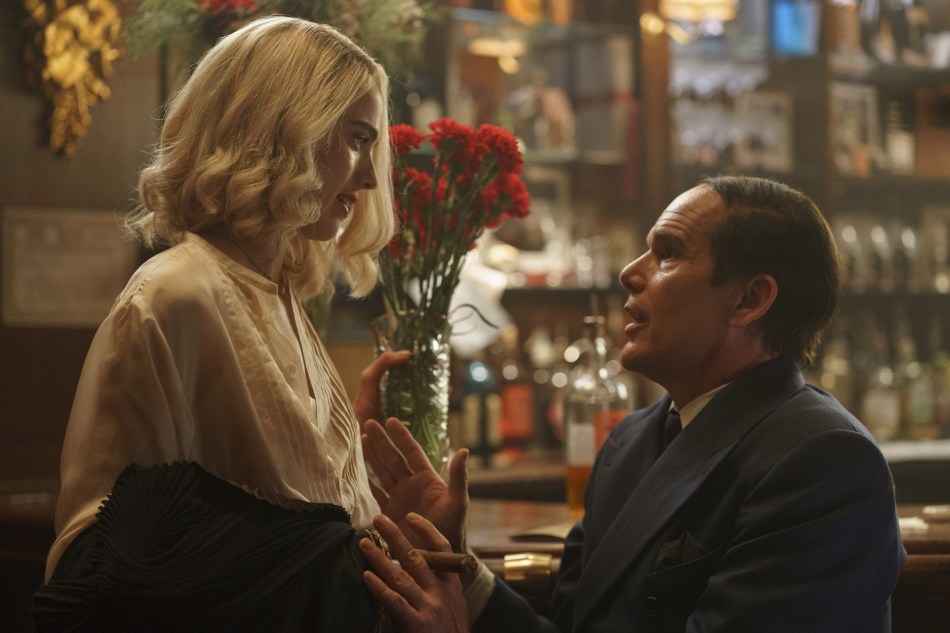
Hart describes Weiland with reverence to Eddie and the pianist; he is enchanted by her. To Hart, she is his Venus, and is as nuanced in meaning as the Botticelli painting (though this also has the effect that Hart is oblivious to her wants and wishes as a person). It is as if he views her as a character in his story, with purpose solely dedicated to completing a pre-determined narrative and meaning that is symbolic more than anything else. If he can earn her affection, he will have salvaged what is about to be an immensely disappointing night. He knows he is to see Rodgers later that night as Oklahoma!’s afterparty is also at Sardi’s.
When Rodgers and Hammerstein finally arrive, Hart’s aching heart is at that point buoyed by a whole bottle of whiskey. Hart’s attempts to reconcile his disappointments are tested as he congratulates Rodgers and is amicable while having to suppress his criticism for what he sees as ingenuine nostalgia in Oklahoma! What makes it even more challenging for Hart is the grace that Rodgers has for him. Having worked together for decades, the two recognize each other’s talents even if Hart’s alcoholism and distractedness impacted their collaborations. Even so, Rodgers offers Hart an opportunity – to write additional songs for a revival of their musical A Connecticut Yankee – and continue their collaboration. Hart pitches to Rodgers an alternative idea, something brand new: a self-indulgent portrayal of Marco Polo, a man who is commendable for his exploration and accomplishments yet unable to have his love requited from his love interest. Unable to see past himself, Hart is convinced he could find love and happiness in Elizabeth, but not from any other aspects of his life which have all led to this night of disappointment.
Ethan Hawke is exceptional in his role as Lorenz Hart. Hawke adeptly portrays Hart as a sympathetic character where it would have been easy to otherwise perceive Hart as sleazy or distasteful. Richard Linklater also takes a number of liberties in telling the story of Lorenz Hart, including elevating the relationship between Hart and Weiland in significance beyond their actual few letters of correspondence, and in showing interactions that same night between Hart and children’s novelist E.B. White (Patrick Kennedy) & aspiring director George Roy Hill (David Rawle). Blue Moon’s writing and Hawke’s acting contribute to a story of a man who achieved great accomplishments, yet never felt adequately loved or recognized. It is a tragic story and just as Linklater reveals Hart’s fate at the start of his film, Hart himself recognizes the depth of his unfulfillment. Nonetheless, Blue Moon – named after the Hart-written song that shares dual themes of sadness and joy – expresses the breadth of emotion that can be experienced, and this aspect of the human condition is perhaps what Linklater found most significant from the life of Lorenz Hart.
Discover more from Cineccentric
Subscribe to get the latest posts sent to your email.
 Cineccentric
0 comments on “Blue Moon ★★★”