
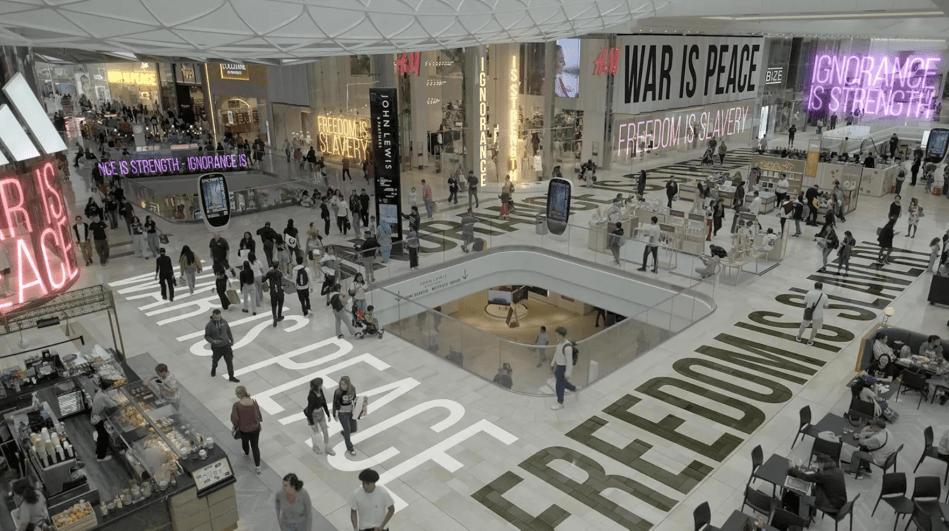
In 2016, Donald Trump beat Hillary Clinton in the U.S. presidential election and, appropriately enough, the Oxford English Dictionary’s word of the year was “post-truth”. Since then, the situation around the world has only gotten ‘post-truthier’ and, yes, more Orwellian.
Raoul Peck’s fantastic new documentary, Orwell: 2+2=5, offers a sobering and unsettling look at just how Orwellian things have become. It’s an eye-popping audio-visual collage of news and found footage, moody narration, movie clips, and other sourced media, that not only takes you through the life of Eric Arthur Blair (better known as George Orwell) but weaves together an urgent, global-minded tale that lays bare humanity’s preferred methods of oppression.
There’s a good reason that, in addition to Orwell, in 2025 we’re also getting Agnieszka Holland’s Franz. There’s a sizable overlap when considering what is Kafkaesque and what is Orwellian, but while Kafka’s world of oppression and disorientation often feels a bit more personal, insular, mysterious, and surreal, Orwell’s major works of Animal Farm and 1984 are quite clear in their description of the broad methodology at play. And Peck’s documentary is largely successful in connecting the dots between what Orwell witnessed in the first half of the twentieth century – the disinformation campaigns, the use of bureaucracy to disempower and enforce class divisions – and how those methods have evolved and continued, largely unchecked, into the present day.
As with I Am Not Your Negro, Peck’s excellent 2016 documentary on the writer James Baldwin, one of the most effective qualities of Orwell is it’s narration, which features the actor Damian Lewis reading passages from Orwell’s journals, letters and novels. It not only serves as the sturdy backbone of the film – there are no talking heads explaining the writer’s work in this movie – the narration does a perfect job of making Orwell’s art personal and the movie all the more powerful. Hearing Orwell describe his time as an imperial police officer in Burma (now Myanmar), and how scarred he was by what he witnessed and the brutality he felt empowered to be a part of, both lays the foundation of his worldview and allows Peck to start drawing strong connections to the oppressive, authoritarian police states around the world.
Among Peck’s many strengths as a filmmaker is his ability to see the interconnectedness of the world. Orwell isn’t just about the United States or Great Britain, much as Orwell’s writing wasn’t just a warning to any one nation of readers. Some of the most Orwellian stuff in the world is happening in Russia, China, India, Hungary – and still in Myanmar, as the effects of British imperialism are still being reckoned with. So while Donald Trump certainly offers a lot of material for Peck to work with, what will hit hardest for a lot of viewers is how clearly the leaders of Israel and Russia are using the “War = Peace” tactic – one of the tenets of the Big Brother government in 1984 – as justification for their ongoing campaigns.
Speaking of Big Brother, perhaps the most distressing part of the documentary comes in the later half, when the focus turns to technology. As if the Stalin-era playbook of mass media-assisted mind-control wasn’t enough, we’ve only recently entered the age where governments can start adding the layer of technological surveillance and manipulation that 1984 prophesized. Add to that the growing power of artificial intelligence and the future forecast looks pretty damn dystopian. Peck highlights China’s Social Credit System, intercut with images from Steven Spielberg‘s Minority Report and it’s hard not to feel either outraged or overwhelmingly weighed down by technology’s unrelenting and unregulated advancements.
There’s a moment in this section of the film taken from Citizenfour, Laura Poitras’ documentary on Edward Snowden, where Snowden explains that his biggest concern is that people won’t be outraged when the leak about government surveillance comes out. They won’t demand change. It’s safe to say that Snowden’s fear proved to be well justified. Whatever outrage there was has largely diminished as technology has continued to become more invasive and make us more disconnected and siloed off from one another.
As 1984 explained, getting the citizens to feel overwhelmed is a tactic used by authoritarian governments. What can we do? What good is the outrage when we’re made to feel that every technological advancement is an incomprehensible inevitability rather than something we can control? But feeling overwhelmed is also a concern when it comes to documentaries like Orwell. Like Snowden, Peck clearly wants to stoke some outrage, but as the examples of our growing Orwellian reality pile up, it also has a cumulative depressing effect. There’s a brief glimmer of hope in the form of Black Lives Matter protests and the 2022 protests in Iran following the death of Mahsa Amini. But it’s hard not to look at such recent history as something of a bygone era.
Peck is well aware of this overwhelming feeling, though. Throughout the doc he brings up the words “I can’t breathe” – which were the last words of the Saudi journalist Jamal Khashoggi before he died at the hands of assassins, and the words of George Floyd as he was being killed by police – and ties them to Orwell’s own slow death from tuberculosis. It’s a powerful bit of filmmaking, as Peck even adds the sounds of wheezing and ventilators. It has a way of making the viewer sympathize with the oppressed, but I also wonder if it adds to that feeling of being overwhelmed, of having the oppressor’s jackboot on your throat and being unable to do much about it.
But Orwell wasn’t all doom and gloom. Even though Winston Smith, the protagonist in 1984, ended up succumbing to Big Brother, the reality in the book – as well as in the real world – is that the government is always more vulnerable than it appears. The proles in 1984 outnumbered the fascists, and Peck reminds us that it all comes down to collective action. Like AI deepfakes, Big Brother is an illusion, and Orwell: 2 + 2 = 5 is a valuable work in revealing and poking holes in the grand facade of authoritarianism.
Discover more from Cineccentric
Subscribe to get the latest posts sent to your email.
 Cineccentric
0 comments on “Orwell: 2+2=5 (documentary) ★★★½”