

Perception. Acceptance. Validation. Luca Guadagnino’s After the Hunt is about all of these themes and more, a messy and often scattershot thriller with a throwback adult drama energy that dives at the heart of the socioethical, philosophical, and moral quandaries of modern times. At its most basic, it is a post-#MeToo thriller about a philosophy professor, Hank Gibson (Andrew Garfield), being accused of “crossing the line” with a student, Maggie (Ayo Edebiri). Hank’s co-worker and dear friend Alma Imhoff (Julia Roberts) is the first to hear about that night from Maggie, as Maggie views Alma as a mentor in the male-dominated field of philosophy. Instead of unequivocable support, however, Alma gives Maggie a mixture of confused emotions and, initially, some defensiveness with her perception of Hank challenged at its very core. From there, After the Hunt remains as complicated and nuanced with Guadagnino exploring and satirizing every inch of humanity and the chaos of daily existence.
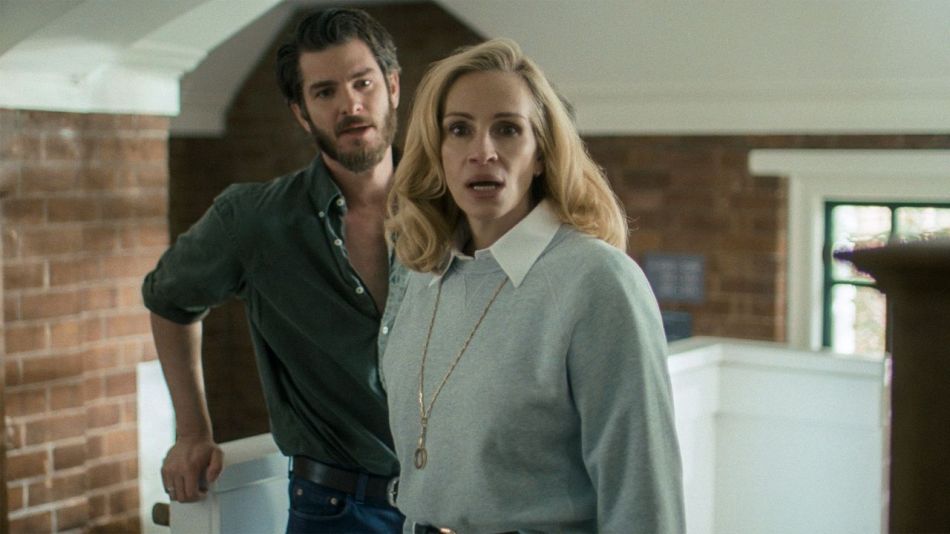
Much of the groundwork of After the Hunt is set in an early dinner party scene, hosted by Alma and her husband Frederik (Michael Stuhlbarg), a psychiatrist. Hank and Maggie are there, as are a host of Alma and Frederik’s friends. The scene has echoes of Whit Stillman’s Metropolitan – much of the dialogue throughout, too, mimics both Stillman’s eloquence in distilling philosophical ideas while also satirizing the arrogance and nonsensical natures of the characters as a comedy of manners; the appearance of frequent Stillman collaborator Chloë Sevigny as the university’s student psychiatrist Dr. Kim Sayers is also quite apt – with a self-important discussion of modern issues, centering on ethics, human nature, and philosophy. There is plenty of discussion of what it means to be a white cis-man today and the role of DEI in the tenure process that may elicit plenty of eye-rolls even as the ideas are rebuked by the characters. However, most importantly, the characters have two larger discussions. One, Frederik asks Hank and Alma, who are both going for tenure, what it would mean for them to be tenured? Why that goal for themselves? Two, they discuss whether any person’s private life could hold up to scrutiny.
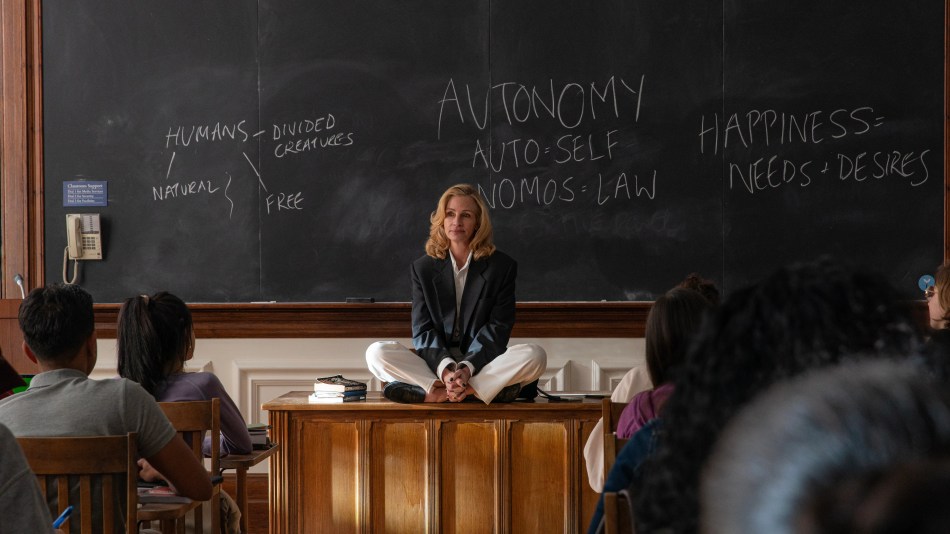
These ideas both center on perception. In a heated discussion in her classroom, Alma relates to a student the story of Odysseus in The Odyssey where he hears a song and recognizes that it is about himself, his exploits, and his heroism. He is moved to tears, finally realizing in this moment, hearing the story from “an other,” that he is a hero. Though the scene turns into an argument over what Alma means by “other” and whether it is wrong to “other” a person, it is revealing in the question about why Alma and Hank want tenure. They may profess to Frederik in the moment that it is about freedom and being above reproach, but the truth lies in the feeling of validation, recognition, and acceptance that they would have. Both want to be seen as great professors – and as Hank laments once he is accused of sexual assault, “to be part of the pack” – with this validation being used to quell the feelings of inadequacy within both.
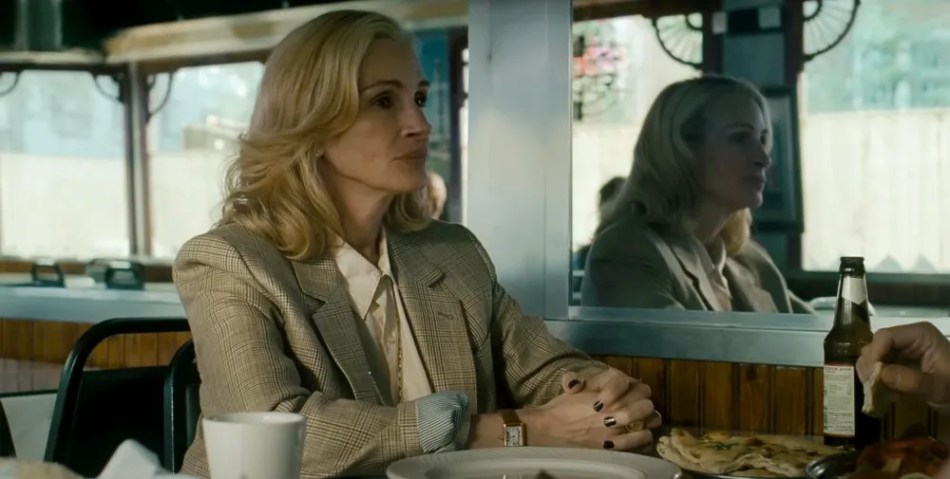
Much of this is tied together with the second aforementioned topic as because one knows oneself fully, they see their faults and strengths in totality with the former carrying considerable weight. Alma sees her faults, feels her guilt and grief over a perceived wrong she committed in her youth – an event that, when she confesses what happened, has a clear opposite perspective that Frederik offers that challenges Alma’s biased interpretation – and judges herself inadequate, viewing this darkness as something she needed to hide until she got tenure and then she would be validated, despite all of the respect and endearment her daily work as a professor had already garnered her. It is impostor syndrome in its purest form and it is a guiding feeling for numerous characters in After the Hunt. In viewing another person, Alma struggles with having her perception of Hank as a dear friend and colleague challenged, both initially by Frederik who sees him plainly as an unrequited lover that desperately seeks Alma affection – Frederik, for his part, is unaware of an implied affair that once occurred between Alma and Hank – and then by Maggie who posits him as a sexual abuser. Hank needs Alma more than anyone to understand he is not guilty, while Maggie needs Alma more than anyone to recognize that Hank is guilty. Without these external validations, both of them wander aimlessly through the film with numerous confrontations with Alma and consistent attempts to win her over to their side. Alma is not only torn in her view of Hank, but of Maggie with Frederik’s initial charge that she is little more than a “mediocre student” whose wealthy parents got her into the school eventually bearing some fruit with Alma identifying that Maggie had been plagiarizing her dissertation in order to appear smart and talented. As Hank cannot let those he cares about know the truth about himself, Maggie cannot let those she cares about know the truth about her. They put on an act, a performance in order to, as in Stillman films like Metropolitan, fit into this world of educated debate, higher education politics, and luxurious dinner parties.
This idea of performance is tied together with many elements of After the Hunt. Frederik and Alma, though married, live very distant lives with references to their lack of intimacy and the depiction of them sleeping in separate beds summarizing where things stand between them despite their attempts to play the happy couple in public. Despite her immense wealth, Alma also frequently rants about the privilege of the students, how the students never had to do anything for themselves, and how they have lived sheltered and comfortable lives. Yet, one can see the hypocrisy in Alma, especially. Though she laments these things, she herself has her husband Frederik prep her pills and water every morning, Frederik cooks every meal and leaves it in the oven for her to show up hours late for dinner, and the couple employs a maid who tends to their every need. They both lead immensely privileged lives and desperately seek out situations that make them comfortable, qualities that Alma finds contemptible in younger people. As she leads a life of cognitive dissonance, she sees the same performance in others, even charging the immensely wealthy daughter of university donors Maggie with dating a non-binary person and being socially conscious for the appearance of doing both, a charge met with a slap in the face from Maggie. This, too, is tied in with Maggie’s dissertation of topic of “performative activism”, an ironic topic for a plagiarizer, but also one that leads to a conversation in another dinner at Alma’s where Frederik presses Maggie on why that topic, only to be met with Maggie’s frustration at being asked why. Whether Alma’s accusation of Maggie is true or not, the ability to manipulate one’s appearance and perception through insincere action is an avenue explored in After the Hunt’s epilogue with the ability to perform one’s way through a crisis yielding social benefits. It is presented that it is less important to be socially conscious, innocent, smart, or educated, than it is to appear as such with considerable benefits to be reaped for those who do.
Guadagnino introduces so many themes and ideas into After the Hunt that it can be overwhelming. To some extent, it loses its way at times with the film biting off way more than it can chew. It positions, initially, this sexual assault allegation and everyone’s perception of it as the main plot element but, in truth, Guadagnino cares little for this machination. It is merely another detail used to peel back the nature of these characters and what it says about the overall human condition, thoroughly mocking both. After the Hunt even introduces an odd sort-of love triangle, while emphasizing the confused mixture of affection and adoration that exists in these friendships, mentor-protege arrangements, and more. It is messy and often scattershot, an unfocused film that nevertheless can be fascinating in its depth and scope.
Guadagnino and cinematographer Malik Hassan Sayeed want to draw the viewer into this world. The lavish details of Alma and Frederik’s home, the warm wood interiors, and the slightly faded look to it lend it a nostalgic and appealing appearance from the outset even as the conversation inside can feel so arrogant and self-important. Sayeed uses plenty of close-ups – especially on the hands, namely with Alma and Maggie to showcase the latter’s mimicry of Alma’s mannerisms – as well as point-of-view shots, selective focus (and plenty of focus racks), and shallow focus to draw the audience into the world of these characters. The way they physically express themselves, both in statements and reactions, are key to their nature and this intimate and heavily structured visual presentation is crucial to highlighting these elements. They are also crucial in highlighting the considerable depth and authenticity in the performances with Julia Roberts, Ayo Edebiri, and Andrew Garfield really nailing their respective roles. They all truly live within their characters, while perfectly playing their part in this comedy of manners. The extremely severe nature with which they treat upper-class academic drama, the messiness and soapy appeal of some of its more chaotic developments, and especially the often poking and knowingly goofy moments afforded to Frederik – Michael Stuhlbarg is marvelous, especially in the dinner scene with Alma and Maggie where he feels slighted by Maggie’s late arrival – make After the Hunt into a truly multi-faceted and highly engaging experience.
In the same classroom discussion that eventually touched on the story of Odysseus, Alma poses a philosophical question to her students about whether it is worth being right in a wrong world. Essentially, if the world is bad, is it worth being good? In the context of the film, is it better to be good or perceived as being good though living untruthfully in order to fit in with a socioethical norm and cultural movement? These characters feel the need to conform, to be accepted by and homogenized into the academic ecosystem they inhabit. It is what guides their every action, needing the affection and adoration of others to feel worthwhile. Their own personal flaws, hypocrises, transgressions, and falsehoods, are their own and, unless laid bare in the public square, they are elements that they can conceal to garner the respect they crave. These questions and Luca Guadagnino’s examination of them turn After the Hunt into an endlessly fascinating film. It can be messy, but it is so rich and thought-provoking that one cannot help but pour over every detail and conversation to mine the interpretations lurking therein. It is, like human nature, chaotic and busy. The world they inhabit is our own with their own interpersonal strife backed by stories of California wildfires and post-Trump DEI rollbacks. Their own problems may feel trite in the larger scheme, but elevated to the center of the picture while the world is literally on fire all around them emphasizes the overwhelming nature of existence and the self-contradictions they maintain.
Discover more from Cineccentric
Subscribe to get the latest posts sent to your email.
 Cineccentric
0 comments on “After the Hunt ★★★½”