

Like Pinocchio before it, Frankenstein sees Guillermo del Toro adapting a classic 19th century story, this time tapping into del Toro’s fascination with monsters. A film spending almost two decades in development, Frankenstein is a long-awaited and aspirational film for del Toro. Eager to capture the tragedy and internal turmoil that The Creature (Jacob Elordi) faced, del Toro sets his adaptation of Mary Shelley’s novel in 1857 amidst a North Pole expedition. It is in the harsh winter that Captain Anderson (Lars Mikkelsen) and his crew encounter The Creature and unbeknownst to them The Creature’s creator Victor Frankenstein (Oscar Isaac) who they rescue and bring aboard their ship. Trapped by ice and desperate for survival, Anderson and his crew are hostile to The Creature after discovering Victor’s mangled body and fearing for their lives. They quickly realize The Creature’s inhuman strength and capability to heal, distinguishing himself from men and their mortality, as he survives the men’s stabbings and gunshots. These only serve to frustrate The Creature further. When The Creature demands the expedition give Victor to him, presumably to kill Victor, this sets into motion the framing story for Frankenstein as Victor Frankenstein recalls his motivations for the creation of The Creature.
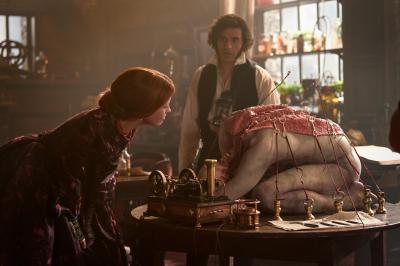
Victor Frankenstein’s story begins during his childhood, recalling the regular absence of his father Leopold (Charles Dance). During the times his father was present, he was strict, hitting Victor if Victor failed to recall a medical term or function. Victor aspires to become a surgeon after his father, one of the most successful surgeons in the country. Despite the brilliance of his father, Leopold is unable to save Victor’s mother who dies during childbirth. Since that day, Victor is determined at any cost to find a means to evade death. Victor’s story in Frankenstein is one of temptation, del Toro drawing the comparison between Victor Frankenstein and Adam and Eve through reference to the John Milton epic poem Paradise Lost. In Paradise Lost, Adam and Eve are tempted by the fallen angel Satan and Victor soon sees a fallen angel in his dreams following the death of his mother, compelling him to pursue immortality. His breakthrough in being able to reanimate a corpse is not received positively, however, and he is expelled from the Royal College of Surgeons of Edinburgh due to the gruesomeness and sacrilegious undertone of his presentation. Yet an attendee, wealthy arms merchant Henrich Harlander (Christoph Waltz), is interested in Victor’s scientific progression and offers him funding and a tower to perform his experiments in. Victor is at first skeptical of his new benefactor, but quickly proceeds with creating his laboratory with the help of his brother William (Felix Kammerer).
William is opposite to Victor in many ways, not possessing Victor’s brooding and macabre preoccupation with death. William is betrothed to Elizabeth (Mia Goth) who is curious about Victor’s experiments, but does not share the romantic interest that Victor has in her. William’s life can be seen as quaint and idealistic in comparison to Victor’s, his elder brother toiling in his experiments and using the bodies of hanged criminals and corpses from the ongoing Crimean War for his research. A belabored, obsessive process with Harlander growing impatient finds Victor finally able to use electricity from a passing storm to animate his creation. Thinking he has failed after The Creature does not come to life, Victor retires to his bed and is surprised as he is awakened by The Creature in all its glory.
Jacob Elordi’s Creature is one that is a patchwork of cadavers, stitches forming the features that define his face. Elordi is practically unrecognizable as The Creature, dedicating ten hours per day in makeup to craft The Creature’s appearance. His tall figure is imposing and Victor is awestruck by his accomplishment. This – and Victor’s patience – does not last as The Creature seems only capable of repeating Victor’s name and Victor is skeptical that The Creature is intelligent. Victor’s troubled relationship with his father is echoed in his treatment of The Creature, soon becoming verbally and physically abusive. Whereas Elizabeth, who accidentally meets The Creature alone, experiences fascination with The Creature and the marvel of his life, Victor sees a malformed imitation of a man who is deeply flawed. Victor’s mistreatment of The Creature and The Creature’s ensuing discovery of self and immortality help portray the tragedy of The Creature who is forced to live but is alone and misunderstood by those he encounters. The Creature is feared, and he has a somber revelation that just as the wolf does not hate the sheep it preys on, mankind, even if not caused by innate hatred, is destined to be violent to him for his differences from them.
Guillermo del Toro’s Frankenstein strikes a humanist angle to the story of Frankenstein’s monster, expanding upon the universal myth of the character. Like a great fairy tale, there is a moral subtext to Frankenstein, one that warns against the destructive impacts of folly, egoism, and temptation. With ambitious practical sets and recurring collaboration with production and costume designers Tamara Deverell and Kate Hawley, respectively, del Toro immerses audiences with a new rendition of Frankenstein that satisfies any expectations for a long-awaited film.
Discover more from Cineccentric
Subscribe to get the latest posts sent to your email.
 Cineccentric
0 comments on “Frankenstein ★★★½”