
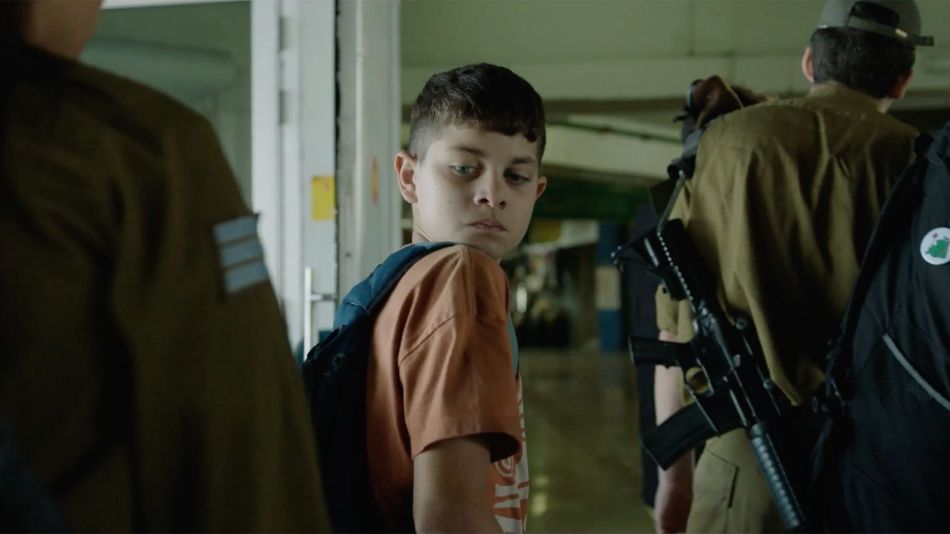
For a film among those which prominently provoked Israel’s culture minister Miki Zohar to threaten that he would cut off all funding for the Ophir Awards, Shai Carmeli‑Pollak‘s meandering drama The Sea takes on a surprisingly tender, occasionally even lighthearted tone. It’s only in the final moments that the minimalist story about a young Palestinian boy determined to go to the sea reveals its devastating outlook and parabolic power. More than anything, it is these closing scenes that reward the long and careful build-up. It follows 12-year-old Khaled (a brilliant natural take by first-time actor Muhammad Gazawi) on his solitary journey full of dangers he doesn’t yet fully comprehend.

From the very first frame, Khaled has his mind set on the Mediterranean Sea, where his class is headed for a school trip. The place is a dreamscape of adventure and joy for the kids growing up with the weight of war and occupation. However, an obligatory checkpoint stop abruptly crushes Khaled’s anticipatory excitement. Something isn’t right with his permit according to the soldier, who refuses to make an exception and threatens to refuse the whole group should they not oblige. While his classmates continue, the young protagonist is picked up by his uncle. On the phone, his work-bound father (Khalifa Natour) is outraged and promises to get a lawyer.
But this will take time, which Khaled doesn’t want to wait for. Without a map, a clear sense of direction, or a word of Hebrew, he secretly sets out on his own on an unauthorized journey that is much more risky than he is aware of. Meanwhile, his father, an undocumented laborer in Israel, risks arrest while searching for his son. Starting out linear, the plot splits into two parallel narratives, one of which follows the father while the other sticks with the son. Though the subtle story starts on a lighter note with comic situations and loving family moments, darkness lingers in small details.
Collecting shell casings to sell them as scrap metal is a pastime for the kids, and there are many casings. A framed photograph of Khaled’s mother conveys her passing before anything is spoken about it. The modest family home in which Khaled and his three siblings live with his father, his uncles, and grandmother contrasts with the safety and comfort Khaled sees once he’s sneaked across the border. But this safety and comfort is closed off from him, just like the blue waves which a classmate shows him on her phone. Khaled’s single-minded desire to at least glimpse the water becomes a metaphor for freedom, equality, and innocent dreams.
Shai Goldman‘s naturalistic images draw the audience’s gaze slowly across landscapes scarred by control towers and border fences. Beyond the border, every police person or bus ticket check means anxiety for the father. Natour’s performance, as much as Gazawi’s, forms the emotional backbone of the bittersweet coming-of-age tale. Told with formal restraint and a clear structure, The Sea is both a timely display of militarist repression and an easily accessible metaphor for the many borders – economic, ableist, ideological – that bar children off from joyful experiences. The film is a patient, morally expansive work that places the simplicity of a child’s quest into the fraught terrain of occupation, repression, and (not) belonging.
Discover more from Cineccentric
Subscribe to get the latest posts sent to your email.
 Cineccentric
0 comments on “The Sea ★★★”