
In a scene in Jafar Panahi’s It Was Just an Accident, two characters compare their situation to the play Waiting for Godot. They find themselves waiting, in disagreement over their next actions, for clarity that isn’t going to come. This indetermination forms the basis for the bulk of It Was Just an Accident.

Vahid (Vahid Mobasseri) is a mechanic who, by chance, encounters Eghbal (Ebrahim Azizi) after Eghbal’s car has broken down after accidentally hitting a dog. Vahid recognizes him from his voice and from the creaking, mechanical sound of his prosthetic leg. He is deeply disturbed upon this realization, remaining upstairs as another mechanic works on Eghbal’s car below. In the past, Vahid had been arrested as a political dissident by Iranian authorities and Eghbal tortured him in prison. Now knowing the whereabouts of Eghbal, Vahid kidnaps him; however, he has some doubt regarding Eghbal’s identity since Vahid was blindfolded when he was tortured. Still, the sound of the prosthetic leg, scarred into his memories of his time in prison, inclines him to believe he has the right man.
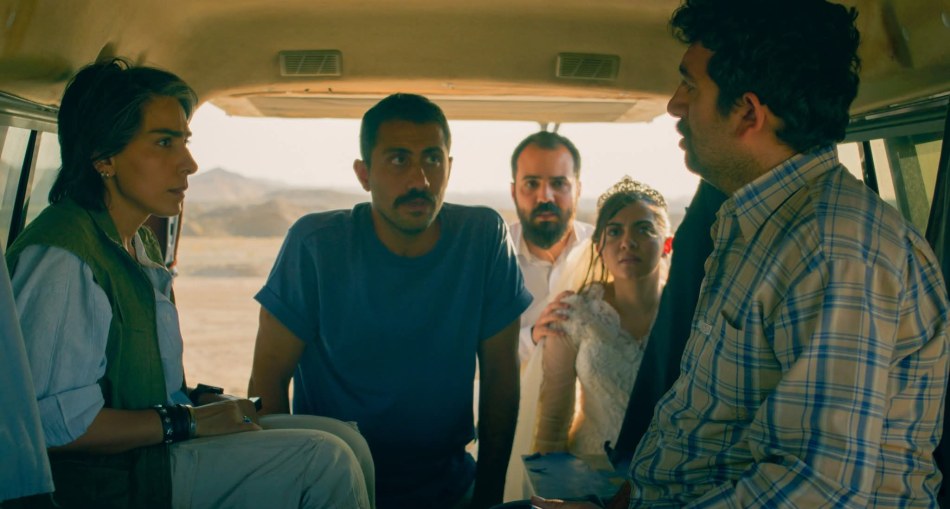
To confirm this for certain, Vahid visits Salar (George Hashemzadeh), a bookseller who was also tortured by Eghbal. Salar isn’t willing to help him, but refers him to Shiva (Mariam Afshari). Eghbal is captive in Vahid’s van this whole time, and Vahid continues to seek out fellow arrestees until one is confident about Eghbal’s identity. Each joins Vahid in his van – a bride and groom in wedding attire even join them – until they can confirm without a shadow of doubt that Vahid has kidnapped the right man. In a different movie, this sequence would lean more into comedy; however, the effect Panahi imposes is more in common with that of Abbas Kiarostami’s The Taste of Cherry. Each of the eventual five passengers of the van has their own perspective on how justice should be enacted and what punishment Eghbal should face.
It Was Just an Accident illustrates the limitations of justice, both in terms of the legal system that sentenced these people to torture and of self-determined justice. The film’s title is a nod to intentions versus impact, and Eghbal makes the case that, just as he hit the dog while driving by accident, he committed acts of violence as a result of his employment and to support his family. “It was just an accident” – anyone could have done it. Still, Panahi makes the point that Eghbal’s acts cannot be undone and now Vahid and his passengers are faced with a challenging decision about what to do with Eghbal. Some want revenge, others are scared of what would happen if they let Eghbal live, and while they all regard this circumstance as opportunistic, they each have been deeply hurt by Eghbal and that cannot change.
Jafar Panahi’s It Was Just an Accident represents an addition to the Iranian road movie tradition while also weighing in with his contemporaries on the impacts of Iran’s theocracy. His film is a more subdued rumination than last year’s The Seed of the Sacred Fig, but is certain to leave audiences with a sense of unease at Vahid’s realization at the close of the film.
Discover more from Cineccentric
Subscribe to get the latest posts sent to your email.
 Cineccentric
0 comments on “It Was Just an Accident ★★★”