
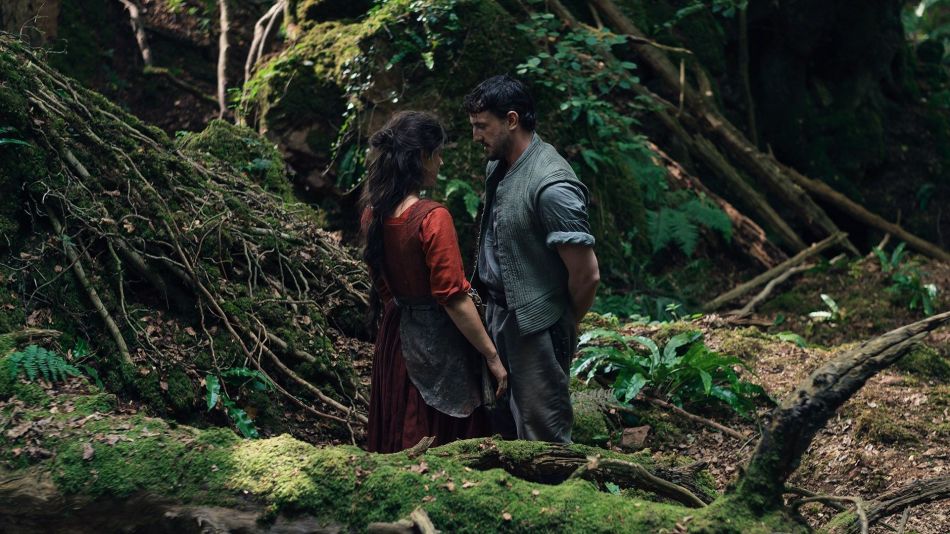
Part of the artistic achievement of Chloé Zhao‘s absorbing account of genius and the personal grammar of grief is not only to build a strongly fictionalized protagonist who can hold up against a near-mythical historical figure but to undo centuries of biographical disparagement. Little is known about the real Agnes Hathaway – or Anne Hathaway, as some documents state – apart from what saved her from historic oblivion. Born in 1556, she became the wife of William Shakespeare. The fact that she was eight years his senior and pregnant when they wed has regularly served as an indication that he had been pushed into an unwanted marriage. In her absorbing adaptation of Maggie O’Farrell‘s eponymous novel, Zhao takes these details as evidence of the opposite.
In her intimate interpretation of their relationship and its most pivotal moment, it’s love at first sight for Will (Paul Mescal), who by the time of their first meeting is still a struggling playwright in Stratford-upon-Avon. Despite all his boyish spontaneity, it’s hard to think of Mescal as 18-year-old, but Zhao, who shares a screenplay credit with O’Farrell, is less interested in historical precision than emotional truths. One of these serves as the painful core of the story, loosely separated into two parts. The first shows the instantaneous and intuitive love of Will and Agnes (a marvelous Jessie Buckley). She is a wayward outsider more at home in the forest with wild animals, one of whom – a hawk – she keeps as a pet.
Both share broken relationships with their kin. Agnes suffers under a cold stepmother; Will under a domineering father. Yet, they build a happy family with their children, the oldest Susanna (Bodhi Rae Breathnach) and twins Hamnet (Jacobi Jupe) and Judith (Olivia Lynes). Some of the homely scenes of their loving interaction breed ideas for his plays, such as the twins playfully switching clothes and each other’s roles, which tend to be slightly sugary. However, they also propose a counter-image to the trope of domestic life as creatively stifling for male artists. Even more, they establish what is taken from the couple when Hamnet dies a sudden, agonizing death from the plague. Agnes laments and is visibly grief-stricken. Will, who was absent when his son died, withdraws into his inner world.
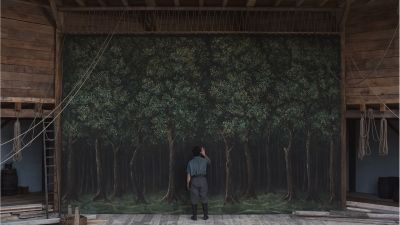
“Hamlet”, his greatest tragedy, is born from a pain he can’t openly express. Writing becomes both a cathartic process for its author and, in the shape of an impressive theater performance, a window into his soul for Agnes. The concept that every person grieves differently — in theory easy to understand; in reality, often hard to accept — lies underneath their emotional fracture. Zhao’s signature realistic style dwells on the fluid border between myth and memory as it explores the absences that shape art, love, and parenthood. While the dialogue cues taken from Shakespeare’s plays can sometimes feel clunky, their visual translation is both beautiful and layered. Human beings appear tiny in her wide, contemplative frames, dwarfed by giant trees and burrows that gape like gates to the underworld.
The fairy-tale-like forest landscape stretches in painterly camera shots that draw their colors from nature. Dark greens and brown hues convey a somber tone, even before tragedy strikes. Death is always present, and, as Agnes’ mother-in-law (Emily Watson) reminds her, one must never take life for granted. This focus on the hidden personal side of history shuns grandiose displays and spectacle. A full theater marks the only crowd scene as an evocation of the empathic power of art. Just like history, it arises from the textures of everyday existence, which Hamnet excavates with all its fleeting moments of joy and everlasting loss.
Discover more from Cineccentric
Subscribe to get the latest posts sent to your email.
 Cineccentric
0 comments on “Hamnet ★★★½”