
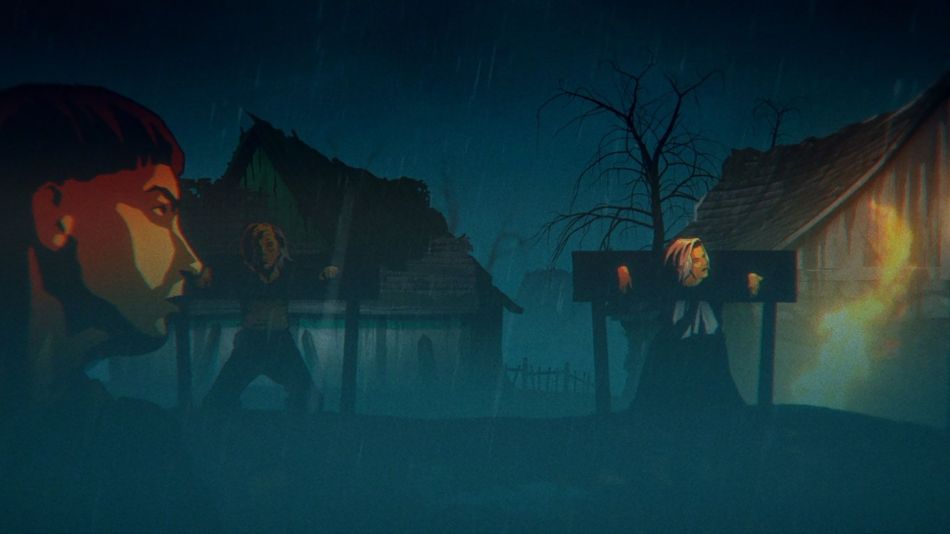
For those not very versed in Eastern European history, “Livonia” might sound like the name of a medieval country straight from a fantasy horror story, just like the anarchic animated tale which director-brothers Raitis and Lauris Ābele bring to Tallinn’s Black Nights Film Festival. In fact, Livonia is a historical region which, by the end of the 13th century, comprised most of what today is Estonia and Latvia. Ruled in parts by Sweden, Russia, and a Teutonic Order with the equally fantastical-sounding name “Livonian Brothers of the Sword,” the area at the Baltic shore was once a bustling intersection of languages, pagan and religious beliefs and superstitions, as well as rare and exotic objects and animals.

All of these come together in an ornamental orgy of grotesqueries, grossness, and gore. There isn’t much of a story, but plenty of events are set in an unspecified time period in the dark Middle Ages — literally, as the images’ main colors are pitch black, blood red, and fecal brown. The last association reflects the director-duo’s visual and narrative predilection for all things abject. Bodily liquids, unsavory foods, and nasty substances speckle the screen. Death and decay, morally and physically, are central to the collection of unhappy fates. Their main protagonists are tavern waitress and healer Neze (Agate Krista), branded a witch, and a perverted priest (Regnars Vaivars) mainly responsible for said accusations.
Then there is his physically handicapped acolyte, a lustful but impotent aristocrat (Kristians Karelins), and his equally lusty and understandably unsatisfied wife, who are either supposed to be German or pretending to be (since the German they speak makes little sense), possibly to appear related to these cool-named sword brothers. Last but not least approaches the titular character, molded after the Latvian werewolf. As his ominous words imply, he is doing the dirty work for God. Of that, there is plenty in the run-down village populated by all kinds of human wrecks. Worst of all are the clergy and aristocracy, whose main difference is that the first are sexual hypocrites while the second are openly debauched.
The stark animation resembles early 90s TV series with a hint of Aubrey Beardsley, blended with a wicked sense of humor. These jokes are as crude as everything else and do little to tone down the excess of detailed sexual perversion, repulsive close-ups, and twisted minds. Without a proper plot and functional characters to give these aspects context and meaning, Dog of God struggles to be more than blunt provocation, which fails to be shocking because it tries too hard. Themes like religious corruption, elitist degeneration, and the porous layer of civilization over primal urges are constantly evoked but never explored. Even more, the filmmakers revel, at least visually, in the digressions they point at.
Food and flesh take center stage in Latvia‘s Oscar entry, the second time in a row an animated film is chosen after last year‘s Flow. Raitis and Lauris Ābele‘s work poses a diametrical opposite to the latter with its scabrous spectacle. A fragmented narrative and impulsive mise-en-scène undermine its imaginative power and mythical allusions. Some of the curious facets are surprisingly historically accurate, and the Latvian werewolf lore has its own fascination. But such details are lost in the violence and obscenities, seemingly set in motion by the titular character. Ironically, the mix of lofty artistic aspirations and midnight movie madness is its own reflection of the central conflict between the spiritual and animal instincts.
Discover more from Cineccentric
Subscribe to get the latest posts sent to your email.
 Cineccentric
0 comments on “Dog of God ★½”