
In the inevitable follow-up to his 2022 survival saga Sisu, Jalmari Helander expands the folkloric brutality of the original into a more mythic action odyssey that occasionally overreaches but rarely ceases to entertain. Returning as the indestructible ex-commando Aatami Korpi, Jorma Tommila brings the same granite-faced charisma to the lead, whose bare-bones biography is slightly expanded. Gritty fight scenes and over-the-top action pieces that brought the first part financial success are still the main feature. Nevertheless, the sequel tries to refine its main character by exposing deeper fissures beneath his stoic surface. Where Sisu was mostly a taut endurance piece, Road to Revenge widens the canvas, pushing Korpi into a Finland now ruled by Soviet militias who fatally underestimate the solitary soldier.

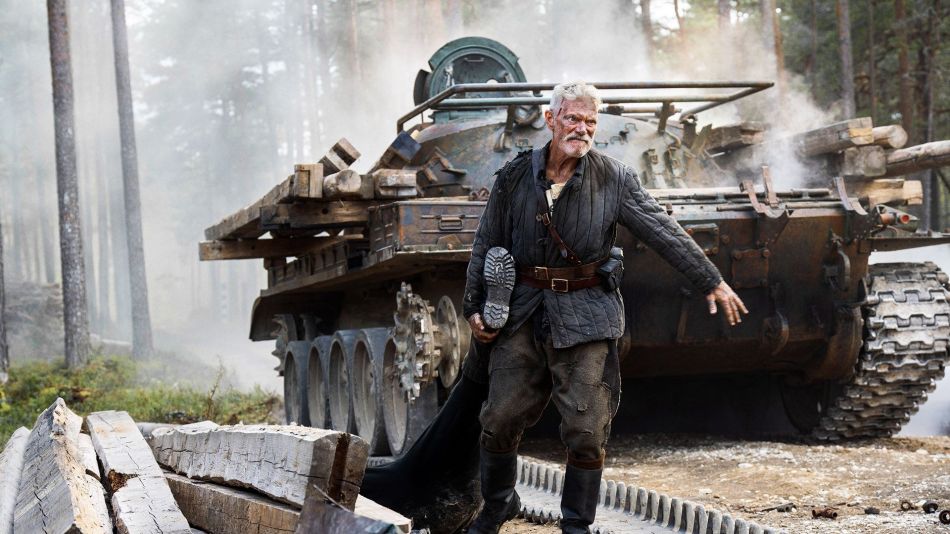
Set in 1946, the film finds Korpi (Jorma Tommila) driving a massive truck toward the remains of his old home—now located across the redrawn border in Soviet territory. His plan to dismantle and transport the wooden house back into Finland is derailed when the Soviets, still seething over the “one-man death squad” who wiped out over 300 of their troops, decide to end his legend for good. Enter Igor Draganov (Stephen Lang), a sadistic Red Army officer released from a Siberian prison by a KGB superior (Richard Brake) to ensure Korpi never returns home. The two men’s history runs deep: Draganov slaughtered Aatami’s family during the Winter War, and he won’t rest until the father joins them in the grave.
The tale of a lonesome super soldier defeating – at least symbolically – a whole enemy empire obviously appeals both to the production country Finland and Estonia, where the scenario was mostly shot. Given the current anxiety about a Russian invasion, moving the historic setting on to the Soviet era feels both uncannily prophetic. It’s not despite, but because of these obvious commercial calculations that the attempts to articulate broader political commentary feel less sharp than the visceral storytelling. Anchored by Tommila’s commanding presence and a series of well-crafted action sequences, the film stands as an exhilarating journey. Stylistically, Helander delivers a rugged blend of brutal bravado and operatic grandeur, which ultimately reaffirms his talent for pairing genre thrills with mythic undertones.
The plot tears through a gauntlet of escalating set pieces. Divided into six titled chapters, these segments are neatly choreographed, even if the sheer volume of violence occasionally muddies spatial clarity. One tank-defying stunt, in particular, flirts with outright cartoon physics. Tommila remains a remarkably physical screen presence despite Aatami’s continued silence. Lang, by contrast, carries most of the heavy-handed dialogue in a performance steeped in snarling profanity. Juri Seppä and Tuomas Wäinölä’s score blends conventional action bombast with throat singing, lending an offbeat texture to the mayhem. Character development is minimal, and the black-comic edge is less pronounced than before. The script also stumbles into a few noticeable gaps, most amusingly, the sudden long-term disappearance of Korpi’s adoring Bedlington terrier.
Mika Orasmaa’s widescreen compositions emphasize harsh landscapes, heavy machinery, and the elemental force of bodies colliding with metal. The theatrical imagery evokes both Western and war cinema without trapping the movie in mere homage. This combination of visceral choreography and confident pacing, playfully blending pathos and pulp, crafts an experience that is as visually striking as it is propulsive. This solid follow-up may not match its forebear’s original spark, but as a stripped-to-the-frame, full-throttle ride, it rarely lets its audience down.
Discover more from Cineccentric
Subscribe to get the latest posts sent to your email.
 Cineccentric
0 comments on “Sisu: Road to Revenge ★★½”