

The original 1987 film adaptation of The Running Man has seen a critical re-appraisal over the years, though one fact remains: it is not really Stephen King’s The Running Man. It does distill many of the same themes while working within a similar framework, but it is a different story. With this re-adaptation, director Edgar Wright – who co-wrote the script with Michael Bacall – aimed to be as faithful as possible to the novel. Having recently read the novel myself in anticipation of the film, Wright’s version is certainly very faithful. However, is this a good thing? Adapting a novel is a challenge with any film tasked with condensing a novel’s story, characters, and themes into a cinematic counterpart. Novels simply have space and time that a film cannot afford. The biggest change here comes in the final act, though the flaws of Wright’s film are found both in the elements that adhere to King’s story and those that do not.
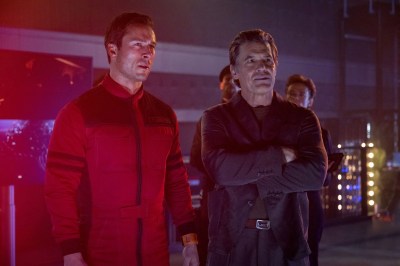
King’s novel is already a fast-paced one. The chapters are brief – a couple of pages each, at most, with some even being just a page – as it counts down the moments and significant events that befall Ben Richards (Glen Powell). Living in the slums with his wife and sick baby, Ben has been “blacklisted” from work. Desperate to get treatment for his baby and to provide for his wife, Ben sees his only option as being to try out for a game show hosted by the “Network.” An authoritarian media organization and arm of the fascist government that rules the United States, the Network hosts numerous macabre game shows that offer contestants a chance at considerable wealth while risking their lives. The shows are all aired on “FreeVee”, a compulsory television set that “watches you while you watch it.” The biggest show is “The Running Man”, a survival game show that tasks contestants with surviving 30 days on the run. All the while, they are hunted by both trained killers known as “Hunters” and any citizen willing to either turn them in or to try to kill the contestant themselves. They can earn money by killing Hunters and by surviving, but nobody has ever lasted the 30 days to win the multi-billion dollar cash prize. It is a death sentence and yet one that Ben is willing to accept if it means his family can escape their present plight.
Thematically, The Running Man shares much in common with another recent King adaptation, The Long Walk. Both are stories set in a fascist and totalitarian United States where the only way out of poverty afforded to the populace are sadistic and fatalistic events watched and enjoyed by a disconnected and bloodthirsty population. In both the young men who partake in “The Long Walk” and the contestants who participate in “The Running Man”, there is an element of hope. If the boys can survive and if the runners can survive, maybe the population can survive and fight back against this oppressive government. Naturally, the Network does what it can to turn everybody against the show’s participants. Ben runs at the same time as two others, Jenni (Katy O’Brian) and Tim (Martin Herlihy), with propaganda delivered by the show’s host Bobby T (Colman Domingo) about how these are vicious criminals out to cheat and kill their way into success while everybody else works hard. In truth, they are all desperate individuals, stripped off all alternatives, and now thrust into playing this brutal game for one chance at escape.
Wright’s film basically follows the plot thread of King’s novel to a tee. The side effect to this faithfulness is how rushed everything feels. Ben goes from declaring he would never be on “The Running Man” to accepting a spot just a few scenes later. He carjacks a random upper-class citizen’s – Amelia Williams (Emilia Jones) – car and holds her hostage during a particularly close encounter with the Hunters and, within a few moments, she flips from being vehemently against him to coming out and saying she is the bad person and needs to help Ben to prove to herself that she is good. The final act is particularly rushed with many of Wright’s adjustments coming here, pulling back from the very dark and brutal finale of the novel in favor of some optimism and hope. Fitting in these changes while also closely following every other beat from the final act strips the finale of any tension, cramming so much information into a condensed package that it ends with a thud. There is no real suspense in The Running Man, just a frantic and cluttered urgency to fit in the next scene. Every scene feels like it is struggling for air.
As a whole, The Running Man always feels off. Its pacing is a big part of this, but also the script and direction. The anti-fascist themes are delivered with the subtlety of a sledgehammer with characters frequently stopping to just explain their feelings and the ideas that form the background of the film. A particularly egregious use of this over-expository language comes in that final act where everything pauses for Bradley (Daniel Ezra), a revolutionary who helps Ben early in his run, to just come right out and explain things. The sequence with Amelia is rife with this, as are the scenes with Elton (Michael Cera), another revolutionary who assists Ben. Never affording any trust to the audience, The Running Man is constantly explaining itself, its world, and its ideas, much to its detriment. A few horrible moments of product placement – the film stops and pans over to a TV screen where Bobby T delivers a Liquid Death ad, while a scene between Elton and Ben stops for Ben to be offered a Monster energy drink – further exacerbate the film’s issues. Wright, as a whole, never seems to have a great feel for the material. Ben Richards is a dark and desperate man. This energy is always in conflict with Wright and even star Glen Powell’s quirkier and lighter appeal, a quality that is never quite squared and leaves The Running Man as an awkward adaptation even if narratively and thematically faithful.
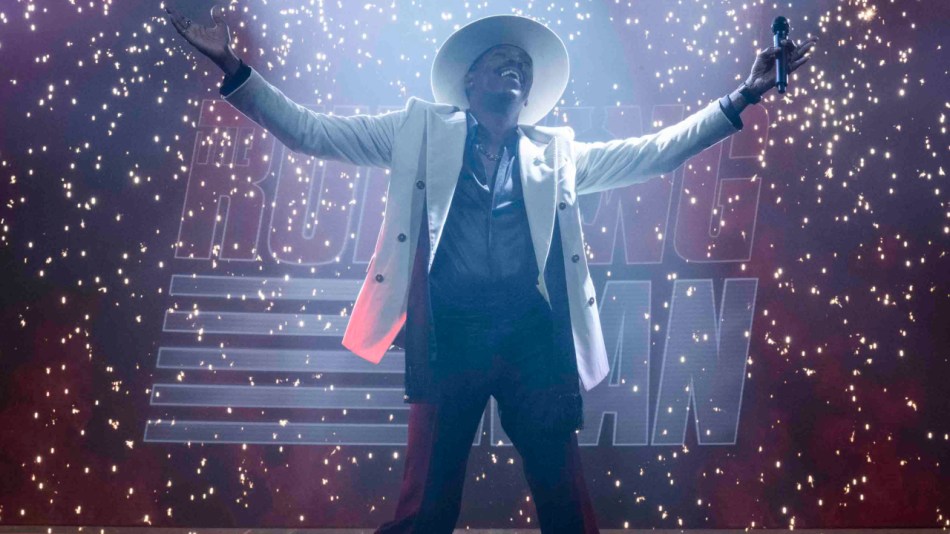
There is a lot going for The Running Man. Wright’s skill in directing action scenes is always clear with a few standout scenes, including a particularly close and explosive call in Boston for Ben. The world building and production design are both impressive with the level of detail in the mise en scène crucial in capturing this totalitarian world. Colman Domingo steals every scene he is in. His charisma is remarkable and showstopping, packed with energy and vitality in a way that so much of The Running Man is not. Powell is a charming and appealing leading man, distractingly cast against type but he does have a few good moments when Ben gets a bit goofier. Powell does struggle when trying to sound tough and hardened, however, with it never feeling authentic. Josh Brolin’s evil “The Running Man” producer Dan Killian is perhaps a conventional bad guy, but Brolin always gives it his all and this role is no exception. He oozes sleaze, moral corruption, and cruelty, giving the role the conviction and sliminess it needs.
The Running Man is a long-term passion project for Edgar Wright and while this is evident in execution, the end result is a disappointment. Finding the auteur in a crowd pleasing blockbuster form and working ardently to faithfully adapt Stephen King’s novel, the typical creative spark and energy in Wright’s films are missing. Hamstrung by this faithfulness with incredibly rushed pacing and with a lackluster, on-the-nose, and awkward script, The Running Man never finds its footing.
Discover more from Cineccentric
Subscribe to get the latest posts sent to your email.
 Cineccentric
0 comments on “The Running Man ★★”