
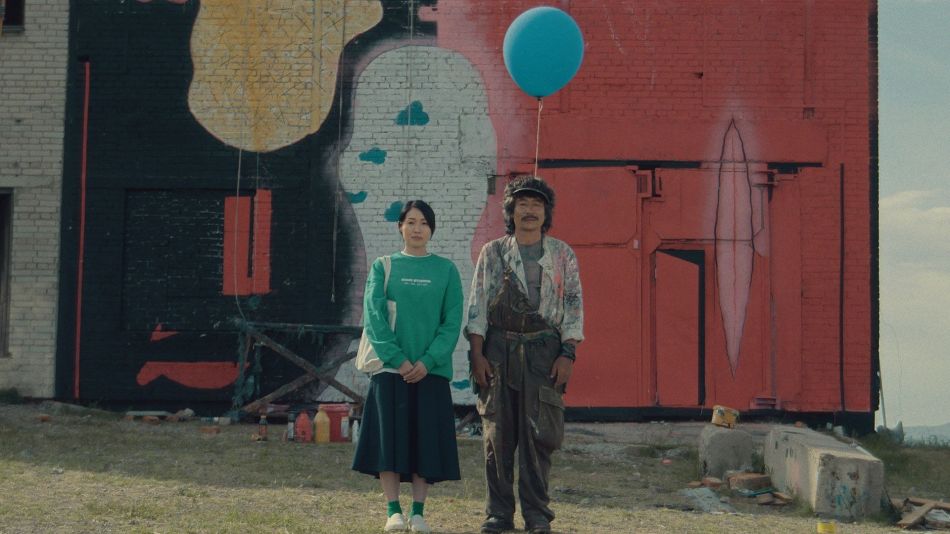
After taking home the golden wolf statue for Best Feature Film at last year’s Black Nights Film Festival with Silent City Driver, Sengedorj Janchivdorj returns to Tallinn with another melancholic meditation on lost connections, loneliness, and laconic humor. Ulaanbaatar, with its glistening skyline set against the endless width of the Mongolian steppe, is once more a central character to the bittersweet story, filled with small connections to the director-writer’s prior work. One of them is the loyal dog of the taciturn protagonist Bayaraa (B.S.Bayinerile), a volatile painter covering the capital’s grey buildings in colorful fantastic landscapes and figures. Often these grand-scale works correspond more to his inner state than the visions of their commissioners.
This sense of artistic integrity, which comes almost magically, as if the stone surface would anticipate Bayaraa’s state of mind, may be one of the reasons for his precarious situation. He and his dog sleep in a tent on the roof of a building that will soon be demolished. This literal loss of stabilizing structure and grounding is one of the meandering plot’s many metaphors, some realistic, some as fantastical as the colorful balloon floating over the protagonist’s head. Decades ago, he left for Europe: for art but also for himself, as he confesses in an interview with a prestigious art magazine. This conversation works as a framing device for the mix of black-and-white flashbacks to his wife and child, whom he once left behind, and color scenes from his current life.
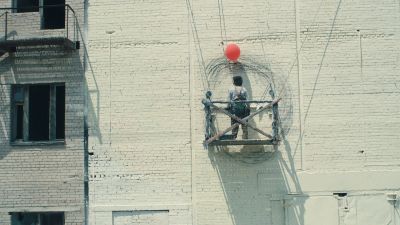
He’s a stranger in a city that has almost forgotten him and disconnected from the family that finally moved on without him. Descending the weather-beaten facade of the abandoned factory on top of which he resides and splashing bold, abstract shapes across the concrete is both a daily ritual and a silent act of resistance against the erosion of memory and undeveloped open spaces. Calm, contemplative pacing and long shots emphasize the physical labor, the time, and emotional weight embedded in his murals. They represent a form of art that is free and open to everyone, adding a touch of beauty to the monotonous routines of workers and inviting the city’s hectic flow to pause for a moment.
Weaving subtle surrealism into grounded human drama and the past into the present, the unhurried plot morphs from picaresque portrait to the tale of a fractured family. Nergui Erdenekhuyag‘s camera captures the Mongolian landscape as if it were part of the concrete canvas Bayaraa returns to each day. Long, unbroken takes immerse the viewers in Bayaraa’s solitude. Natural light and muted palettes underscore the city’s post-Soviet melancholy, while sudden bursts of color, like the floating balloon over Bayaraa, fracture the austerity with dreamlike poignancy. The result is a visual language that feels intimate, tactile, and quietly monumental, mirroring the emotional excavation at the narrative’s core. The human characters appear small against the backdrop of vast nature and towering buildings, like tiny drops of paint.
When Bayaraa paints a portrait of someone, their surprised joy reveals people’s shared need to be seen in their individuality. When he paints over one of his works, on the other hand, this act symbolizes his wish to erase past mistakes, to start over on a blank page. Creation and conservation of art become a metaphor for the tentative process of repairing human connections. Just as the murals are sometimes admired as unique artworks, sometimes perceived as vandalism, Bayaraa and Ulaanbaatar are both caught between preservation and reinvention. Thus, The Muralist crystallizes the same question that haunts its protagonist: What remains when everything is built to disappear?
Discover more from Cineccentric
Subscribe to get the latest posts sent to your email.
 Cineccentric
0 comments on “The Muralist ★★★”