
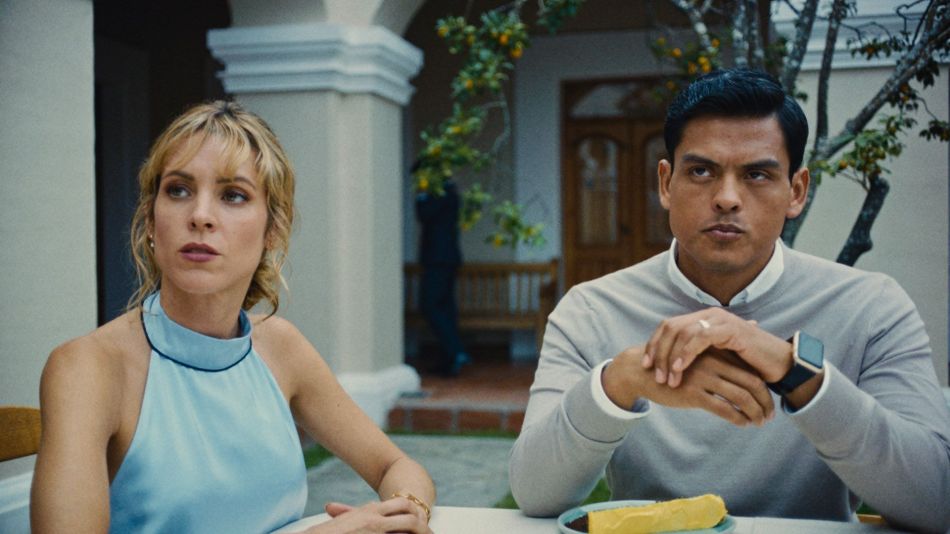
Much like its main character, Andrés Clariond‘s slippery satire comes frustratingly close to striking political gold. But rather than snatching the comedic crown – or in the case of the unlucky protagonist aiming for Mexico’s highest state office, the presidency – he lands an embarrassing misfire, before retreating into private excess which turns increasingly absurdist. The most blatant aspect of this curious cinematic combination of lavishness and ludicrousness is the evocation of the titular French estate. As residence of Sun King Louis XIV as well as France’s last king Louis XVI and Marie Antoinette, the name has become synonymous with decadence, delusion and downfall. The themes of political power, hubris, and loss of reality are right on the surface of the parabolical plot.
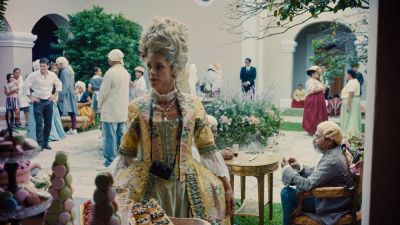
The latter, unfortunately, has no idea where to take them – except towards the nominal royal residence. Or, more correctly, an extravagant replication of it, dreamed up by the megalomaniac anti-hero and his equally self obsessed Spanish spouse. In the beginning, Chema (Cuauhtli Jiménez) is a young and dynamic Mexican politician headed for success. He is slated to become the next president, but is unceremoniously sidelined by his party. Humiliated, he retreats to his countryside hacienda where he creates his own kingdom to rule. His servants have to decorate the house in the style of the Ancien Régime and dress up as courtiers and ladies-in-waiting while he – his obliging wife Carmina (Maggie Civantos) as queen by his side – crowns himself king.
Not a very subtle metaphor, but an intriguing premise nevertheless, even more so thanks to its coincidental coeval with the “No Kings” protests. Not only have these real-life parallels make the half-baked story look more timely and poignant than it actually is, but also more subversive. Chema is dark-skinned and director and co-screenwriter Clariond, who is white, treats his fanciful reign as a commentary on the intoxicating influence of political power on people who are supposedly not fit for it. In his self-appointed position as king, modeled after a white Eurocentric ideal, Chema embodies numerous racist tropes: the idea that people of color couldn’t handle responsibility, would seek out politics merely to satisfy hunger for power, and would decree absurd policies.
With his fake crown and royal costume, Chema represents a contemporary version of historical caricatures of people who lacked the high social standing, formal education, heritage or skin color associated with state officials. Carmina also embodies a reactionary trope as a discontent, child-free career woman. Early on, she pushes her husband on his path, reminding him that she sacrificed her wish to have children to prioritize his career. Later, she forcefully takes the baby of a young mother among their employees and treats it as her own. Men are driven crazy by frustrated ambition, women by frustrated motherly instincts. A man’s ideal wish is power; a woman’s ideal wish is motherhood and family.
Underneath the provocative façade, Versailles is both conventional and conservative. A freak accident severing Chema’s thumb points at his emasculation, and a baby bunny he adopts at his regression to childishness. Surprisingly little of the superficial humor actually deals with politics, social hierarchies, nepotism, or the alarming rise of plutocracy. Most jokes revolve around the quickly tiring punchline of employees acting out of their historical character: slouching when they should stand upright to salute the king or looking at their mobile even though it’s the 18th century. Visuals and acting mirror the style of humor in their conventionality. Jiménez seems more like a naive kid whose games go too far. The opposite is true for Clariond’s calculating concoction.
Discover more from Cineccentric
Subscribe to get the latest posts sent to your email.
 Cineccentric
0 comments on “Versailles ★½”