
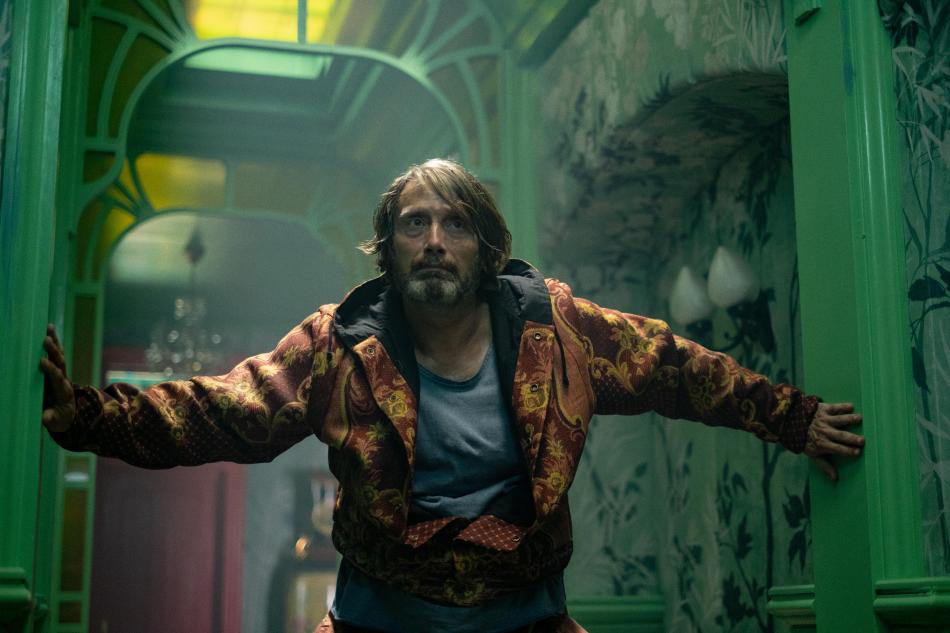
Dust Bunny is a wild concoction. Best known for his work in television with series such as Pushing Daisies, Hannibal, and American Gods, Bryan Fuller makes his feature film directorial debut with Dust Bunny. Originally pitched by Fuller as a “family horror film,” it also has plenty of roots in dark fantasy, sci-fi action, and crime. It is sort of Gremlins/The ‘Burbs type Joe Dante film tonally mixed with Labyrinth, Big Trouble in Little China and Tideland, and a character setup akin to Leon: The Professional. The premise is simple: a little girl, Aurora (Sophie Sloan), hires a hitman, her neighbor from Apartment 5B (Mads Mikkelsen), to kill the monster under her bed. As Aurora explains, she once wished on a shooting star for the monster, but now she fears it as it has killed her adoptive parents and needs it dead. Naturally, the hitman does not believe that the monster is real, but he knows something Aurora does not: “monsters” are real. He sees them everyday and is paid to kill them, in fact he agrees with Aurora on her motivating factor: “monsters” killed her most recent set of adoptive parents. Except, he knows that he is a hunted man and it is easy to confuse apartments. Not only is he a target for repeated attempts by would-be assailants, but so is Aurora because though her mind slips into perceived imagination, there are grains of truth in what the little girl knows and what she knows is dangerous.
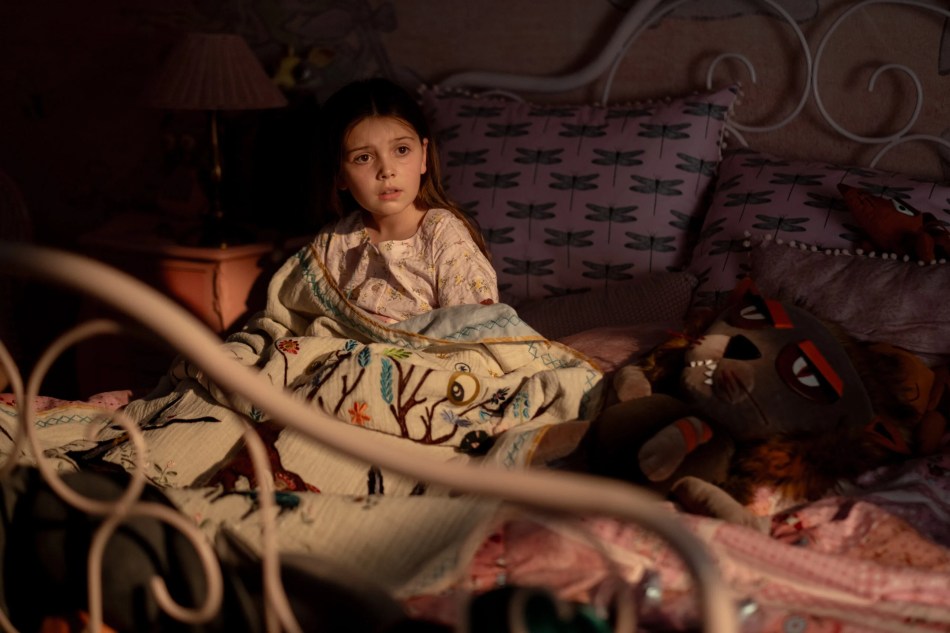
Fuller initially frames Dust Bunny from Aurora’s perspective. Opening with a prolonged sequence of limited dialogue, mostly just Aurora experiencing her encounters with the monster, moving to her fire escape to elude the monster’s grasp, and then following the hitman as he ventures out into Chinatown for a job, Dust Bunny drops the audience into the mind of a child. The forbidden adventure, the dizzying array of the Chinese New Year celebrations, and finally, witnessing the hitman do his job. A man in a dragon costume casts a large shadow that seems like a real dragon to this little girl and as Aurora watches on, she envisions this hitman as a dragon slayer. A cheesy and bombastic slow-mo action sequence follows as the hitman dodges flashes, bullets, and swords as he slices up his foes. Once monsters claim her parents, she knows she only has one man she can trust for the job of slaying the beast under her bed.
Dust Bunny is many things. It is a trip into a world where anything is possible. It dares the audience to doubt Aurora’s story. Heck, all of the characters scoff as she warns them to not walk on the floor at night. Terrific special effects bring to life the nightmarish vision lurking in the shadows of her room and fully capable of venturing anywhere in this expansive apartment layout. As the floorboards open up and a monster’s roar can be heard, who can say this entity is not real? All the while, the typical threats mount. Assassins hired to eliminate Aurora, those who are out to kill Aurora’s neighbor hitman, and even FBI agents undercover trying to figure out what is going on – as is revealed, this is not Aurora’s first set of parents to allegedly be eaten by a monster – all converge on this apartment building. It has the strain of John Carpenter’s sci-fi action films to it, especially in how it blends the fantastical with classic shoot ‘em up chaos and a heavy dose of cheese. It is funny and, in the dynamic between the hitman and Aurora, unexpectedly earnest and sweet mixed with the macabre rapport they develop when it comes time to dispose of the dead bodies that the monster did not eat. This is a little girl who has seen too much of the world in her youth and a wayward man who knows far too much about the evil that does not need to hide under children’s beds to be terrifying. Together, they find a unique kinship that forms the foundation of Dust Bunny and anchors it, even as its story embraces every outlandish and mysterious angle it can find.
Fuller and cinematographer Nicole Hirsch Whitaker give Dust Bunny a consistently unique and striking look throughout. The early scene of Aurora following the hitman around has a dream-like haze to it with the hitman fading in-and-out of the smoky streets with his silhouette disappearing into the distance. There is a child-like wonder to the approach with Aurora and the camera alike taking in the fireworks and chaos in the streets with exuberance, culminating in the shadowy display of him slaying a dragon and this whimsical edge continues throughout the film. There is a great close-up shot of a glass door as a hitwoman reaches for the knob from the other side, her fingers appearing long and thin like a monster’s then a cut to a shot of her very normal hand reaching for the door from the other side. It plays with reality, embracing its child’s POV and adding this imaginative flair to every sequence. Dust Bunny is also a very colorful film throughout with rooms often awash in color with the film embracing its fairy tale roots to move its characters through a world of kaleidoscopic beauty. Even scenes of the hitman meeting with his boss find them surrounded by flowers of every color and wearing exuberant patterns, a shallow focus to these medium shots draws one into not just the characters but gives the scenes a dreamy vibe. The hitman and Aurora will later find themselves in a dimly lit but still colorful restaurant with a shark swimming around in the background. This is a trip to another world, playful tonally and embracing the vibrancy of its mood with a rainbow-wide color palette. The editing from Lisa Lassek plays into it as well, especially in a very striking iris transition that adds punch to a particularly comedic note.
Fitting with the bizarre and unusual tone of the overall film, the cast is all over the place. Sigourney Weaver hams it up and chews as much scenery as she can, embracing the moral blackness and quirkiness of her character, the “handler” for the hitman, in equal measure. Mads Mikkelsen plays a typically dark and shadowy figure, a man who wears the marks of everything he has seen and done in his eyes and beleaguered face. He has a unique and unconventional charm, something that Mikkelsen brings out and his genuine chemistry with the young Sophie Sloan gives their unusual dynamic genuine pathos. One sees the growing bond between them and the duo gives credence to this connection.
Is the monster under the bed real or imaginary? Is it a genuine threat or a manifestation of Aurora’s many traumas in life? It is perhaps a little bit of each with Fuller toying with the audience in both positioning the story from Aurora’s POV and also using the mise en scène to offer plausible alternatives. Not only is her mind running wild, but it is an old building with creaky and groaning elevators and pipes. Add in the encroachment of the criminal underworld and any child’s mind is liable to run wild. But, yet, Dust Bunny is at its best when it throws caution into the wind and embraces Aurora’s wild visions and when the adults, too, are returned to that childish terror of staring at an otherwise empty hallway and feeling that evil lurks within. Dust Bunny is many things. It is funny and charming, often macabre and dark, while also fantastical and wild in a way often trafficked by filmmakers like Joe Dante, John Carpenter, Jim Henson, and Terry Gilliam. It has a child-like sense of wonder to it, believing anything is possible, even a monstrous hitman finding his soul and sense of purpose in protecting the little orphan girl across the hall or a little girl wishing for a monster to protect her only to end up finding the parent she always needed in the process.
Discover more from Cineccentric
Subscribe to get the latest posts sent to your email.
 Cineccentric
0 comments on “Dust Bunny ★★★”