
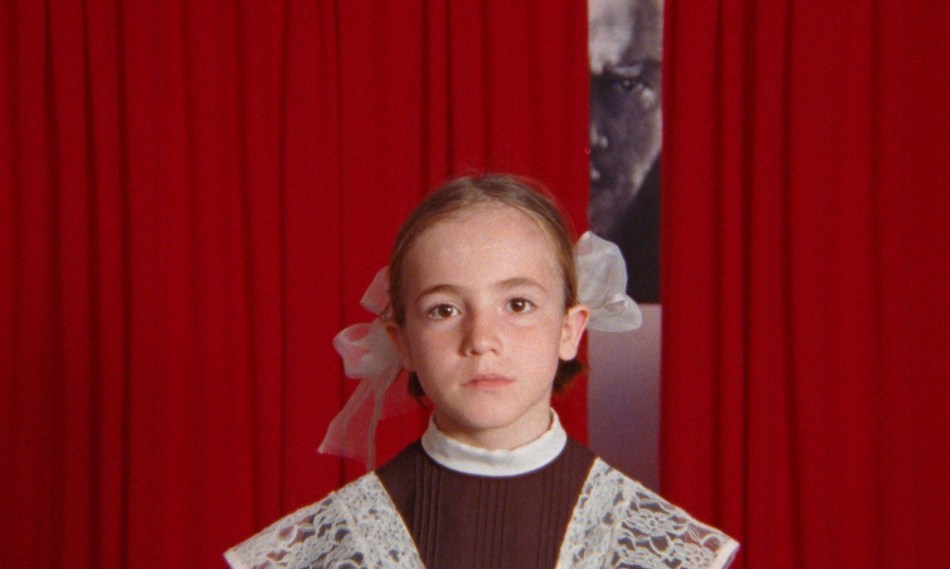
From its opening frames, Vladlena Sandu‘s essayist drama announces itself as an intimate reckoning with a childhood disrupted by violence, both personal and political. War, propaganda, and mistreatment shape her upbringing in Grozny during the last years of the Soviet Regime up until the Russian occupation. Wavering between remembrance, reenactment, and re-imagination, her first feature-length work Memory transforms personal trauma into a cinematic testimony of infantile resilience. The director-writer herself acts both as narrator and witness to her childhood years under the sadistic supervision of her maternal grandfather. Her six-year-old alter ego is uprooted from Crimean stability and transplanted into a rough shack in Grozny, just as the Soviet Union is about to disintegrate.
Ethnic tensions erupt into full-scale conflict. Russian-speaking classmates vanish, food becomes even scarcer, and childhood games turn into uncomfortable initiation into ideology. Neither straightforward documentary nor pure fiction, the episodic storyline moves in the liminal zone between cathartic monologue and twisted fairy tale. Archival photographs, family heirlooms, propaganda artifacts, and a handmade toy-theater inhabited by mutilated plastic dolls create a bizarre bricolage. This fusion of metaphors and monography preserves reality with its jagged edges. Visuals oscillate between nightmarish visions and brutal awakenings. Gruesome games, macabre miniatures, and surreal stagings evoke a world both realistic and strangely removed. Theatrical tableaus, and scenic arrangements resembling mixed-media installations create a curious hybrid of emotional excavation and political palimpsest.
While the autobiographical autopsy aims to cut deep with its blunt rendition of draconian disciplinary measures and psychological cruelty, it leaves viewers curiously disaffected. A focus on personal pain dilutes the historical analysis and sense of geopolitical urgency. The narrative structure struggles against the confines of a coming-of-age tale by infusing Sandu’s own childhood with biographical scraps of her brutal grandfather. But these eclectic elements never fully come together to a clear image of family, ideological obedience, or social assimilation. The willfully selective focus highlights everyday events of personal importance, circling around trauma and recalling unspoken fears. The local movie theater becomes a secret temporary escape from all the pain, terror, and hopelessness.
It is within these memories of movies that a touch of absurdist humor lightens the depressing aura. An imaginary King Kong sits beside the little protagonist in the cinema hall: a misunderstood outsider in a strange environment he fully can’t comprehend. Political figureheads are revered one day and reviled the next. Systems crumble, homes are left behind, friends disappear. In its strongest moments, the expressive images interrogate how trauma distorts the act of remembering, how institutions (re)shape private histories and align them to sanctioned official statements, and how the instability of historical events erodes individual recollection. But these ideas seem only half-formed in an erratic examination casually shifting between the trivial and tectonic.
Despite its rawness, Memory is at its core about the reclamation of one’s own history. The decision to confront the past appears as a liberating act of defiance. As Sandu says, making her docu-dramatic diary was “an act of remembering in a country that insists on forgetting.”
Discover more from Cineccentric
Subscribe to get the latest posts sent to your email.
 Cineccentric
0 comments on “Memory ★★½”