
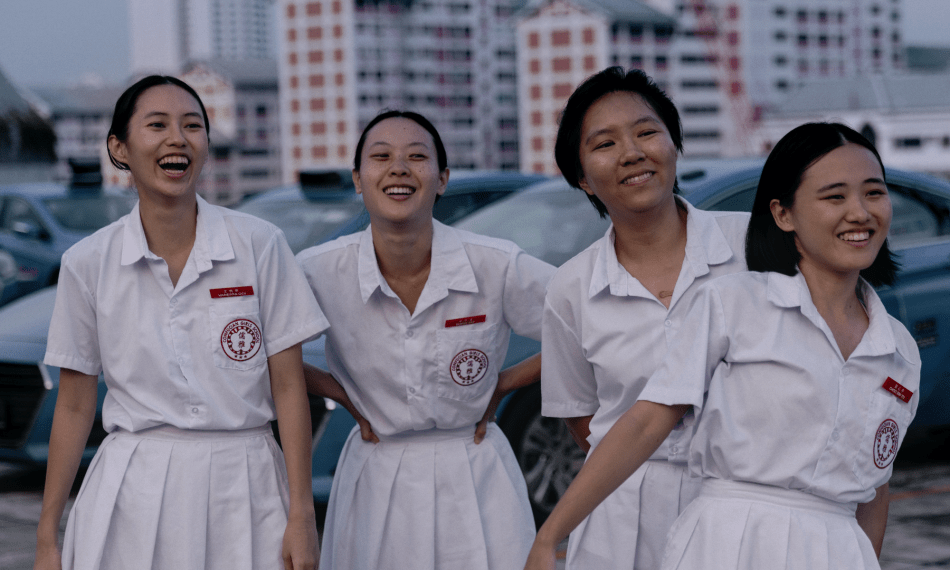
The amorphous body of the titular organism becomes a microscopic metaphor for the undefined shape of adolescence trapped within rigid structures in Tan Siyou‘s distinctive debut feature Amoeba. Her blistering portrait of the tentative bonds forming when young outsiders carve out space for themselves follows a Singapore girl gang whose members resist institutionalized repression. Premiering in Toronto earlier this year and running in competition at Marrakech, the confident coming-of-age tale depicts an uneasy alliance anchored in rebellion, myth, and shared longing. Blending teenage turbulence with a sharp critique of institutional conformity. Set within a fictional authoritarian girls’ school in Singapore, Amoeba traces how youthful defiance is essential in the development of intellectual independence.
At the heart of the narrative is 16-year-old Choo Xin Yu (Ranice Tay) who reluctantly returns to the school she once left behind. The transfer student’s refusal to assimilate to the rigid codes draws three peers into her orbit: Vanessa Scarlett Ooi (Nicole Lee Wen), Gina Wong (Genevieve Tan), and Sofia Tay (Lim Shi-An). Their careful closeness grows into a pact marked by late-night recordings on Sofia’s camcorder, whispered spells, and the shared dream of forming their own gang. This idea of community is encouraged by the nostalgic stories of Sofia’s elderly driver, Uncle Phoon (Jack Kao). Adolescent discontent deepens into strengthening solidarity.
With Sofia’s camcorder, the girls begin recording their routine, even broaching the idea of capturing a ghost that Choo believes haunts her room. When the recordings reveal nothing but empty halls and the weight of expectation, they turn instead to fantasy. Drawing inspiration from folk stories spun by Uncle Phoon, tales of colonial-era street gangs and underground youth defiance, the clique delights in small but potent gestures of defiance. Scenes of the girls running through rain-soaked streets and sharing cigarettes behind school walls accumulate into a self-assured argument against conformity. Pacing and style border on the impressionistic, wandering from one emotional crisis to another in their search for the volatility of youth.
This structural looseness allows the scenario to align with its protagonists’ formless, shifting identities. Cinematographer Neus Ollé’s softened lighting and observant style lets the white uniforms, clinical classrooms, and monitored hallways feel claustrophobic. Editing by Félix Rehm accentuates the rhythm of blossoming rebellion and the thrill of trespassing within the school’s omnipresent authoritarianism. Militaristic assemblies, moral drills, and demands for obedience define a place that systematically stifles self-expression. Through its all-female cast, the story explores the thin line between discipline and control, personal dreams and societal expectations.
Amoeba situates its events within the broader sociopolitical landscape of a nation celebrated for efficiency and multicultural polish, yet burdened by an undercurrent of control. Tan weaves in reflections on national symbols, most pointedly the Merlion, which the students liken to a creature trapped in an aquarium. Such demystifying metaphors point towards the group’s own containment. Even language becomes a form of symbolic dissent, as the dialogue revels in Singlish, instead of the sanitized linguistic common in Singaporean mainstream media. With her portrayal of girlhood as a period where life feels both imminent and permanently deferred, Tan finds space for the electrifying experience of forming a world of one’s own – even in an environment that polices every gesture.
Discover more from Cineccentric
Subscribe to get the latest posts sent to your email.
 Cineccentric
0 comments on “Amoeba ★★★”