
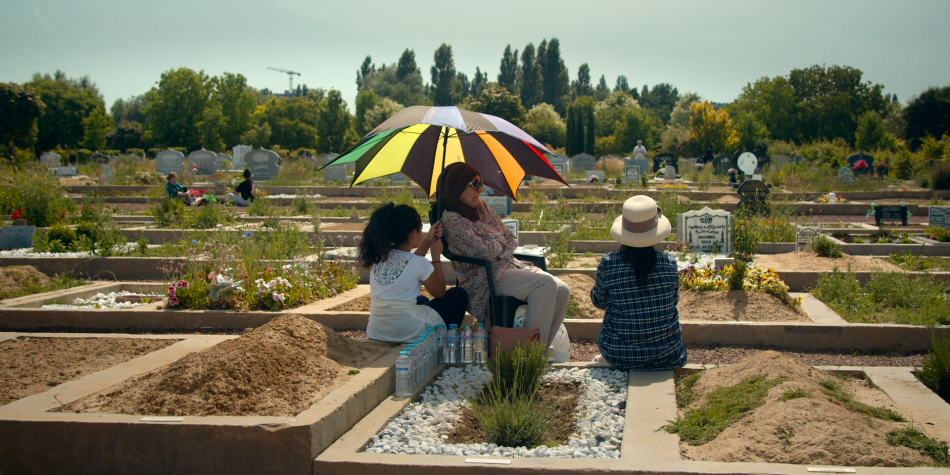
Do the living watch over the dead in Karima Saïdi‘s observational obituary? Or is it in fact the dead who watch over the people who come together in Brussels’s first multi-confessional cemetery? The answer would likely depend on the faith or individual conviction of the person visiting the site of the Belgian director’s tender documentary. Just as her cinematic debut A Way Home five years prior, Those Who Watch Over is intimately connected to Saïdi’s mother. Back then she was suffering from Alzheimer’s; now she is laid to rest according to her wishes at the Intercommunal Multifaith Cemetery of Brussels.
This personal loss makes Saïdi’s respectful study of a unique place and its people, alive or deceased, also a cinematic exercise in mourning and active remembrance. While the themes of death – past, present, or approaching – grief, and loss may anticipate gloom and gravitas, the colloquial collage seems surprisingly light. Bright sunshine glazes the burial site in an inviting warmth to which the visitors gladly respond. Some bring parasols and sunglasses when attending the graves of family and friends. Others have lunch boxes filled with generously shared snacks—often North African and Middle Eastern specialties. Many from Brussels’ Muslim community come here to share dedicated moments with their departed.
While the cemetery is open to all faiths, 90 percent of the burial sites are Muslim. This makes the park-like area also a hub of intercultural and inter-religious exchange. Death may be an endpoint, but here it is also the beginning of new connections, lively exchanges, and an empathy that feels painfully rare. Human connection is as essential to this place and its compassionate documentarist study as are migration, identity, and memory. Being herself one of the mourners provides the director with a natural sensibility for the right amount of distance towards the persons she depicts. Through varying rituals such as cleaning stones, laying flowers, or reciting poems, mourning becomes a regular part of life.
For migrants and descendants, the mourning practice and graves of relatives form a special connection to their land. A microcosm of multicultural life, the graveyard seems more like a vibrant communal space, where the living continue to nurture bonds with the deceased across generations. The camera wanders casually among the stones as Saïdi did for over a year before starting to actually film. With its unspectacular air and leisurely pace, the mise-en-scène demands lots of patience, especially as the view of the central location is idealistic to a fault. Strife, inconsolable pain, anger, and desperation, all of which are not uncommon to the process of grieving, remain absent.
With the same discretion, the director overlooks the economic questions. Death has its price, and more and more people can’t afford it. The vivid images quietly celebrate inclusivity but never mention the expenses for a dignified burial or modest resting place. Cinematographer Caroline Guimbal’s idyllic scenes of children playing among tombstones and compassionate gestures leave much space for silence — but none for those outside the hedgerow walls. While framing the cemetery as a living archive of shared humanity, the cinematic memento mori carefully omits the cost of that shared humanity. In its universality, death might overcome the barriers of language, beliefs, and nationality, but never poverty.
Discover more from Cineccentric
Subscribe to get the latest posts sent to your email.
 Cineccentric
0 comments on “Those Who Watch Over (documentary) ★★½”