
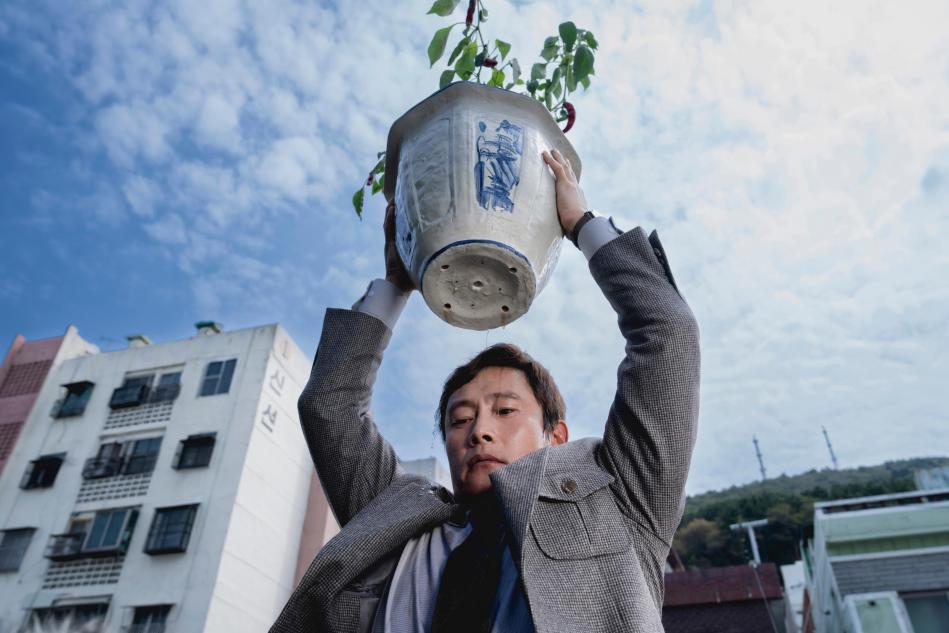
For many, their occupation is a significant part of their identity. Ideally, one’s employment is of personal relevance or interest. The location of work informs where one lives and where one’s children grow up and go to school. Salary determines what house, neighborhood, and car one drives. And this isn’t just true for the middle class. Man-su (Lee Byung-hun) is a high-standing manager at the papermaking company Solar Paper. He lives in luxury, the opening shot of No Other Choice pointed upwards showing the beautiful sky and trees above his luxurious mid-century modern style home. He has a wife who he is romantic with, two children, and two golden retrievers. It’s a bit cookie-cutter, but many would kill for a life, family, and house like Man-su’s. And Man-su comes to the same conclusion himself after he is suddenly laid off at his job. His twenty-five years of employment at the same company – two-plus decades of experience – is not enough to retain him in light of automation technology. He has a deeply personal connection to his job and the group therapy provided as part of his severance package isn’t going to help his identity crisis.
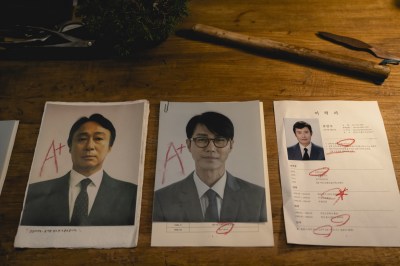
Man-su has always been a paper man, through and through. On Instagram, he sees Seon-chul (Park Hee-soon), a manager at rival paper firm Moon Paper and becomes envious, convinced he is a more capable worker than Seon-chul. Following an uncomfortable interview experience and the risk of being foreclosed on his childhood home, Man-su is driven to desperation. He realizes that deposing Seon-chul would not be sufficient to ensure he can take Seon-chul’s role and has a cunning idea to identify fellow papermen who would be competitive against him for the role. Uncomfortable to Man-su however, is his resolve to murder each of these men until he can gain employment at the leading paper mill Moon Paper. After all, he does not have twenty-five years of experience being a hit man. Director Park Chan-wook derives dark humor and tension from showing how ill-equipped Man-su is at committing murder and Lee illustrates the deep discomfort that Man-su experiences. Lee excels in playing a man who is terrified for his livelihood, portraying with realism both the fear that Man-su experiences when he is driven to murder and his fear of losing his family as Man-su’s wife becomes distant from him and suspicious of Man-su’s nighttime excursions.
The film’s title – “no other choice” – becomes Man-su’s personal mantra after hearing American executives respond to his criticisms of the layoffs with this remark. Man-su is convinced he has no other choice but to commit murder and this is reinforced after observing his first victim, an older man who, along with his wife, provides an uneasy portrayal of what Man-su’s life will become in the coming years if he continues his unemployment. Man-su and the older man are resolved to be papermen and not pursue an alternative occupation despite the industry and its pursuit of automation leaving them in the past. Park shows that company leadership has no qualms about the changes in their industry that workers experience. They are insulated from any impacts. Man-su’s desperate plan to regain his employment and his resolve that there is ‘no other choice’ than to kill his fellow working men is tragically bleak and misdirected – it doesn’t address or prevent the hardship he and fellow workers experience. Man-su’s destructive path compounds the misery other families face and his use of a handgun passed down from his father who fought in the Vietnam War likens the weight of Man-su and working classes’ struggles to warfare.
No Other Choice portrays the impact on labor of the AI and automation boom that is so keenly felt today. For this reason, it is difficult to predict what staying power No Other Choice will have decades from now compared to Park films Oldboy and The Handmaiden that are poised to stand the test of time. No Other Choice directly holds a mirror up to contemporary life and values and, like us today, doesn’t have a clear solution or remedy for what the next decade or two will look like as automation capabilities continue to expand to more specialized roles. The film lives in the present, suggesting a need for change and questioning why wellbeing is prioritized last during seismic technological changes.And as No Other Choice depicts, the employment and status quo that Man-su fights so desperately to maintain looks very different compared to the role he was laid off from…
Discover more from Cineccentric
Subscribe to get the latest posts sent to your email.
 Cineccentric
0 comments on “No Other Choice ★★★½”