

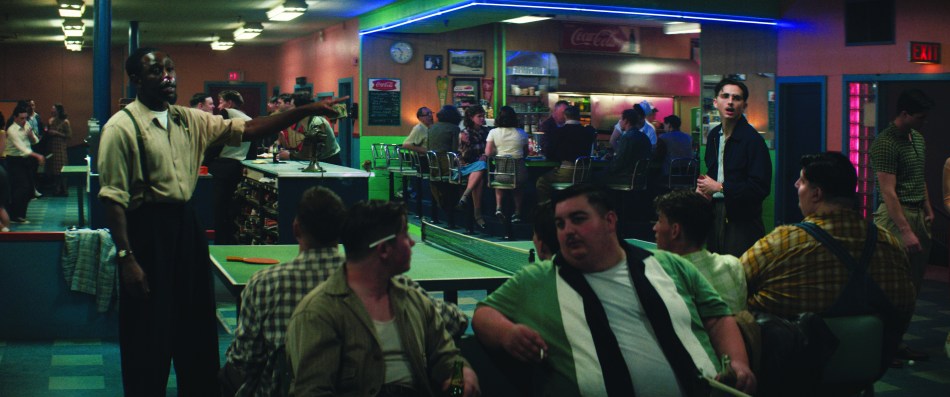
Marty Mauser (Timothée Chalamet) is a dreamer. The year is 1952 and he is grinding as a shoe salesman at his uncle’s store to pursue his passion of taking the table tennis world by storm. He sees it as a rising sport, a grand opportunity for a young man like him to carve out a name for themselves in bright, shining lights. “It’s only a matter of time before I’m staring at you from the cover of a Wheaties box,” he boasts in a sales pitch, trying to convince a local businessman to fund his idea of orange ping pong balls. It is a moment that defines the brashness and bravado of this man. He can so easily wrap one around his finger through sheer charisma alone and he often does, entrancing numerous characters along his journey to help him try to achieve his dream of international stardom in the table tennis world. However, this is not just a story of table tennis. Marty Supreme is a story of a young man desperate for a way out of his circumstances and for the American dream to come true for him.

The only path to the American dream for a man like Marty is to shed oneself of all pride and dignity. They must sacrifice themselves at the altar of capitalism, to be held captive by the decision makers with all the money and to play for them whenever they need the amusement. He is, as even he admits, a “performer” of a kind. In his mind, though, he is a showman out to entertain audiences with his skill as the main attraction. He is performing even for himself, though, deluding himself that his dream is within his grasp because of his drive and ambition. Yet, at every stage, he is a helpless young man. He needs money from his uncle to even go to the World Championships. He needs the help of old friend Wally (Tyler Okonma) to hustle some kids at a bowling alley for traveling cash. He needs the help of lover Rachel (Odessa A’zion) to extract reward money from a man who lost his dog. He must beg and plead from his hands and knees, embarrassing and humiliating himself in front of businessman Milton Rockwell (Kevin O’Leary) to get an opportunity that he was once too proud to accept. Everything in his life is defined by money. It is not enough to dream, one must have the cash to make that dream possible and, even then, bureaucracy and barriers to entry are boundless with Marty often on the outside looking in of actually achieving the dream he assigned himself: to be the best table tennis player in the world.
And that is just it, it is a dream he assigned himself. He is convinced this is his purpose. He has a wandering soul and a frenetic energy bouncing within him. One could see a young man like this once upon a time exploring the world as an adventurer or inventing the next great, world changing tool. Instead, the only dream afforded to him is the one right in front of him: being a world-class table tennis player. He frequented the local table tennis hangout, so it is a natural fit, but it is a dream where he can only see the world via being a halftime side act at Harlem Globetrotters games or selling his soul for the pittance that the capitalistic influences in his life will dole out. Director Josh Safdie opens Marty Supreme with a very bold scene. The connection of Marty and Rachel is immediate as she comes into the shoe store and the two have sex in the stock room. The opening credits play over a microphotography recreation of sperm racing towards an egg with that egg soon dissolving via a match cut to being a ping pong ball. It is not long before Marty is pitching his orange ping pong ball creation because following the white ball in the sport is too hard. It is the excuse of an immature child on the surface, but together with that opening transition, this immaturity is crucial. The orange ball is a distraction. His dream is achievable with the white ball and, what is more, the table tennis itself is a distraction from a higher purpose he has no idea is coming his way.
At its core is a young man who wants to make something of himself, who wants to be the man of the house in the wake of his father’s absence, and who wants to get his mother out of tenement housing. He is a Jewish person less than a decade after the Holocaust, out to establish a place in a world that traumatized and scarred him and his friends. He is so focused on making it, on hustling, and grinding that he misses what is right in front of him. He misses the white ball, caught up in the details and excuses that define immature minds. It is only in the end, in the electric closing act of Marty Supreme that his mind sharpens, focuses on what matters, and his world slows down. He is not racing around aimlessly, desperate to prove himself. His game is the proof. He is not just brash and full of hot air, but an actually great table tennis player. He is actually an individual who is able to show grace in winning and one who can show empathy for another, while also caring for somebody like Rachel and, especially, the by-product of their sexual encounter. He can be moved to tears by the immensity of a dream realized that he never even knew was a dream he had, a dream he had lost sight of in his reckless and often inconsiderate drive to make something of himself.
Safdie creates another kinetic and absolutely electric viewing experience. The frenetic pacing, entrancing and hypnotic score from Daniel Lopatin (plus some terrific needle drops in the soundtrack), the incredibly detailed production design, and cinematography of Darius Khondji transport the viewer in the world of Marty and 1950s New York City. The hustle and bustle, the grit and grime, and the colorful characters that make up this hive of activity. It is After Hours centered on a Catch Me If You Can protagonist, an impulsive and reckless individual who has no idea how to be an adult and can only act out imitations of what adulthood looks like to him. Tossed into various side quests and chaotic encounters – especially around Ezra Mishkin (Abel Ferrara) and his dog Moses – Marty Supreme is constantly anxiety-inducing with Marty flitting around, desperate to figure out how to make his dreams come true, and always seeming to get in his own way with newly discovered ways to box himself into a corner. There is a vibe shift in the film from this young dreamer who does not care who he hurts to a scared little boy who feels his dream slipping away and is willing to do whatever it takes to get even a shred of what he envisioned to be his, all building towards an incredible emotional crescendo.
It is exhilarating to watch with Marty Supreme’s wild odyssey given a remarkable performance from Chalamet, who anchors this with a performance that dares one to root for Marty in spite of all of his shortcomings because he is just that charismatic and disarming. In a career of great performances, Marty Mauser may be Chalamet’s greatest performance yet. The closing scene is especially powerful to watch with Chalamet able to tap into something soulful and deeply human at every moment in Marty Supreme. As much as one is able to cast dispersions on his character, there is a live wire within that makes one understand and see Marty for who he is at a deep level, all because of Chalamet’s performance.

He is surrounded by a terrific cast. Kevin O’Leary is shockingly terrific as Rockwell, a callous businessman that plays to O’Leary’s strengths but there is something deeply fascinating about this character, especially due to his final scene with Marty that O’Leary taps into. This is a deeply evil figure, a human being made up solely of greed and consumption, one that sucks the life blood of dreamers like Marty to make himself feel big. O’Leary nails the energy of the role and his face at every moment fills one with disgust. One of the final lines he delivers is given so much conviction that one buys it at face value despite its ridiculous content. Chalamet’s scoffed and stunned reaction to it brings the scene home, the two working wonders together whenever paired. Tyler Okonma is energetic and electric as Marty’s friend, their excursions channeling The Hustler with as much charm as one would expect while their chemistry is contagious. Odessa A’zion plays a character who is often as selfish and manipulative as Marty, but their chemistry – that look they share across the shoe store in the opening is too good – is undeniable. A’zion is a captivating presence at every moment. Abel Ferrara, the legendary New York director, is given a seedy role here and every moment he gets is fascinating with the character’s own strange odyssey in Marty Supreme providing a thematically rich sub-plot. However, among the supporting cast, it is hard not to be most moved by Gwyneth Paltrow. Playing Kay, the wife of Rockwell and a one-time movie star trying to make her big comeback, Paltrow provides not just an authentic lived-in feeling for Kay but also a raw insecurity. She exudes class and confidence, yet at her core, she is still that scared beginner trying to prove to herself and to everyone that she has what it takes. Marty is very much the same – hence why the climactic match is so moving to him – and in one another they find that unspoken bond, they see one another for who they are beneath the bravado and external beauty. They are frightened that their dream is slipping away or is in the past. Paltrow’s connection with Chalamet is a huge asset, but she is at her best in the moments she casts away her confident exterior to reveal that fragile internality that grips Kay’s soul.
Marty Supreme is a frantic and intoxicating film from director Josh Safdie. It is a critique of hustle culture and the American dream as much as it is an exciting, odd, often funny, and thrilling detour into the wild world of New York City. It is alive and electric, a place where everything seems to be happening at once and for Marty, that is how his soul feels. Every moment he sits in a single spot is a moment wasted, as he could be somehow grinding and advancing his dream. He is laser focused on success, except it is success limited by his youthful mindset and of visions of what others’ success looks like. It is success that requires the approval of the capitalistic hands of the market and success that requires a narcissistic sacrifice of all things and people that actually care about him in his life. It is destructive as much as it is enriching and moving. Marty, at his core, is a scared little boy desperate to prove his feelings of inadequacy wrong, at first masked with his false confidence and conman sensibilities. He is frightened he may be stuck in this world of working at his uncle’s shoe store and living in tenement housing forever. He will do whatever it takes to get out, but all the while, he misses something greater, until he finally slows down, looks around, and is no longer this ping pong ball flying back-and-forth across a table. He is able to settle, stop for a moment, and take in the awe-inspiring sights of a world he never realized were forming around him. Marty Supreme is a great film from Josh Safdie, marvelously directed, written, and acted while boasting a terrific score and great cinematography. It is the wild ambitions of young adulthood meeting the reality of adulthood, an eye-opening and soul stirring journey realized in a pulse-pounding package.
Discover more from Cineccentric
Subscribe to get the latest posts sent to your email.
 Cineccentric
0 comments on “Marty Supreme ★★★★”