
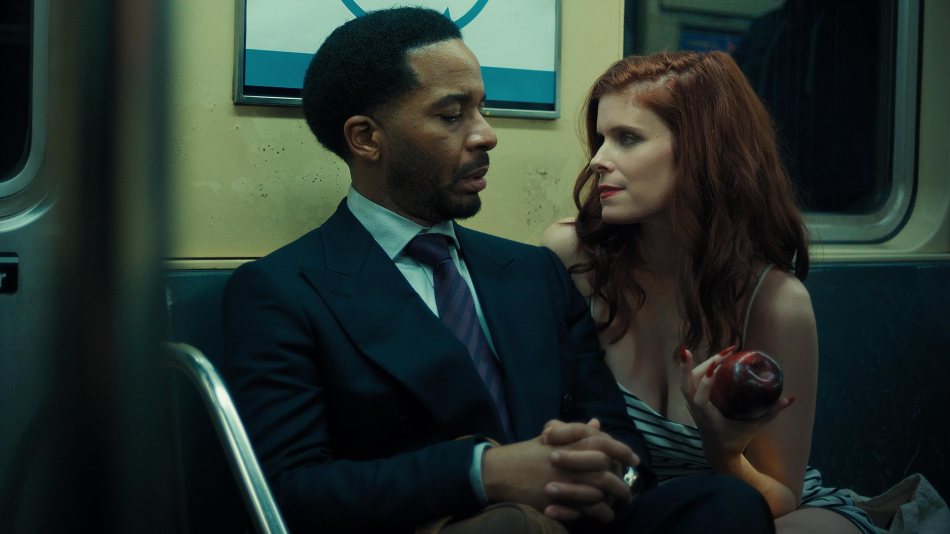
The Dutchman is ambitious. The play Dutchman by Amiri Bakara serves as the basis for director Andre Gaines and screenwriter Qasim Basir’s work, but it is not a straight adaptation. It is as much an adaptation as it is a metatextual examination of adapting – namely, whether or not these characters are fated to their ordained ends – and a conversation with its source material. It retains the main focus on the encounter between Clay (André Holland) and Lula (Kate Mara) on a train, but Gaines adds prologue and added context in between the train-set scenes. It also elevates it to being a story about dreams, seemingly set within Clay’s mind as he struggles with his own personal and identity issues with much of the story functioning as a sort of play within the film. It is messy and, admittedly, confusing. But, it is a hard film to shake from one’s mind, as it demands to be reckoned with and its form is so fascinating that one wants to pour over every element.
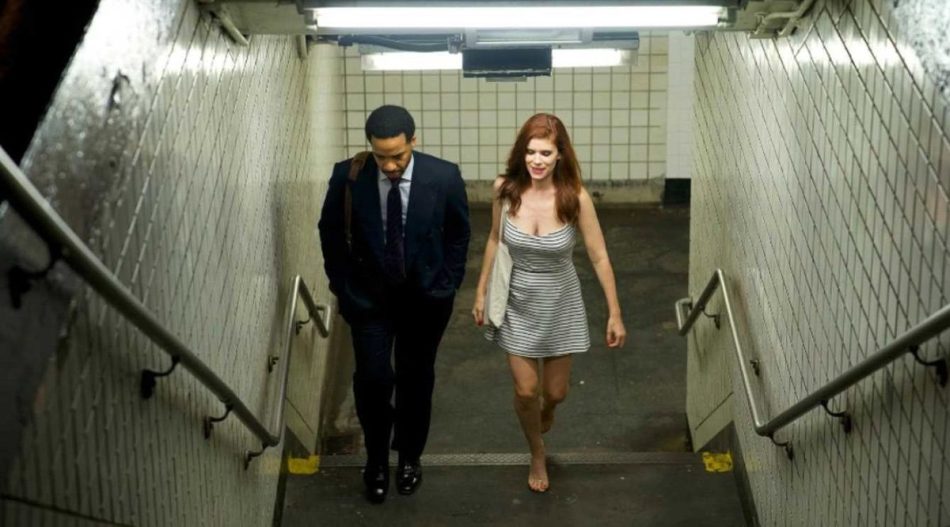
This may be part of its downfall as what is fascinating about The Dutchman is less what it says about the world and character it depicts than in how it says it. The main hook is this: Clay is in therapy with his wife Kaya (Zazie Beetz). Trying to piece their marriage back together after Kaya’s infidelity, the therapy session with Dr. Amiri (Stephen McKinley Henderson) is contentious. Kaya points to Clay’s inability to open up and communicate with her as a source of problems, while Clay feels blamed for Kaya being unfaithful. Internally, he is haunted by images of her with this other man with Gaines interspersing these out-of-focus visions of Kaya and this other man throughout the film. He is also a very busy man with a party scheduled for tonight in honor of Warren (Aldis Hodge), Clay’s friend and a local Harlem political representative seeking re-election. Clay is expected to speak at the party with both his eloquence and influence seen by Warren as crucial to the event being a success. Trying to balance these worlds, find some semblance of peace, and to find a way through with his wife, Clay is in emotional turmoil. As the session ends, Dr. Amiri stops Clay and offers him a copy of the play Dutchman. From there, he sees a figurine of a person on a stage on Dr. Amiri’s cabinet and he is, essentially, thrown into the play Dutchman. The orange and red-tinted world of reality is suddenly washed out into blues and greens as Clay walks to the train station. He gets onto his train, then a woman comes striding down the platform. She is Lula. Their eyes meet. She is on the platform as the doors begin to close and, then, she is somehow walking through the train and strutting over to Clay, making her first overture.
The Dutchman does not hide Lula’s intentions. She is a temptress, armed with a Biblically-inspired apple that she desperately wants Clay to eat. This scorned and lonely man – who even heard from Warren that “turnabout is fair play” in regards to Clay perhaps having an affair – is an easy mark for Lula’s seductions. It is not long before they head to her apartment – where that same figurine on a stage is shown on her cabinet – and have sex, a moment that sends everything spiraling into chaos as Lula insists on going to Warren’s party with Clay, threatens to claim he raped her, and drops his used condom into her purse (yes, really) for evidence. The Dutchman traffics in these nasty sexual politics with Lula the character being basically just seduction and manipulation in a human body, a misogynistic construct to a fault. Lula is more an idea and a manifestation from Clay’s own subconscious, but nevertheless, The Dutchman does little favors for itself in proliferating the belief that women lie about rape to blackmail, control, and manipulate men to their own ends.
On the other hand, this scenario is an apt depiction of how White America can weaponize the law and police officers against a Black man. At a moment’s notice, Lula threatens to scream or call over the police whenever she feels Clay steps out of line. His life is constantly on the line when he is interacting with her, and Holland expresses this discomfort with great detail. While The Dutchman struggles to balance its unique style and narrative approach with probing the larger ideas on its mind, it does have a lot it is trying to tackle. Dutchman the play carries with it many racially important themes and a politically charged context. This film carries with it many messages about Black identity, being a Black person in a White-dominated world, and White America’s desire to exploit Black cultural spaces. It may not strike much new ground, but it is not all style over substance.
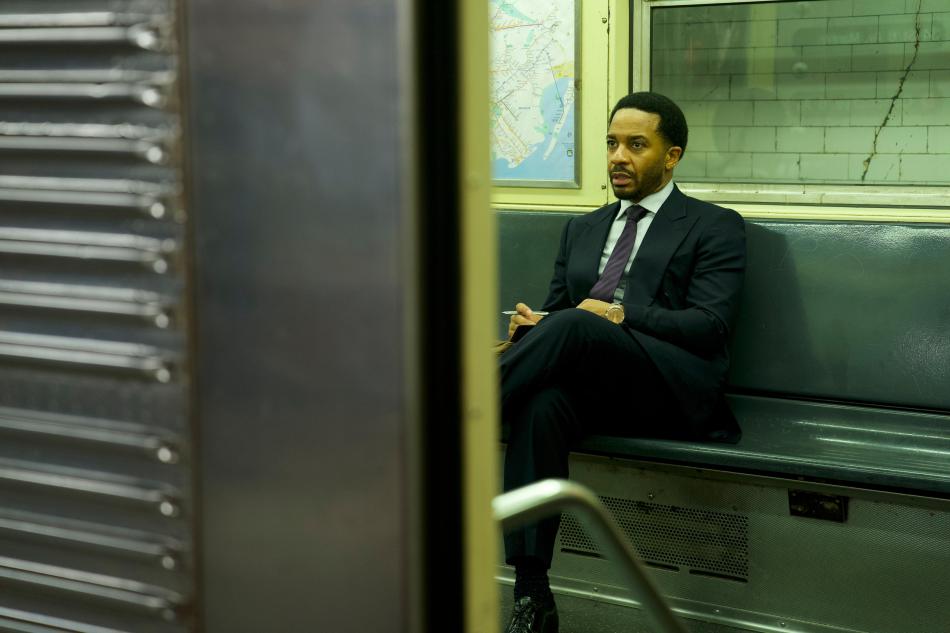
Prior to their return to the train, Gaines shows Clay watching the finale of the original film adaptation of Dutchman from the 1960s and one is primed for how this encounter will turn but here, Gaines works in some comments and adjustment for the original material to add his own spin. It is not ready to just accept that the way things have ended for Clay for 60 years of the story being a thing is how it must end for him now with even Dr. Amiri popping up here and there, desperately hoping to nudge things back in Clay’s favor. Henderson is so impressive in capturing this off-beat figure that one can never quite tell if Dr. Amiri is all together a force for good or simply a master puppeteer watching his latest catch go through this mind-bending exercise. Its roots as a play are obvious with The Dutchman often verbose and stagey, but it nevertheless rises on the back of the strong performance from Holland. However, as with much of the film, it is this metatextual conversation and the film’s particularly kaleidoscopic and trippy forays into this dream world that stand out as its most interesting elements. A quick flash in a mirror of Lula’s true appearance, a faceless cab driver, a set on a real theater stage, Dr. Amiri’s continued presence, the color shift, and more, are all great touches and thought provoking scenes that establish The Dutchman’s disquesting vibe and unique world. However, it also has the side effect of drowning out its larger themes. It all kind of jumbles together into a bit of a garbled mess, struggling to make sense of what its dream world really means, how to fit it into this metatextual context, and how to fit it to the larger social ideas raised by the original play.
Director Andre Gaines does not play it safe with The Dutchman. It is part adaptation, part re-imagination, and part examination of the entire adaptation process, in addition to being a racially provocative interrogation of Black identity in a White-dominated society. The Dutchman is fascinating and, in the end, does come recommended if only for how bold it is in how it approaches this material. It has its flaws in trying to tackle this material from an entirely new angle, while Gaines does not stick the landing with every swing but it is a film that dares to try. The Dutchman is engaging and thrilling. It, like a dream, can be quite haunting and disquieting. Anything can happen and even as elements call one’s attention to it being a dream world, it can feel so real that one begins to question where Clay’s dreams and reality meet. The Dutchman is structurally and narratively exciting, a film worth approaching with an open mind and sitting with afterwards to let its unique approach to this story sit with you.
Discover more from Cineccentric
Subscribe to get the latest posts sent to your email.
 Cineccentric
0 comments on “The Dutchman ★★½”