
Father Mother Sister Brother is a film built on its silence. It is quiet and unassuming in general, but it is in the silence that one can feel its heartbeat. Whether it is on the drive to one’s parents home for a visit, an awkward pause that nobody seems able to break, a comfortable silence that is neither awkward nor unwelcome, or simply stopping to watch some kids skateboard on by, Father Mother Sister Brother soaks in the emptiness. It can feel weightless or heavy, it can communicate immense depths of feeling or lack thereof between these characters, or it can simply appreciate the moment for being the moment. Writer-director Jim Jarmusch holds up a mirror to family life, presenting a triptych united in exploring the complexity of family dynamics.
Jarmusch is never in a rush, content to pause the film and linger on a beat. Each story is like a time machine, taking these characters back to a world and a life they eventually grew out of and moved on from. The gap in time is felt by the added wrinkles to their parents’ faces and the different lives their siblings are leading since the last time everyone was together. It is often dryly funny and it is frequently marked by that awkward silence. It is a film about what is said, what is meant, and what is left unsaid. Every moment communicates multitudes about these individuals and their unique family culture, all united in being a film all about the secrets built up and eventually left behind by parents, as well as the posturing of both parent and child alike. Father Mother Sister Brother, in soaking in the space around these characters, allows one to feel the immensity of their surroundings, the lives led in these rooms, and the complicated mixture of emotions felt therein.
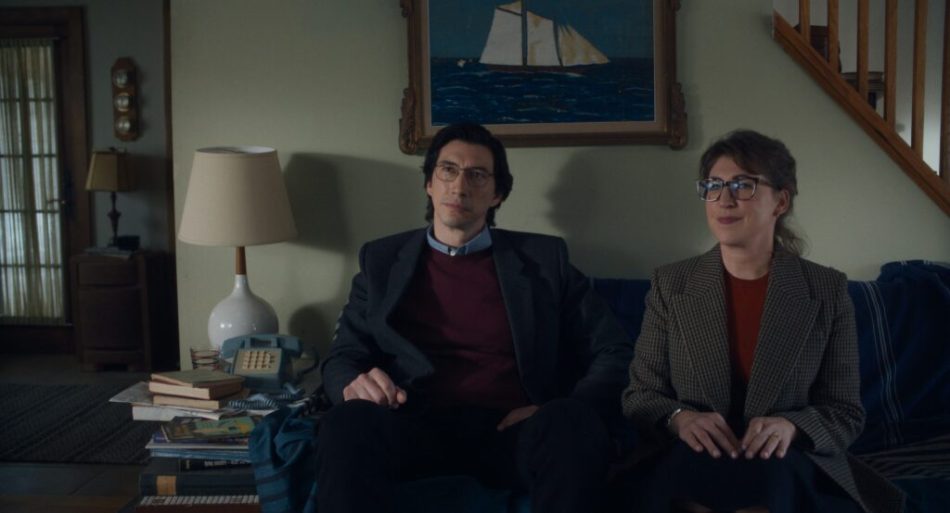
The three stories of Father Mother Sister Brother – entitled “Father”, “Mother”, and “Sister Brother” – all find siblings traveling to their respective parents’ home. Jarmusch repeats a few motifs in each story, such as skateboarders, a Rolex watch, a toast, conversations about water, and the saying, “and Bob’s your uncle”, among others. In “Father”, Jeff (Adam Driver) and Emily (Mayim Bialik) travel to see their father (Tom Waits). He was always, as they later admit, a bit of an enigma to them and he still is now, with Emily finding books on his shelf that she never could imagine him reading. Their father presents as a bit disheveled, lonely, and lost with their mother having passed away a few years ago, though this is all part of an act to attract their sympathy and, especially, any cash they can spare to help fund his hidden active lifestyle. Jeff is the doting son bringing groceries to his father, but their dynamic is always off. Jeff and Emily are very worried about Father, questioning him constantly about the goings-on with him, but he is often evasive and short. “Father” benefits from the deadpan skills of Driver, Bialik, and Waits, providing much of the film’s comedic punch. It and the following “Mother” are marked by that stilted conversation, though, a seeking of topics and a flow to the gathering that never quite formulates. It is just three disparate people sharing a room and toasts together for a bit before returning to their lives.
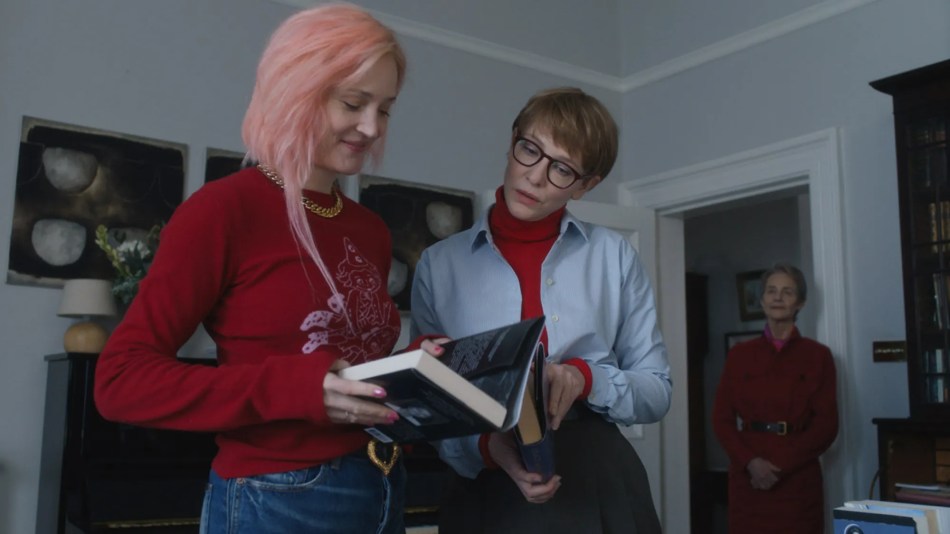
In “Mother”, nobody needs to travel far as daughters Timothea (Cate Blanchett) and Lilith (Vicky Krieps) live in Dublin, as does their mother Catherine (Charlotte Rampling). However, they only see one another once a year for afternoon tea. Contrary to Father, who was a bit happy to see his children leave despite much pleading, Mother is waiting by the window for her daughters to arrive and rarely breaks from the stiff upper lip she presents to mask her marked loneliness. The two daughters could not be more different. Lilith is the rebellious one, wearing a graphic shirt and sporting pink hair, while she is dating Jeanette (Sarah Greene) and lies to her mother about the handsome and rich boyfriend she has. She boasts about her personal success, which one can easily spot as a lie but Catherine plays along to keep the peace. Timothea is the conformer, even now fretting when Lilith touches Catherine’s books – which she always forbade when they were kids – and largely matching the mannerisms of her very demure mother. “Mother” is the saddest section, retaining that same sense of obligation from “Father” but spun a different way. Catherine will not admit it to her daughters, but she is desperate for more time with them. Her kids, even if different individuals, are united in being desperate to conclude this yearly commitment. There is symbolism even in what they bring and exchange. Lilith brings nothing, but Timothea brings a flower arrangement that ends up being comically too large for the encounter (a great bit of physical comedy ensues as Rampling desperately tries to keep it, but can never find an angle to actually see her daughters across the table), forcing Catherine to swap it out with something smaller. If not said in words, Catherine’s love is in the vast assortment of treats she bought for the occasion and in the goodie bags she prepared for her daughters to bring home. They will never let her into their true selves, nor will she let them into her true self. There is a longing for more meaningful connection, but the gap between them all is too pronounced. Her secrets – the novels she wrote – are already boxed up, but remain inaccessible to Lilith and Timothea, a reveal that will have to wait for later.
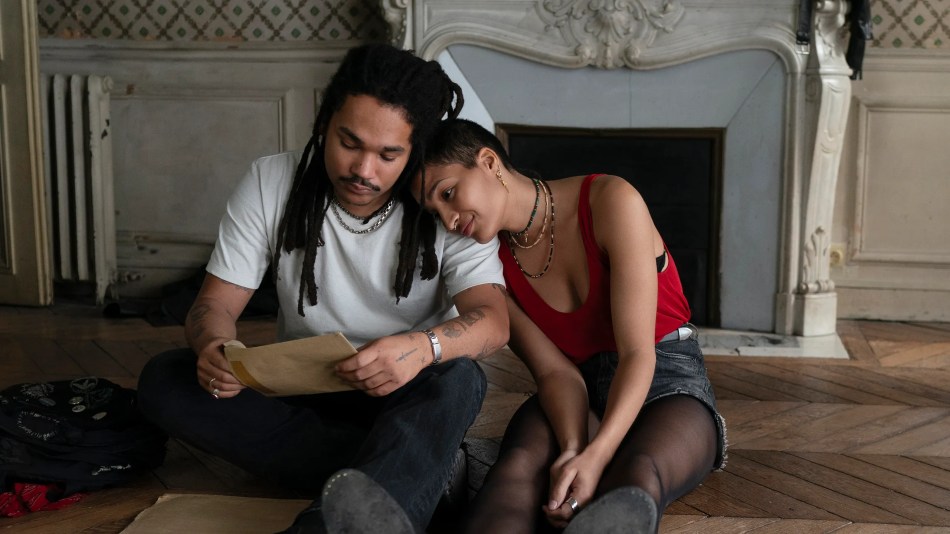
“Sister Brother” is the warmest section, culminating in perhaps the defining image of Father Mother Sister Brother. Skye (Indya Moore) and Billy (Luka Sabbat) have come home to Paris to visit their recently deceased parent’s apartment one final time. Billy recently worked on emptying the apartment and moving everything into a storage unit. Moore and Sabbat share a wonderful chemistry together as siblings. They have their share of awkward silences between them, but there is a flow to it all. They are twins and share that connection, often referencing past conversations that highlight their intuitive bond. They loved their parents, imagining their exciting and adventure-filled lives as seen in old photographs of them. Their parents had fake passports and identities. They had forged birth certificates and marriage certificates. Everything about them was some kind of fabrication, but what was never a lie was their affection for their children. Old toys, photographs, and art, “They kept everything,” Billy says to Skye. Father’s home was cluttered and came with a beautiful view. Mother’s home has a quaint iron wrought gate and is filled with knick knacks, featuring a cordoned off and fractured floor plan. Billy and Skye’s parents’ apartment is, naturally, empty. But, it is full. The chilliness of the American winter at Father’s home and in the demeanor of Mother’s home is not found here. Instead, it is two siblings laying on the floor of their parents’ home, letting the memories wash over them as they share a contented silence together. As they go to the storage unit, there is the towering image of the full unit. Billy remarks it is quite a deep unit, too, with stuff even from their grandparents included. “It never felt like this much,” they say. Yet, stacked before them is multiple generations lived. It is all that is left physically. What is left emotionally, for them, is immense. Perhaps they never knew their true parents, but they know one another and they know they were loved. That was no secret.
Father Mother Sister Brother is a powerfully rendered and often understated look at family. It can be funny and disarmingly affecting. It has power in the mundane, whether the idle conversation that occurs between families when they have nothing to talk about or the drive to the family home that feels so ritualized. The use of point-of-view shots from the hood of the cars as they drive up to the home or apartment where one can see the passing foliage, the line of parked cars, or packed city streets and even feeling the rocking back-and-forth of an unevenly paved driveway, draws one into each story and into the uniquely melancholy feeling of making this trek. It is a trip down memory lane for each character, a revisiting of the dynamic (or lack thereof) that defined their childhoods. They are all looking for something and Billy and Skye seem to find that feeling with the others left still searching for whatever undefinable feeling they were after. The cast of each story is terrific, bringing to life these characters as real individuals with a depth to them that, true to form, is only slightly shown in the film itself. As he has done so often in his career, Jim Jarmusch holds up a mirror to life itself. It is, as he admits, a “quiet” picture but it is brilliant in its silence.
Discover more from Cineccentric
Subscribe to get the latest posts sent to your email.
 Cineccentric
0 comments on “Father Mother Sister Brother ★★★½”