
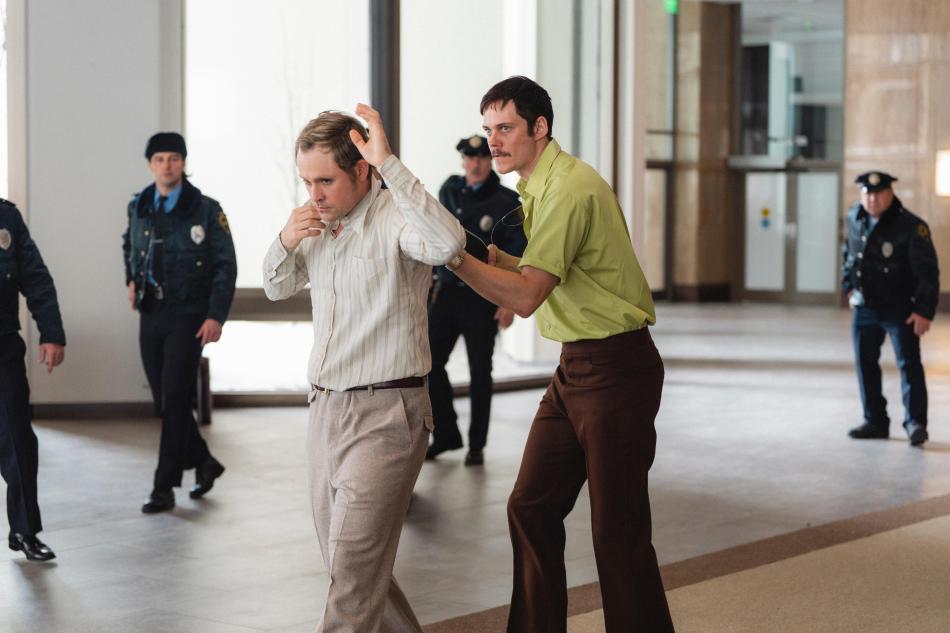
Tony Kiritsis (Bill Skarsgård) is inconsolable. He’s the prototypical “small guy” who, in his view, has been taken advantage of by predatory mortgage lender Meridian Mortgage. He is so far past reconciliation that he plots to take Richard Hall (Dacre Montgomery), the son of M.L. Hall (Al Pacino) who founded Meridian Mortgage, hostage to attract nationwide attention and expose the lender’s misdeeds. This true crime story that occurred in 1977 led to the adaptation of the story into a documentary, a podcast series, and now the Gus Van Sant film Dead Man’s Wire.
Tony’s process of kidnapping Richard – via tying the two together with metal wire to the trigger of a sawed-off shotgun – became a sensation during the 63-hour affair. This method indicated the premeditated nature of the kidnapping and Tony’s conviction that his plan would not be disturbed. If the police were to shoot Tony, he would fall, causing the shotgun to go off and kill Richard. If Richard were to attempt to escape, the shotgun would then also shoot him. In this manner, Tony kidnapped Richard in broad daylight with little worry about being observed. In fact, he wanted to be noticed.
Despite this being a time before the 24-hour news cycle, Tony’s kidnapping of Richard was immediately captured and broadcasted on live video by local television networks. Dead Man’s Wire uses the character of reporter Linda Page (Myha’la), eager to capture noteworthy news and accelerate her career to illustrate the presence of news media and its motivation to document (and benefit from) a sensationalistic event. A photo from the hostage situation would later win the Pulitzer Prize for Spot News Photography. Despite the ethical questions raised about showcasing Tony and the shotgun to American households, the incident quickly attracted both local and nationwide attention, eyes peeled to home television screens for the latest updates.
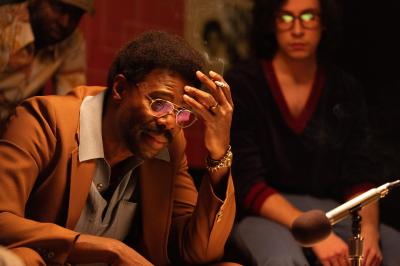
Tony himself made news media central to the kidnapping, demanding airtime and to speak with radio host Fred Temple (Colman Domingo). Indianapolis radio listeners soon got to know Tony’s off-beat humor and eccentric personality through his aired discussion with Fred. It is Tony’s dry humor that Skarsgård leans into cracking jokes to Richard (“I call shotgun.”, “This morning was a whirlwind, let me tell you”) that, along with Skarsgård’s wiry frame, convey a hunger or desperation with a mental state that is intensely active and witty. To portray himself as an everyman, Tony realized that he could appeal to Fred’s listeners who devoutly listen to Fred each morning as routine on the way to work or by the radio. Fred’s radio programming speaks to the consciousness of the people of Indianapolis and the character of Fred was not only inspired by the actual person, but also radio hosts Rosko who spoke on poetry and politics and Georgie Woods who would speak on civil rights between playing songs. Domingo’s warm voice is aptly suited for Fred’s radio broadcasting excerpts we hear in Dead Man’s Wire and evokes a parasocial kinship between Fred, Tony, and the people of Indianapolis. The irreverence in tone that Tony speaks to the police and negotiators with is not used when Tony speaks with Fred. Tony genuinely believes he and Fred are ‘on the same side’ as the common person, and this places Fred in an unusual predicament where the police are eager to work with Fred to be able to get through to Tony whereas Fred has no desire to be associated with Tony yet feels a strong fealty to help resolve the hostage situation if he can. Against his wishes, Fred is central to the way that the next hours unfold in Dead Man’s Wire. Van Sant contrasts the character of Fred who wants nothing to do with the Tony Kirtisis hostage situation with Linda who is at the beginning of her career and sees an opportunity within the disturbing event.
To make a connection between the 1970s in Dead Man’s Wire to the present-day, cinematographer Arnaud Potier used Ikegami portable broadcast cameras that would become obsolete in the 1980s to kinescope the production’s monitor and return grainy film stills taken from the shoot that would look as if they were filmed in the 70s. These stills are effectively inserted within the scene of the kidnapping to evoke a sense of authenticity and reminder of the true crime source material. The casting of Al Pacino as Richard’s cold and uncompromising father M.L. Hall also recalls the 70s, Pacino famously starring in 70s New Hollywood films such as Dog Day Afternoon which explored thematically relevant topics to Dead Man’s Wire – personal identity and the loss of the American Dream. This period of Hollywood that includes films such as Network and The Conversation has been given new life in recent years with themes of populism, communication, and media manipulation resurfacing as immensely relevant today.
Much like the outcomes of these films, the aftermath of the kidnapping is messy. Gus Van Sant emphasizes this as well as illustrates that there is minimal moral high ground to be found within Tony’s objective. Tony’s demand for $5 million dollars as ransom suggests a motive for the kidnapping that isn’t solely aligned with seeking justice for the everyman. And Hall’s callous nature and lack of visible concern for his son (he primarily receives updates on his son’s kidnapping through watching television at home) prompts Richard and Tony to speak about their relationship with their fathers, illustrating that the two have more in common than what is visible at first glance.
Following the outcome of the hostage situation, the song ‘The Revolution Will Not be Televised’ opens the credits for Dead Man’s Wire. This occurs moments after Van Sant shows Tony actualizing his demand to be broadcasted on live television, ironically interrupting an awards show speech by John Wayne whose classic Western films depicted individualism, vigilantism, and criminals, and evoke Tony’s violent means of seeking justice. Tony’s appearance on television, though highly unusual in circumstance and in showing Tony’s eccentric mannerisms, is suggested to have not achieved any revolutionary objective through the song choice in the credits. On the other hand, the accused actions of Meridian Mortgage and predatory behavior of other lenders is not televised yet has an outsized impact on many families’ quality of life. Thus, there is a very different tone that is suggested when hearing ‘The Revolution Will Not Be Televised’ and an uncomfortable murkiness that Van Sant evokes, not unlike his New Hollywood inspirations. For its depth in thematic exploration and character study, Dead Man’s Wire represents one of Gus Van Sant’s strongest films and is certainly the most fully-realized film we’ve seen from him in over a decade.
Discover more from Cineccentric
Subscribe to get the latest posts sent to your email.
 Cineccentric
0 comments on “Dead Man’s Wire ★★★½”