
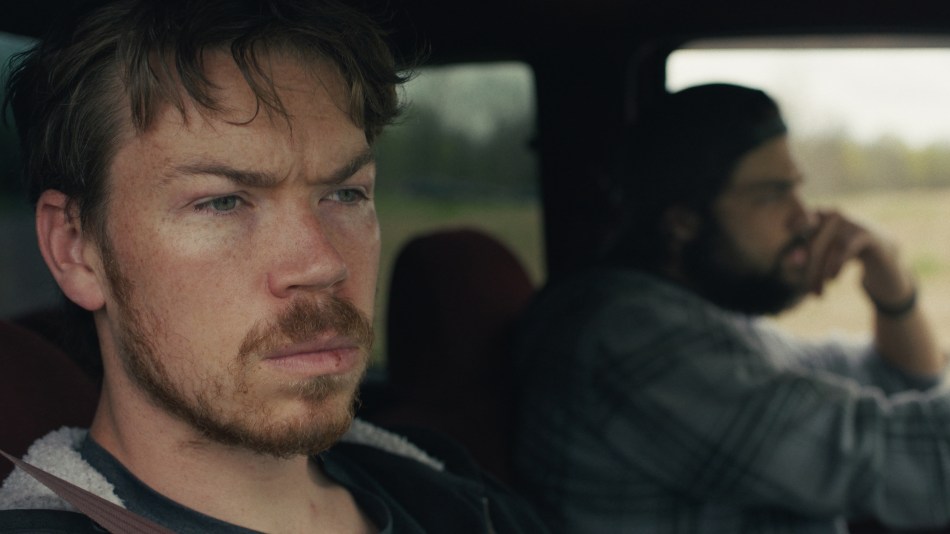
he story of Adam Meeks‘ bleak feature film debut isn’t one that hits close to home: it barrels right into it, tearing a window into the harsh lives of the inhabitants of the director-writer’s own hometown. Union County is a run-down place in rural Ohio where jobs are scarce and underpaid, while the infrastructure and social networks are steadily disintegrating. Addiction is a familiar problem, for many in a painfully literal sense. This is especially true for the young protagonist Cody Parsons (Will Poulter). He has struggled with substance use and abuse for years and is now navigating the tenuous transition from incarceration to sobriety.
The watchful eye of a county-mandated drug court program is always on him, just as it is on his brother and co-program member Jack (Noah Centineo). At one of his regular courtroom hearings that double as exposition, Cody has to state that they are technically foster brothers, but their deep bond makes such specificities meaningless. Though their different dispositions don’t always betray it—Jack brims with playful exuberance, singing along to the radio, striking up instant friendships, while Cody is more withdrawn and earnest—both share profound trust and comfort in one another. But there is also a dangerous seesaw of supporting and enabling each other when it comes to drugs.
Set on a narrative path that blurs the line between fiction and documentary, their struggle to reclaim their lives meanders between hope and despair. By connecting his raw recovery story with his own local roots, Meeks searches for an authenticity that shows dignity and respect to his challenged community. Yet, the mechanics of classic independent social-issue cinema are often all too obvious in this well-intentioned tale of returning to what is presented as the right path. Cody and Jack both make optimistic first steps, they improve, stall, stumble, and fail. After that, Cody has to continue alone, realizing he might not get another chance.
Poulter’s strong performance carries the plot well, and supporting roles, played by actual members of the recovery program and residents, provide a much needed realism. But the moralizing, especially when delivered in prolonged conversations, inserts an uncomfortable sense of superiority. While he follows Cody as he moves from sleeping in his car to a room in the recovery facility and ultimately taking integral steps towards stability, Meeks never shows the pain at the root of opioid misuse: pain of cravings, of withdrawal, of physical and psychological dependency. Pain of untreated chronic illness, an insufficiently treated injury, or constant overload despite which people have to go on.
He never looks at the medical and pharmaceutical structures that channeled highly addictive medications into vulnerable communities, and the systemic issues—like the absence of affordable health care—at the root of the opioid crisis. Most conspicuously, Cody and Jack are addicted to heroin, which thus is conflated with prescribed opioids. Such obscurities increase the severe stigmatization of controlled medical opioid use while blurring the personal and political causes for the epidemic. Though the story evolves around underclass people, and even allows them to participate—which is extremely rare for any film production—there’s little insight into and understanding of this world.
Preserving the documentarian look of long, unbroken takes, natural lighting, and hand-held camera of his eponymous short film on the same subject, Meeks turns precariousness into an aesthetic instrument. When real participants step to the bench and share progress or setbacks before a judge, the mood is overwhelmingly positive. The recovery program seems almost saintly in its devotion to its patients, none of whom utters any critique. With legally enforced programs such ideal circumstances are rare at the very least. Despite its committed performances, thoughtful direction, and naturalistic aura, Union County leaves some uneasy questions, and not the ones it wants to ask.
Discover more from Cineccentric
Subscribe to get the latest posts sent to your email.
 Cineccentric
0 comments on “Union County ★★”