
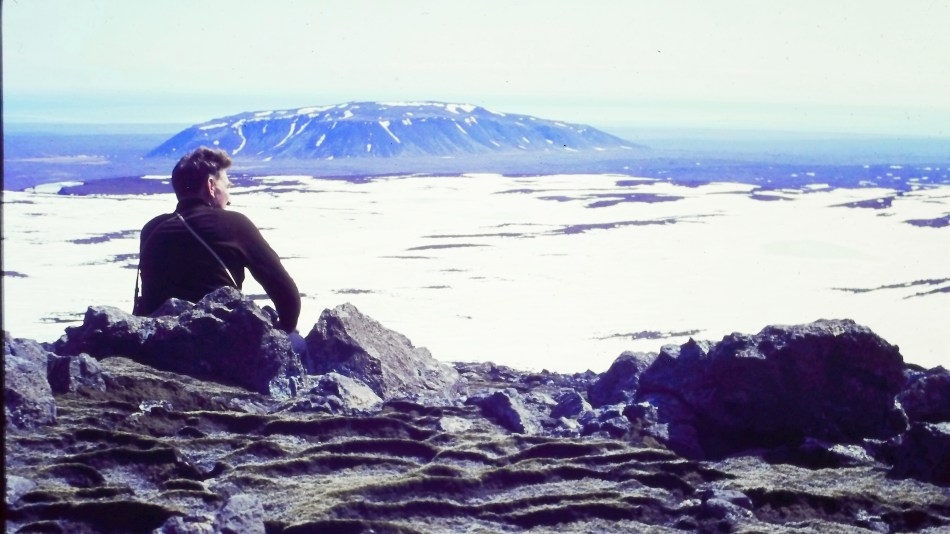
Already renowned for the elemental beauty and emotional acuity of her 2022 Sundance hit Fire of Love, Sara Dosa returns to the festival with a documentary that is at once smaller in scope and astonishingly ambitious. Slowly carving its narrative mold, the monumental meditation refracts the urgency of climate change through the intimate lens of memory, mortality, and melting glaciers. Debuting out of competition at Sundance Premieres section, the essayistic narrative blends environmental exposé and cinematic elegy to build a kinematic time capsule, designed to outlive its makers and subjects. It’s an urgent warning to a distant future, from a present in which much has already been lost.
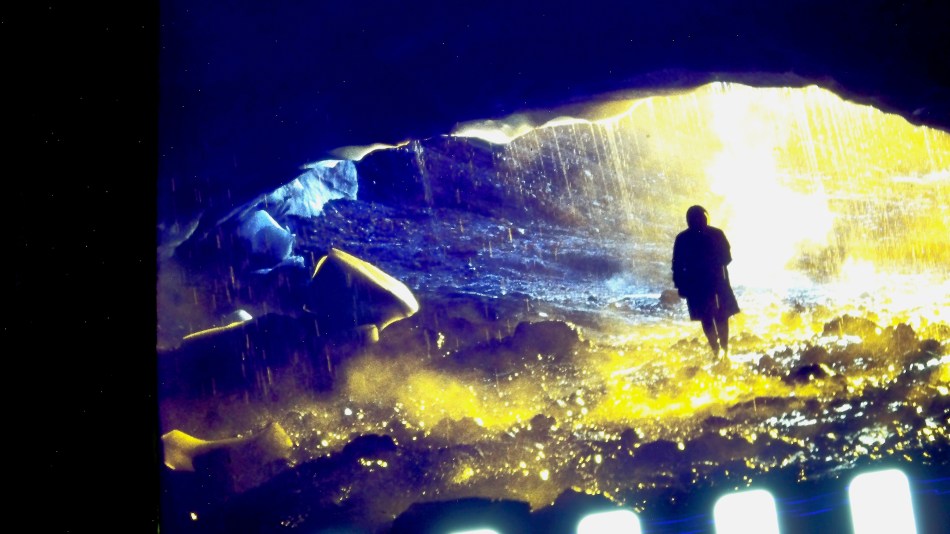
At the narrative’s center is Icelandic writer Andri Snær Magnason, whose concerned voice over anchors the pensive stride. Magnason, tasked with writing an eulogy for Okjökull, the first Icelandic glacier officially declared “dead” due to climate change, provides the structural spine. What begins as a task to memorialize a vanishing landscape grows into a contemplation on the passage of time: geological, familial, and personal. Ice that once measured centuries is now disappearing within a human lifetime. Magnason’s narration often circles back to that stark paradox: “I thought I had more time.” Exactly this is the fatal misconception stalling immediate action to slow down climate change.
Dosa’s decision to frame her work as a memoir addressed to future generations imbues the slow narrative with a prescient power. Home movies of Magnason’s grandparents exploring glaciers that no longer exist, intercut with sweeping contemporary shots of Iceland’s rapidly receding ice fields, serve as emotional emphases on the inseparability of personal and environmental. These archival fragments, drawn from decades of private footage, hold layers of past events. When it disintegrates – like memory or ice – the toll is immense. Pablo Álvarez-Mesa’s cinematography is striking in its calm grandeur. Long takes allow the landscapes to breathe, capturing the vastness of the majestic terrain with melancholic elegance.
Glacial surfaces shimmer and fracture, echoing the fragile state of both the natural world and human recollection. The interplay between analog archival material and pristine digital footage evokes a sense of time folding in on itself. Past and present collide in ways that are sometimes beautiful, sometimes devastating. Animator Lucy Munger‘s subtle interventions from mythic illustrations to gently animated newspaper clippings underline that Dosa’s work is as much about storytelling as it is about observation. Dan Deacon’s soundtrack complements this visual tapestry with airy compositions that balance visual gravitas with lightness. Resisting data-based urgency, Dosa sets her focus on affect and experience.
At the narrative’s core lies the emotional exploration of grief for a dying glacier and the people and moments that slip beyond human reach. In weaving together the death of Magnason’s grandparents with the disappearance of the ice, the structure draws a poetic parallel between two forms of inevitable loss, the imprint of which can be preserved through story and image. Though the reflective rhythm of this allegorical approach can verge on redundancy, circling familiar themes without always offering new intellectual ground, this repetition formally echoes the workings of memory, returning again and again to the same emotional ground. Once more, Dosa marvels at the persistence of love, the intimate bond between human and nature, as well as united perishing—a touching search for consistency in a crumbling world.
Discover more from Cineccentric
Subscribe to get the latest posts sent to your email.
 Cineccentric
0 comments on “Time and Water (documentary) ★★★ ½”