
If you read my pre-festival preview of the Competition titles for this year’s Berlinale, you know I had some high hopes for Everybody Digs Bill Evans, a biopic of the legendary jazz pianist, directed by Grant Gee, who’s making his narrative feature debut after stellar docs on Radiohead and Joy Division. While some have been lukewarm on the film, I pretty much adored it. For starters, it has some of the best black and white cinematography I’ve seen in years, and it exceeds its goal of presenting you with a full biography while only dramatizing a small slice of a man’s life.

That slice is the month or two following the death of Scott LaFaro, the bass player in Bill Evans’s original trio. Scotty’s death sends the already fragile, heroin-addicted Evans (Anders Danielsen Lie) into a fog of doubt, disillusionment, and the early stages of self-destruction. The first half of the film is Evans being tended to by his brother’s family. The second half sends him to Florida to stay with his parents, who are beautifully played by the two legends of the craft Bill Pullman and Laurie Metcalf. Sprinkled throughout are flash-forwards to the 70s and 80s, distinguished by switches to saturated color photography, and largely dealing with his tragic, co-dependant relationship with Ellaine (Valene Kane).
It’s easy to see why Gee’s film won’t be to everyone’s taste. As the director has pointed out, Evans was a ghost long before he died, and it’s not easy to make a movie about a character who’s often nodding off and seems frustratingly passive about everything. But for me, that’s the magic of the movie. What we learn about Evans happens through his brother and his parents. By seeing the hopes, jealousies, worries and frustrations they’ve carried with them, a full picture emerges of the family Evans emerged from and it’s one that really comes to life through the excellent work of Metcalf and particularly electric Pullman. Even though it’s a movie about a junkie musician, it avoids all the biopic clichés to create something more artistic and impressionistic, and I was fully on board from the start.
Also, there’s something to be said about Anders Danielsen Lie’s performance. Yes, it’s extremely understated and passive, but it all serves to make the little moments that much more impactful – the tear rolling down his cheek, the tremor in his voice, the little sign of a smile or smirk. It’s quite a risk the filmmakers are taking, but hey, like the title suggests, I dug it.
Elsewhere in the Competition, my hopes weren’t exactly dashed by Nightborn, the new movie by the Finnish folk-horror auteur Hanna Bergholm, but the movie turned out to be less outre and more conventional than I was expecting. It’s not a bad movie by any means. It’s a solid addition to the growing genre of postnatal psychodramas (see also the recent Die My Love, a movie that weirdly shares a lot of the same themes and structure) and Nightborn sets itself apart by offering up plenty of body horror and going deep on the dark lore of what lurks in the Finnish forests.

In particular, Seidi Haarla, who plays Saga, the mother of a disturbingly bloodthirsty newborn whose parentage seems to belong in equal part to the spirits in the woods surrounding their isolated home, is absolutely excellent and should probably consider herself in the running for an acting award. Haarla is put through the ringer in this movie, and gives such a full-bodied, impassioned performance that she alone really makes Nightborn a worthwhile movie. Everything else about the movie goes along as you’d expect given the familiar premise that can trace its roots to Larry Cohen’s 1974 classic It’s Alive (which spawned two sequels and a misbegotten remake), and Paul Solet’s underrated 2009 film Grace. While I wish it went a bit further and took more chances, I have a hard time knocking movies that do such a good job in getting into the inner lives of characters like Saga. This is something that movies rarely did for so long, and I can’t get too upset if it isn’t as bold as a Lynne Ramsay movie – few things are.
As it turned out, I didn’t have to wait long for something truly transgressive, because the next screening was Rosebush Pruning, the new movie by the Brazilian auteur Karim Aïnouz. Talk about a movie that isn’t for everyone – this is dark comedy at its most aggressively antagonistic. Some will find it distastefully repugnant, others will find it distastefully hilarious. Count me in the second camp, as I was not only laughing quite a bit, but I also ended up feeling oddly moved by the end of the sordid affair.

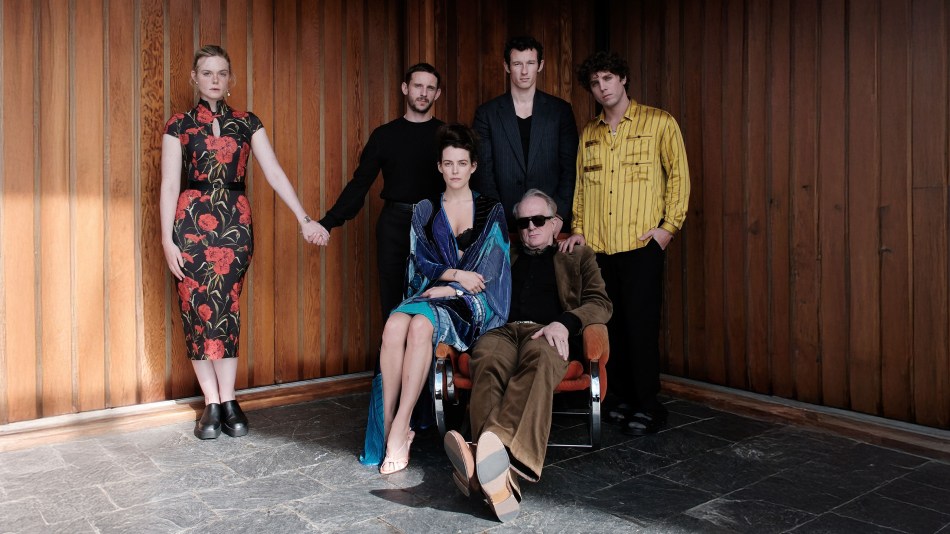
Rosebush Pruning is the story of a terrible, incestuous family of soulless rich people who’ve ended up being transplanted from New York City to a villa in some beautiful corner of Spain. When we meet them, we’re told that the matriarch (Pamela Anderson) has recently died – torn apart by wolves is how the story goes. The remaining family members include the father (a wonderfully horrendous Tracy Letts); three brothers, Jack (Jamie Bell), Ed (Callum Turner) and Rob (Lukas Gage); and one toxically deranged sister, Anna (Riley Keough).
Our surprisingly reliable narrator is Ed, and he likes to come up with trite sayings that sound profound, like “a person is like a rose, and a family is like a rosebush, and rosebushes need pruning.” As Ed puts it, Jack is the only member of the family with a heart. He genuinely believes that Jack deserves to have a decent life. And when he brings home his girlfriend Martha (Elle Fanning), who is duly humiliated by the rest of the family, it becomes clear to Ed that the only way Jack is going to have any chance at happiness is if the entire rest of the family is pruned, one by one.
Not unlike an installment in the Friday the 13th franchise, Rosebush Pruning presents us with a group of people whose death you have no trouble rooting for. But unlike your typical horror movie, Aïnouz’s film is truly disturbing in its depiction of humanity – to the point where you can come around and recognize that it is indeed saying something about how bad things have gotten. It’s a frightening glimpse at what lurks under the shiny, designer-branded facade of the isolated ultra rich and the emptiness that arrives when you’ve got it all. It might be far from realistic, but it does feel like an honest indictment – the kind of ruthless, satirical skewering that John Waters would appreciate. After starting this Berlinale with a string of Competition films that were by and large playing it safe, it was downright refreshing to see a movie that was as audacious as Rosebush Pruning.
Next time I’ll sing the praises of Yellow Letters, and we’ll check in on some movies starring Ethan Hawke, Amy Adams, and John C. Reilly.
Discover more from Cineccentric
Subscribe to get the latest posts sent to your email.
 Cineccentric
0 comments on “Berlinale 2026: Everybody Digs Bill Evans, Nightborn, Rosebush Pruning”