
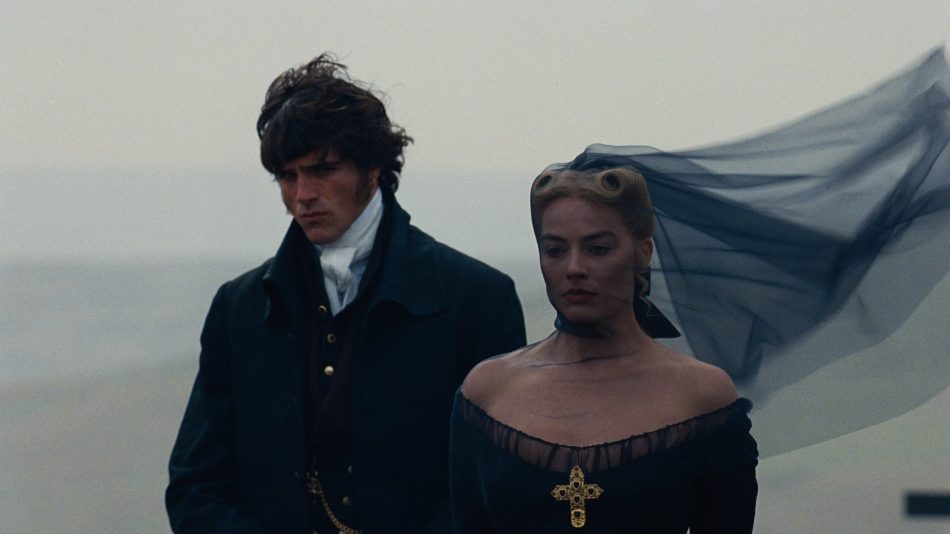
For her third feature film, oft-discussed director Emerald Fennell tackles Emily Brontë’s classic novel Wuthering Heights. As has been done in past adaptations of the novel, it focuses entirely on the first generation of characters, excising some of the racial and generational themes. In their place, Fennell centers on the toxic and obsessive romance between Catherine (Margot Robbie) and Heathcliff (Jacob Elordi) as well as the class commentary, making her take on Wuthering Heights a perfect fit in her filmography. Having read the novel, I admit it would be unfair to expect the film adaptation to match Brontë’s work. Film and novels are simply different mediums, while Fennell has never come out and claimed that this would be a faithful re-telling of the story. It is, as Fennell said, “a version” of the story, as much an adaptation as it is simply inspired by the novel. However, Fennell’s Wuthering Heights fails not because it is unfaithful to Brontë, but because it lacks a heart and soul. It is all visual panache without anything beneath the surface.
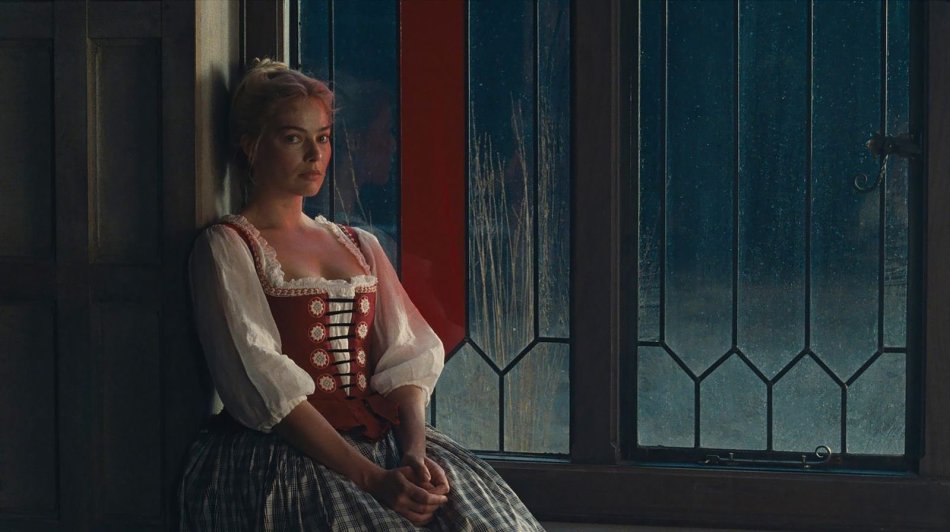
Wuthering Heights feels like a pop version of the story. The prime example is in its climax. Spoilers for those unfamiliar, but this is a tragedy at its heart. It is about two star-crossed lovers who simply cannot be together fully, whether for class, personal, wealth, or social reasons, and the considerable longing for one another that often goes unfulfilled in life. One of the most heartwrenching lines in Wuthering Heights comes as Heathcliff begs Catherine, “You said I killed you – haunt me, then! The murdered do haunt their murderers, I believe. I know that ghosts have wandered on earth. Be with me always – take any form – drive me mad!” This monologue is delivered by Elordi in Wuthering Heights, but given a muddle-mouthed delivery while Fennell and composer Anthony Willis have a blaring score increasing in volume as he delivers it. One can hardly hear him and at such a crucial juncture in Wuthering Heights, in such a vulnerable and intimate moment, it renders the moment emotionally inert. It tips its hands in this sense. It is not about the emotion. It is about the vibes. It is about the flair. It is about the lavish lifestyle and production design. Catherine and Heathcliff are just adornments in a highlight reel version of Wuthering Heights.
To have longing in a film, there must be some authentic feeling and genuine absence, but Fennell never gives either time to breathe. Wuthering Heights is consistently rushed, abbreviated, and undercooked. A key sequence in their arc comes as Catherine opts to marry Edgar Linton (Shazad Latif) because he asked and is wealthy. Heathcliff overhears her talking to her servant Nelly (Hong Chau) about it and hears Catherine say that it would “disgrace” her to marry Heathcliff (though he does not hear her add that, in spite of that, she “loves him”). Heathcliff responds by leaving for many years. In that time, Catherine marries and assimilates to life at Thrushcross Grange with Edgar and his sister Isabella (Alison Oliver). Fennell turns this time into a quick montage, flipping through years and lavish celebrations with gaudy costume and production design – at all times, Fennell juxtaposes the wealthy and bright Thrushcross Grange and the shallow-ceilinged, dark, and grimy Wuthering Heights where Catherine’s father (Martin Clunes) lives – with the score and soundtrack humming in the background. After this relatively brief moment, Heathcliff is back and his obsessive and destructive love with Catherine can continue. Though their reunion is brilliant due to cinematographer Linus Sandgren’s masterful use of the fog on the moors between the Thrushcross Grange and Wuthering Heights residences, the passage of time has been so brief that any of the underlying longing and yearning is left empty and flat.
This is felt throughout their romance. As much as Fennell is obsessed with the sweat, the sultriness, and the gooey nature of their love – she and Sandgren really click here with plentiful extreme close-ups of backs, beads of sweat, oddly sensual dough, and suggestive cracked eggs – by the time that Catherine and Heathcliff exchange their sweet-nothing’s and their forbidden passions, it feels too undercooked. Its romance is more often communicated than genuinely felt, using the most romantic lines from the novel as a crutch to pay the balance for its lack of genuine on-screen romantic fire. Elordi and Robbie’s chemistry is lacking, despite their respective talent as actors. Their performances both feel too distant and disconnected, far too performative as they struggle to bring passion and feeling to the most emotionally fraught lines in Wuthering Heights. As Fennell rushes through the years, trims Catherine and Heathcliff’s romance to the basic essentials, and tries to build sensuality through just sweat and bodily substances, Wuthering Heights longs for a genuine connection. It is empty and flat, fizzling out over the course of the film with even its sex scenes spliced into another fast montage devoid of the titillating appeal they need to deliver on some of the scandalous and sexy material that Wuthering Heights has promised.
Wuthering Heights lacks much of the soul found in Brontë’s novel. The moors are a character all their own in the novel, yet feel just as vapid and distant as the characters in this version. As Heathcliff seeks revenge on Catherine by romancing Isabella, even that too lacks the same feeling. Instead, Fennell takes the themes of spousal abuse and revenge in Heathcliff and Isabella’s marriage and turns it into tiring provocation. There is nothing underpinning her here, just a chance to be emptily kinky and degrading. The cuts and alterations from the novel mostly make sense in terms of streamlining it for the film, but in this version, what remains cannot stand alone. It lacks the dramatic heft and narrative building that makes Wuthering Heights such a shocking and bewitching novel, something that Fennell never quite captures in her pursuit of style instead of substance.
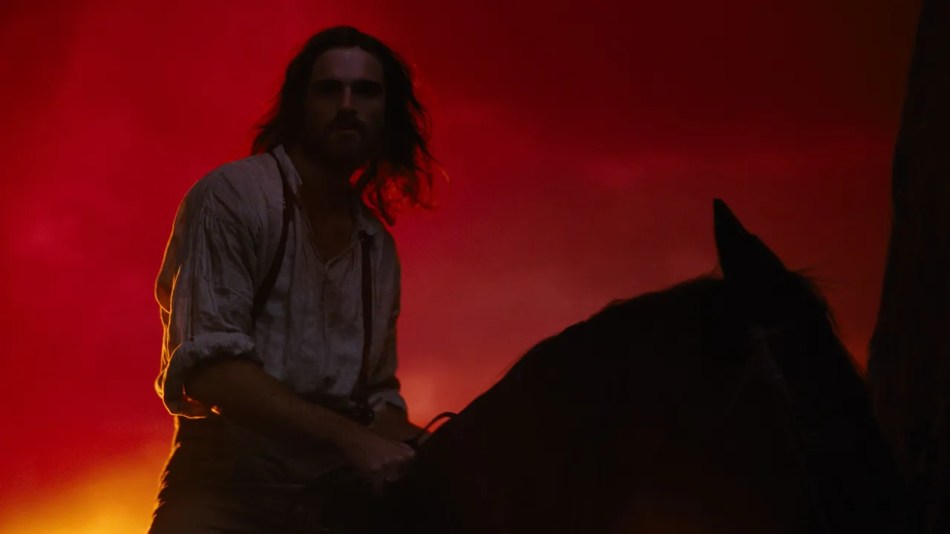
It is a stylish film, to be fair. The cinematography and lavish production design are the main draws. It has a dream-like quality to it at times, taking in the bodies, the looming Wuthering Heights, and the sprawling Thrushcross Grange. It is very in-tune with what Fennell wants to capture stylistically, a marvelously staged and often remarkably beautiful film. A scene of Heathcliff riding up to the hillside, backed by the red and striking sky, is the kind of otherworldly beauty that Wuthering Heights is capable of, while Sandgren’s framing and lighting is consistently remarkable. As with Saltburn, his work is unimpeachable and his collaborations with Fennell demonstrate the artistic chemistry they share with one another. However, in taking Wuthering Heights, the story of Catherine and Heathcliff, and turning it into a pop version of itself, it is largely devoid of emotion, too rushed and dramatically inert to click, and even its most sensual and provocative bits fall flat without the necessary feeling beneath them. Wuthering Heights looks brilliant and one wants to fall head-over-heels for what Fennell has constructed, but it lacks heart and soul.
Discover more from Cineccentric
Subscribe to get the latest posts sent to your email.
 Cineccentric
0 comments on “Wuthering Heights ★½”