
Let’s catch up with the Competition, shall we? When I wrote about Rosebush Pruning I mentioned that a lot of the festival’s early films seemed to be playing it a little safe. But that’s not to say they weren’t good movies. Three of the earliest Competition screenings were Yellow Letters, In a Whisper, and Rose – all of which are well-made and emotionally affecting films that comment on relevant issues in contemporary society.
Yellow Letters (Glebe Briefe) is the latest from German-Turkish director İlker Çatak (The Teacher’s Lounge) and it couldn’t be a more timely film as it depicts the deep, personal damage that happens when authoritarian governments silence dissent and criticism. The story follows a Turkish family made up by the actress Derya (Özgü Namal), her husband the playwright and university professor Aziz (Tansu Biçer), and their teenage daughter Ezgi (Leyla Smyrna Cabas). After Derya and Aziz’s latest play, Derya snubs a photo-op with the mayor. If that weren’t bad enough, Aziz then encourages some of his students to take part in a protest. Before you know it, Aziz has been suspended and Derya has lost her position at the national theater – the title of the film coming from the color of the letters that people like Aziz and Derya receive from the government.
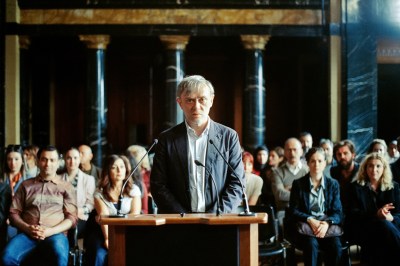
While Çatak’s film is inspired by stories he’s heard from friends in Turkey, it feels especially relevant to the current situation in the US, where national art institutions and universities are under pressure to toe the government’s ideological line. It’s eerie to see benign pro-democracy social media messages used against the family, and when Aziz tries to contest his suspension in court, the outcome is essentially predetermined.
There’s good drama in the family’s efforts to work the system and do what they can to fight the charges, but the real story is about the effect all of this pressure has on their relationships with one another. At the start, Derya and Aziz are an ideal couple, equal partners, with nothing but love and support for one another. By the end, it’s an open question as to whether they’ll ever get back to that dynamic. Aziz has been forced to take a job as a taxi driver, while he works to put on an independent theater production that doubles-down on his critique of the nation’s oppressive government. His relationship with his daughter has evaporated and his partnership with Derya threatens to do likewise when she wants to take a job on a state TV soap opera.
The debate around selling out seems to be coming back to the forefront these days. After a couple of decades where it was considered the quaint concern of previous generations, Yellow Letters manages to raise solid arguments on both sides. Which is more important, paving the way for your child’s comfortable future, or being a good role model and upholding the virtues that you want them to live by? But what Çatak is underlining is how shameful it is when society forces you to decide and refuses to let you have it both ways.
It’s not a perfect movie. The third act gets bogged down in some unconvincing drama involving the teenage daughter, but it does land as an extremely timely and keenly observed study on the very personal effects of authoritarianism. Interestingly enough, since there’s little chance Çatak could shoot this movie in Turkey he has Berlin stand in for the Turkish city of Ankara, and Hamburg stand in for Istanbul. Rather than try to hide it, the movie announces it and the distinction becomes part of the movie’s visual text in an unusual and effective way.
Speaking of politics… There was a pretty big hubbub early on in the festival when the jury for the Competition prizes sat down for a press conference. No one on the panel seemed prepared for a reporter to ask the group about the German government’s position as it pertains to Israel and Gaza. Since the Berlinale festival relies upon government funding and government officials have often misconstrued anti-Israeli sentiment as antisemitism, which is a punishable offense, jury president Wim Wenders put on a graceless dance in trying to answer, or not answer, the question. Wenders tripped over himself in trying to delineate between political films versus personal films. He said, “We have to stay out of politics because if we make movies that are dedicatedly political, we enter the field of politics… But we are the counterweight of politics, we are the opposite of politics. We have to do the work of people, not the work of politicians.” He went on to say that the news and politics aren’t compassionate and empathetic, but movies are.
One festival guest, the Indian author Arudhati Roy, saw Wenders’s comments as saying that filmmakers shouldn’t be political, which was outrageous enough for her to decline her invitation to the festival. And maybe I’m being too sympathetic to one of my favorite filmmakers, but I interpret Wenders’s remarks differently. After all, he’s previously said that all films are political, so it’s not hard to read his fumbling words as saying that filmmakers need to stay away from propaganda and artless rhetoric.
No one in their right mind would say that Berlinale movies aren’t political – in fact, that’s kind of what the festival is known for. But, like Yellow Letters, they’re often political by way of the personal. Their emphasis on the human experience is what makes them moving and separates them from being didactic, which is what I think Wenders was trying to steer the press conference away from.
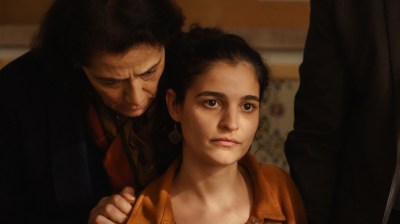
The early Competition screening In a Whisper (À voix basse), is another perfect example. Here we have a movie, from Tunisian director Leyla Bouzid, about the illegality and persecution of gay men in Morocco. But the absurdity of the law is addressed through the story of a Muslim family who are struggling to cope with the death of the matriarch’s closeted gay son. But all is revealed when family member Lilia (Eya Bouteraa) comes home for the funeral, bringing her French girlfriend along for the ride. It’s a very sweet, heartwarming movie – the kind of movie about gay issues that you could comfortably watch with your parents. It’s so well-intentioned and heartfelt that I couldn’t knock it even when it served up one of the corniest, sappiest lesbian love scenes you could ever imagine.
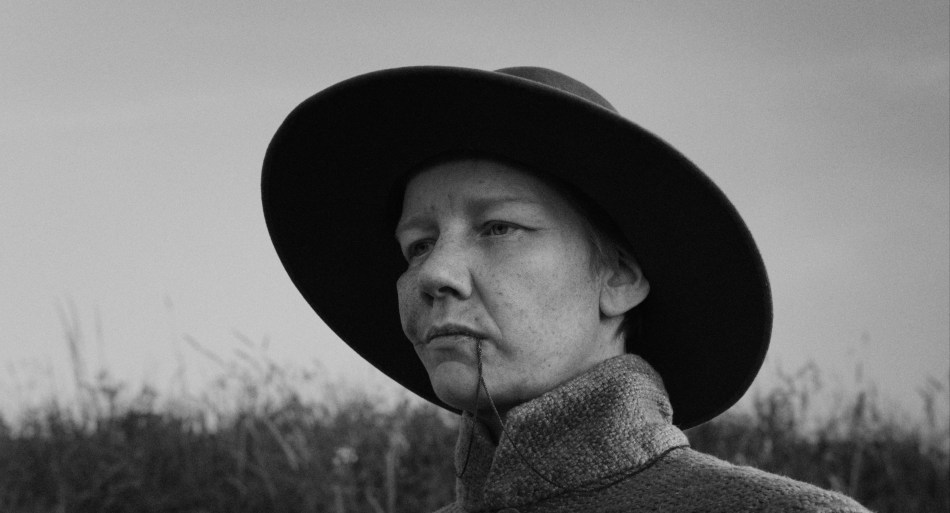
A much better film with an almost sneakily good LGBTQ+ message is Rose, the striking black-and-white film from the Austrian actor and director Markus Schleinzer. It stars the always reliable Sandra Hüller as Rose, someone who’s passed as a man for much of her life. She’s fought in battles as a soldier and has the scars to prove it, and is now taking the identity of a recently deceased friend who is returning to his family’s farm. She’s carrying the appropriate papers, validating the claim on the property, but complications ensue when she’s pressured into an arranged marriage with Suzanna (Caro Braun, a real scene-stealer), the daughter of a major landowner in the community. Once the marriage is “consummated” and Suzanna turns out to be pregnant, the only question is how long before the truth comes out and how bad is it going to end up being. The tonal shifts that happen in Rose are a marvel. A lot of the business surrounding the marriage is quite funny, right up until the moment it’s not, and things turn dark. Schleinzer proved adept at bringing the story to life in unexpected ways.
I knew the premise going in, but what I didn’t expect was for Rose to turn out to be a pretty powerful movie about trans rights. Hüller gets a couple showtopping monologues in the film, one of them coming shortly after she’s accused of being a woman. She stands in the doorway to her house, dressed in her trousers and frock coat, asking her accusers, so what? Why do you care so much about what’s between my legs? Am I not an upstanding member of this community – earning money, employing people, teaching you to read and write – isn’t that enough? Whether or not Rose is really based on a true story from the seventeenth century is hardly important. It’s chillingly effective, vital filmmaking. The personal is always political.
Discover more from Cineccentric
Subscribe to get the latest posts sent to your email.
 Cineccentric
0 comments on “Berlinale 2026: Yellow Letters, In a Whisper, Rose”