
There was a general impression that Wim Wenders, head of the 2026 Berlinale International Jury, had some explaining to do. As I mentioned in a previous dispatch, his remarks about the intersection of politics and cinema had loomed large over the entire festival. It gave this year’s award ceremony an unusual amount of anticipation. You knew that the 80-year-old German auteur had to make an attempt to elaborate on his statement or otherwise redirect the unflattering narrative that had taken hold.
But, given the way the Berlinale award ceremony is structured, where Wenders and the Jury wouldn’t be introduced until the final section of the ceremony, when the big awards are handed out, there’d be plenty of time for the early winners to clarify what everyone (including Wenders) already knew: that all of these films are, in one way or another, political.
It began with one of the first awards handed out, the Golden Bear for Best Short Film, which went to Marie-Rose Osta and her film Someday a Child (Yawman ma walad), about a Lebanese boy with the kind of supernatural powers that allows him to remove Israeli military jets from the skies above his home.
One of the highlights of the night came right afterward, when Abdallah Alkhatib won the Best First Feature award for his film Chronicles From the Siege. The Palestinian-Syrian filmmaker, who currently lives and studies in Germany, gave an impassioned speech while his producing partner stood next to him holding up the Palestinian flag. When Alkhatib spoke about a future where Palestine would have its own international film festival held in Gaza, it was like a pressure valve going off. The audience was activated, and the host for the evening, Désirée Nosbusch, did an admirable, and unenviable, job calming people down so that they could continue the ceremony.
At certain points, following the acceptance speeches, Nosbusch was visibly overwhelmed, holding back tears. In my seven years covering the Berlinale, I’ve never seen an awards show so emotionally charged. When festival director Tricia Tuttle finally made her way to the stage at the end, even she seemed beside herself, calling for people to be less reactionary and claiming Berlinale as a safe space where voices are heard and dialog encouraged, refuting the online accusations that the festival was censoring people.
As for Wenders, when the jury was brought on stage, he opened up a notebook and read a long and winding statement that acted more like an anesthetic than a clear and understandable clarification of his principles. But as the final round of awards were handed out, the point was made: Wenders is drawing a line between being political and being a humanitarian. To paraphrase Roger Ebert, cinema is a machine of empathy, and Wenders sees the subjects of “human dignity and protection of human rights” as the unpolitical “language of cinema.” So, if anything, you could accuse Wenders of being slightly naive, because the sad truth is that in the world at large advocating for the oppressed and basic human rights is very much the stuff of politics, whether you want it to be or not.
But it wasn’t all tensely charged drama. One of the early winners of the night, for the Berlinale Documentary Award, was my favorite movie of the fest, If Pigeons Turned to Gold, by Pepa Lubojacki. In a moment that reduced me to a blubbering mess, Lubojacki told the audience that the €40,000 that comes with the award would go to keeping her brother David, the main subject of the documentary, housed for the next couple years. God bless you, Pepa.
The big International Jury awards started with another choice that I completely supported, with the Silver Bear for Outstanding Artistic Contribution going to Yo (Love is a Rebellious Bird), by the wife and husband team of Anna Fitch and Banker White. The only reason I haven’t showered this movie with praise yet is because it was the last Competition movie screened on Friday morning.
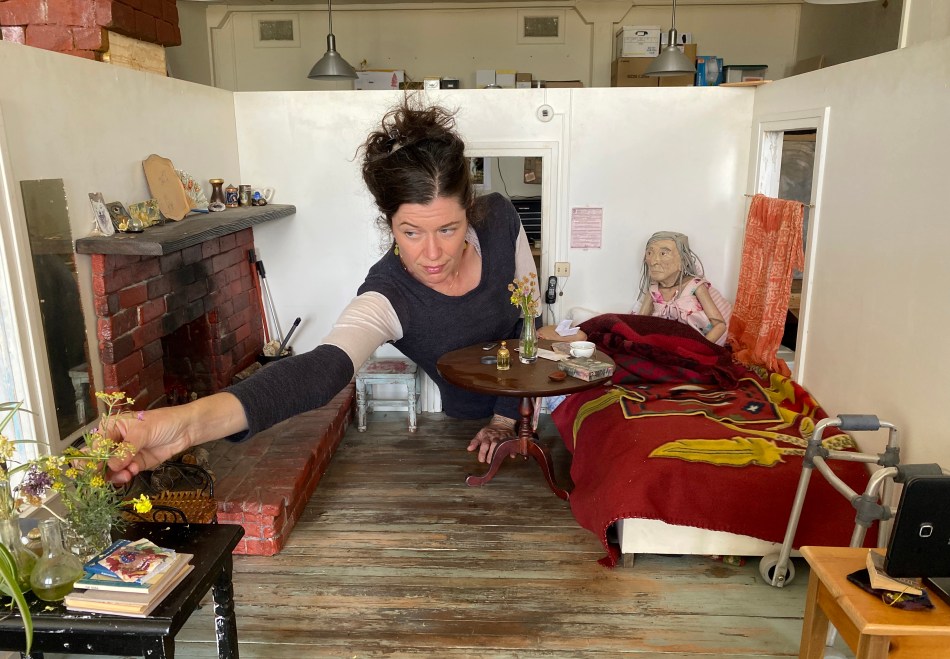
Much like If Pigeons Turned to Gold, Yo is a beautifully creative movie that finds clever, unexpected, cinematic ways of injecting life into the documentary format, which is often bogged down with talking heads, archival material, and perfunctory camerawork. Fitch and White use elaborate scale models, puppets, and all manner of old-school, analog, forced-perspective camera trickery to bring the story of Yolanda Shea to life. Given Fitch’s background as an entomologist, sometimes the reenactments even involve caterpillars and other creepy-crawlies.
Yolanda, better known as Yo to her friends, was born in the cultural crossroads of Switzerland in the 1920s. She was a rebellious kid – not afraid to tell the priest in the confessional booth to go to hell with his inappropriate questions – and she eventually found her way to the idyllic coast of Northern California, where she settled, down, got married, had kids, but let it all go after a particularly potent hippie-era LSD trip.
Yo may not sound like your typical documentary subject, but that works in the movie’s favor. Fitch met Yo at a flea market and the two became fast friends, despite the fact that Yo was about fifty years older than her. When her elderly friend started getting sick, Fitch brought in the camera and began recording her stories. Sure, Yo is a pot-smoking grandma who’s completely open and has made peace with the few regrets in her life. But in a way she’s also just the kind of old lady that could be living in your neighborhood. This movie is proof that life-changing friendships and remarkable stories are just around the corner, and that doesn’t make them any less powerful or special.
The filmmakers’ love for Yo is palpable in every frame of the movie, which exists as a sort of art therapy tool. As her narration tells us, making this movie helped Fitch come to terms with losing one of her best friends, just as it helps her to keep Yo alive (the immortality of cinema!) and share her with others. I’m glad she did. It’s a funny, unique, and heartwarming film that made for a perfect ending to the festival. I cried a lot at this Berlinale, but the tears for Yo were indeed of the therapeutic variety.
As for the other winners of the night, almost all of them have been covered in past dispatches. The screenplay award went to Nina Roza. The supporting actor award went to Anna Calder-Marshall and Tom Courtenay of Queen at Sea. In the least surprising move, the best actor award went to Sandra Hüller for Rose. And Grant Gee gave the most humorous and self-deprecating speech in accepting the Silver Bear for Best Director for Everybody Digs Bill Evans. While the Golden Bear went to Yellow Letters, which one could argue was both predictable and a somewhat surprisingly safe choice.
The only big winner we didn’t already touch upon is the Silver Bear Grand Jury Prize. And this year’s runner up was Salvation (Kurtuluş) by Emin Alper. Salvation got a very mixed response at the fest, but even its detractors had to admit that Alper made a beautiful looking film. The divisive issue was the movie’s allegorical nature, of two neighboring clans fighting each other even though their problems are shared and their fears are the same, and whether or not it was too on-the-nose. But as this festival saw people in the film industry turning on one another for very questionable reasons, maybe Salvation was the perfect film to honor.
Overall, this year’s Berlinale was a fairly strong edition. As my Letterboxd list will attest, very few movies fell below the three star mark (you can chalk some of that appreciation up to the festival bump, which has a way of adding at least a half-star to everything). But as happens at the end of every Berlinale, I now feel the need to sleep for a few days straight and maybe watch a couple of trashy Hollywood movies in order to restore my intake equilibrium. Until next year…
Discover more from Cineccentric
Subscribe to get the latest posts sent to your email.
 Cineccentric
0 comments on “Berlinale 2026: Awards and Wrap-up”