
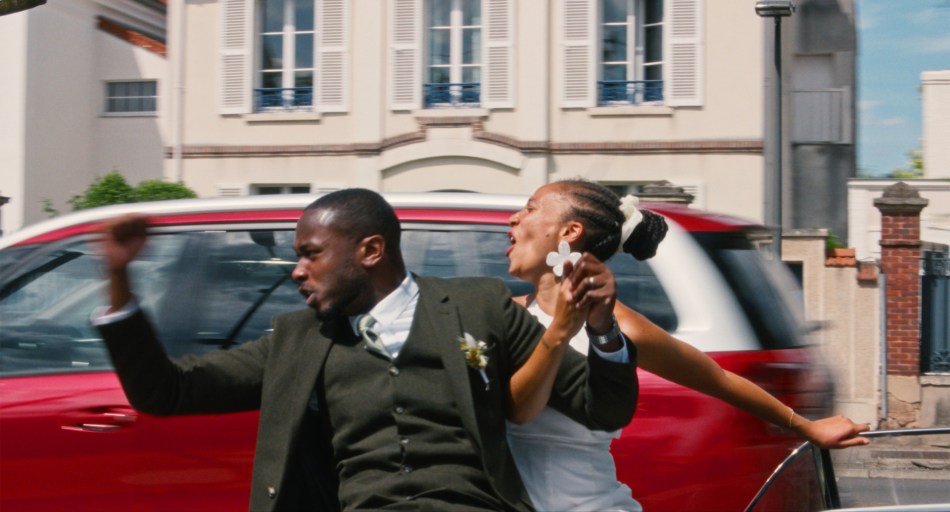
With his third Berlinale competition feature after 2012’s Aujourd’hui and Félicité in 2017, Alain Gomis reaffirms himself as one of contemporary cinema’s formative chroniclers of cultural identity and heritage. Anchored in a ritualistic narrative structure and spanning 185 minutes, his essayistic epic is an ambitious hybrid of ethnographic tapestry and family saga that both invigorates and, at times, overwhelms. Before the events unfold, starting not with the first fictional scene but the casting and character-building process, an on-screen text explains the title as “a perpetual and circular movement which flows in everything and unites the world.” This dynamic becomes a metaphor for the elliptical meditation on community, (re-)connection, and the liminal space between personality and performance.
The French-Senegalese director allows his female cast to find their own characters in his sprawling story, loosely evolving around two celebrations: a memorial and a wedding. Exploring the diasporic identity and cultural roots of several French Bissau-Guinean women, the constantly shifting narrative follows them to the land of their ancestors and back to France, juxtaposing and interconnecting the two fragments of their existence. Second-generation immigrant Katy Correa lends aspects of her own life to her character, Gloria, who travels to her father’s village in rural Guinea-Bissau to attend his memorial and put his spirit to rest. Accompanying her is her daughter Nour (D’Johé Kouadio), who has never before seen her family’s homeland.
There is an astounding maternal tenderness in their intuitive rapport and what look like real tears, as Nour/D’Johé approaches the village where melancholic memories and old tensions linger. These microaggressions and unresolved conflicts also emerge in the scenario’s second half, celebrating Nour’s lavish wedding in the Parisian suburbs. Mourning and joy emerge as conjugated states of being, each of which contains aspects of the other. The narrative’s cyclical movement serves as both a structural and thematic overture, rich in sensory detail and careful observation. Their pairing underlines the overarching motive of performative social action where actual feelings are artificially heightened. Memory, loss, and belonging are enacted collectively, even as the characters struggle to reconcile identities fragmented by migration and generational rupture.
Collapsing diegetic norms, scenes from the Paris wedding intercut with sequences of preparation for the ancestral rites in Guinea-Bissau, eroding conventional dramatic boundaries. While this kinetic approach is fascinating, it is also disorienting, at times even for the actors. Mobile and intimate, the camera tracks faces in moments of happiness and sorrow, occasionally catching glimpses of confusion. Dao reiterates itself like a mantra, insisting that time is nonlinear and that memory itself is ritualistic. The freewheeling tale’s formal rigor and exhaustive length also turn it into a test of patience. Though confrontations and emotional strain are palpable, there is no typical plot to anchor them. A lack of dramatic propulsion and deliberate pacing bring the naturalistic visuals closer to a cinematic installation.
As such, the contemplative study of communal gestures and cultural customs is equally immersive and opaque; a genre- and definition-defying testament that prioritizes intuition over cinematic convenience.
Discover more from Cineccentric
Subscribe to get the latest posts sent to your email.
 Cineccentric
0 comments on “Dao ★★★½”