
Concluding his “Growing Up” trilogy that began in 2013 with Ilo Ilo and continued with 2019’s Wet Season, Anthony Chen makes his mark at the Berlinale by bringing the first Singaporean feature film into Competition. However, with its melodramatic masculine imagery and superficial exploration of intergenerational ties, the overlong tale of emotional estrangement and economic aspiration never lives up to its lofty ambitions in heart and scale. Despite its gratuitous length of more than two and a half hours, the episodic story crucially lacks depth, both on a psychological and social-analytical level. This absence of emotional and critical resonance is partly due to the aimless narrative’s maladjusted focus on the least interesting of the four central characters.
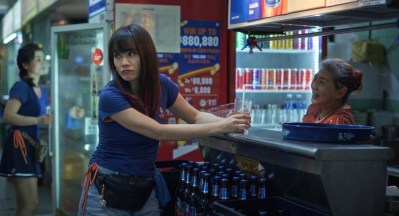
Aimless 21-year-old Junyang (Koh Jia Ler) has just finished his military service – strictly mandatory for Singapore’s male citizens – and looks for a shortcut to material success, silently resenting the monotonous hard work of his widowed father Boon Kiat (a strong performance by Andi Lim). Despite his declining health, he can’t afford to retire, toiling daily at his little noodle stand in a dingy food mall. His only consolation is sneaking longing glimpses at sassy beer waitress Bee Hwa (Yeo Yann Yann). She is stuck in a socio-economic dead-end of her own, being merely tolerated at her younger brother’s place where she camps in her little nephew’s room after the last of likely many useless boyfriends ran off with her savings.
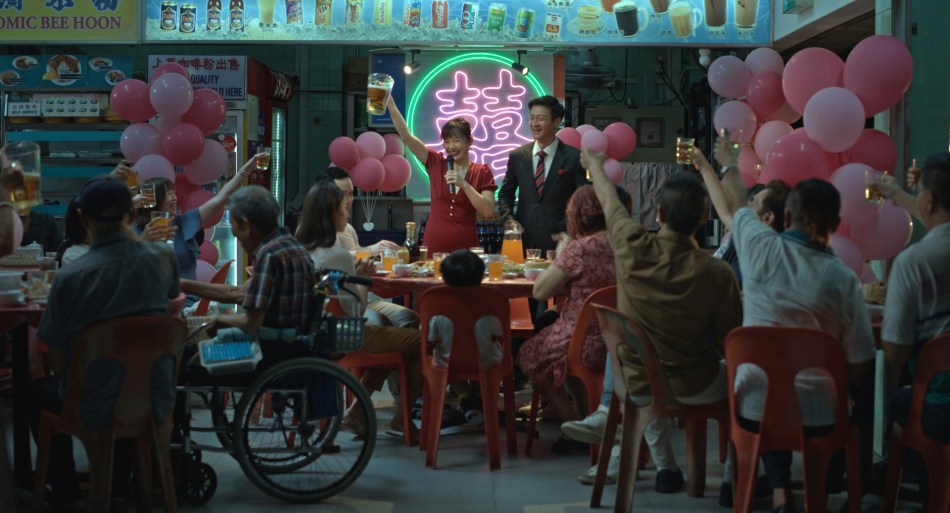
Irrevocably aging out of her job where youthful looks drive beer sales and her younger colleagues collect higher tips, she accepts Boon Kiat’s marriage proposal because she’s run out of options. The middle-aged couple stands in for an older generation, most of whom never had a chance to pursue their dreams. When they finally marry, the modest event in the food hall stands in stark contrast to Junyang’s flashy wedding. Unaware that his father got into debt to pay for it, he is more concerned with his own perceived loss of freedom than the ruined future of his pregnant teenage girlfriend Lydia (Regene Lim). As her affluent family disowns her, she loses basically everything.
Writer-director Chen, however, couldn’t care less about a young girl giving up her social status, university education, physical wellbeing, and prospects as a concert pianist to become a stay-at-home mom. The episode is characteristic of the psychological, dramatic, and stylistic missteps dragging the convoluted storyline down to soapy moralism. Junyang and Lydia’s young love is framed to pop songs as a series of Instagram shots and is so uptight that Lydia’s pregnancy seems irrational. Her decision to have the baby seems a given, as banal as picking a dress, relevant solely in its effect on Junyang. Chen doesn’t waste a single shot on any struggle Lydia might have. This callous chauvinist pattern repeats itself when Bee Hwa’s fate takes a devastating turn.
Once again Junyang isn’t to blame, but gets the dramatical treatment of being the actual victim, because he feels slightly bad about it and has to look for a real job. The two hours between these incisive events show the ups and downs in the life of the five-person family living together in Boon Kiat’s three-room government flat. An authentic look into the working-class reality of a nation boasting its economic prosperity and targeting impoverished individuals with its Destitute Persons Act, would have been both relevant and engaging. But the scenario where poverty is verbally professed, but never palpable seems the opposite of that. Struggle, personal and financial, appears mostly self-induced by laziness, lust, and levity.
There is some great acting, especially from Yeo Yann Yann who turns Bee Hwa from a caricature into a complex figure, and microscopic traces of a systemic critic. Singapore loves rich people, observes a disillusioned Bee Hwa. But this is true for any capitalist country (and communist, too). Stereotypical generational conflicts can’t make up for the lack of character development while Boon Kiat is reduced to a pitiful outline and Lydia functions mostly as a narrative instrument. Even Junyang remains one-dimensional and the obstacles he faces tend to feel contrived. Just work hard, obey your parents and stay in your social class preaches the conformist construction, never allowing the facade of sunny, globalized modernity to crack.
Discover more from Cineccentric
Subscribe to get the latest posts sent to your email.
 Cineccentric
0 comments on “We Are All Strangers ★★”