
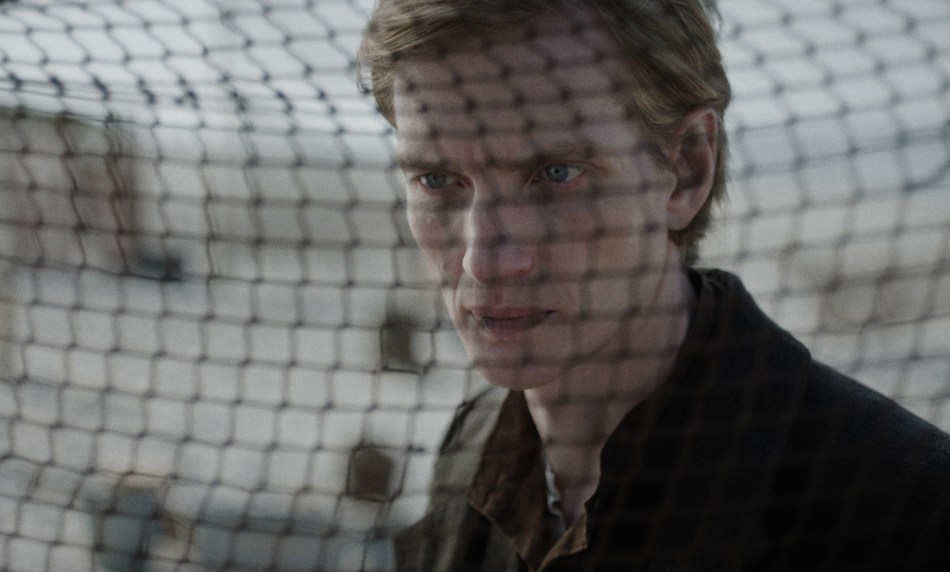
There is a strange stage-like quality to Kai Stänicke‘s first feature Trial of Hein, premiering in the 76th Berlinale’s Perspectives section reserved for cinematic debuts, one that is so uniform it suggests the historical drama might be based on a theater play. While the allegorical tale of young Hein (Paul Boche) returning after years on the mainland to his remote home village on a tiny island, where nobody seems to recognize him, has no direct source material, strangeness lies at its core. The original German title means literally “The Homeless,” building its minimalist plot upon themes of alienation, collective denial, and illusionary idealization.
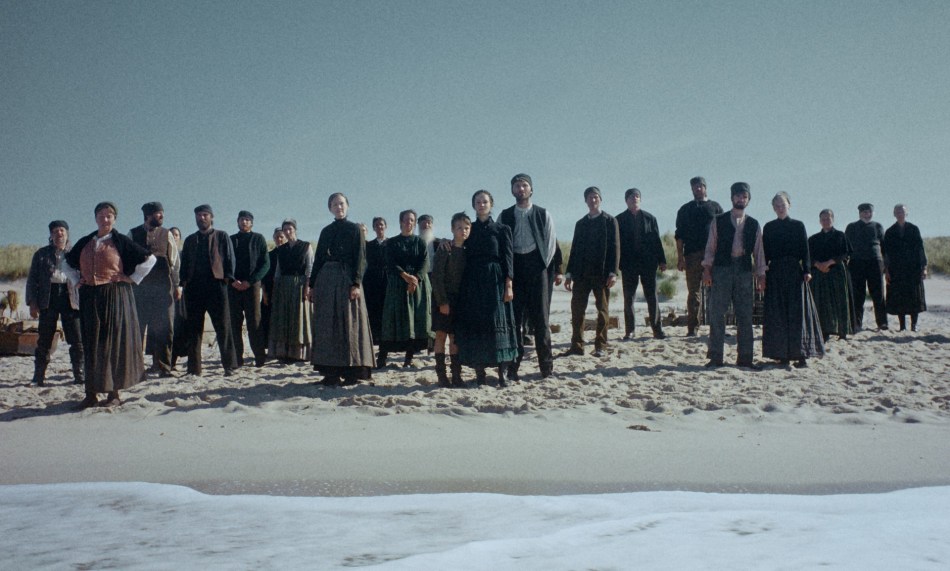
After 14 years spent on the mainland, shunned and scorned by the inhabitants of the unnamed North Sea island where the scenario unfolds, Hein returns to the small fishing community. Instead of giving him a warm welcome—as it soon turns out, not only is the weather cold in this scenic place—the islanders meet the young protagonist with confusion and mistrust. Though they admit that Hein left when only a teenager, they don’t recognize him as the person in his mid-thirties standing before them. Even his alleged childhood friends Friedemann (Philip Froissant) and Greta (Emilia Schüle) appear unconvinced of his identity.
Then again, why should anyone come to this sparse and distant place and claim to be a plain boy from an undistinguished fisher family? A village court is convened to determine whether Hein is truly who he claims. The absurd but enticing setup becomes a showcase of contrasting memories. Alternating, Hein and members from the community describe crucial events from Hein’s youth. While the villagers remember proud initiation rituals and a dignified burial of Hein’s father, he remembers humiliating public failure and lonely grieving. These contradictions underline the combination of a straightforward realism in costumes, performances, and interactions with half-open scenery buildings.
Half life-sized dollhouses, half theater set, these fragmented constructions with minimal props emphasize the performative aspects of both the courtroom procedural and daily life. Though this aesthetic risk adequately translates the mutual feelings of estrangement and contorted reality, it also overstrains the narrative’s already ostentatious message. Emotional depth is scarce, given the characters’ conceptualized nature. Everyone here is less an individual than a personification of social and institutional forces. Despite Boche’s serious acting, Hein himself is little more than a stand-in for the kind of person likely to feel pushed into social roles.
The subject of an unrecognized homecomer itself is a classical yarn, told in countless variations from ancient myths and fairy tales to modern novels. Stänicke positions his puzzling film fable dramatically and visually between these two opposites. The elaborate staging masks the shallow exploration of the key themes of warped memories, self-deception, and group psychosis. Similar situations play out again and again, retelling things which are already plain to see. In contrast, the islanders’ individual motives like peer pressure, rigid tradition, and desire remain largely obscure. Hein’s past is teased through testimonies and flashbacks, but these fragments rarely coalesce into a fully realized inner life, leaving his personality vague.
Underdeveloped peripheral roles reinforce the sense that the community functions mainly as a narrative mechanism. Cinematographer Florian Mag‘s bleak images of windswept dunes and uninviting houses evoke an atmosphere of loneliness and unease. This aura of emotional distance is all too fitting for an ambitious, though incomplete meditation on how societies construct truth and dismantle it.
Discover more from Cineccentric
Subscribe to get the latest posts sent to your email.
 Cineccentric
0 comments on “Trial of Hein ★★½”