
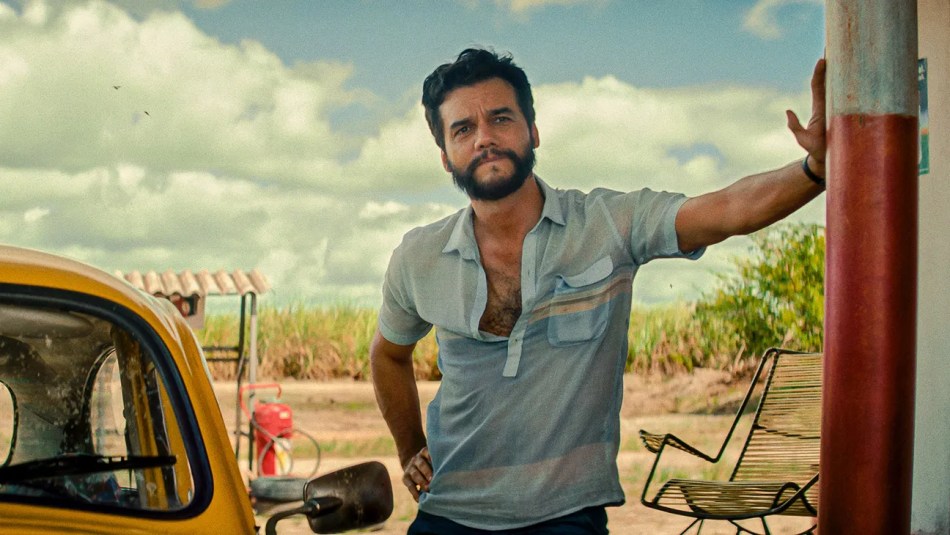
The Secret Agent is a time machine transporting viewers to 1977 Brazil. The sights, sounds, and feeling, all come to life in director Kleber Mendonça Filho’s sprawling neo-noir political thriller. It follows Armando (Wagner Moura), who was a university professor before drawing the ire of the authoritarian Brazilian government. As the film begins, he is traveling to Recife where his son Fernando (Enzo Nunes) is living with Armando’s in-laws, including his father-in-law Alexandre (Carlos Francisco). Though it is risky, he wants to be with his son. He will be living in a refuge run by an old Italian anarcho-communist named Dona Sebastiana (Tânia Maria), all while trying to live his life in the shadows. He is a man on the run with a death warrant on his head, and he is being hunted by the corrupt corporations, politicians, and police chiefs who hold considerable influence with the military dictatorship. Filho’s The Secret Agent is a magical cinematic experience, but also an urgent and powerful story.
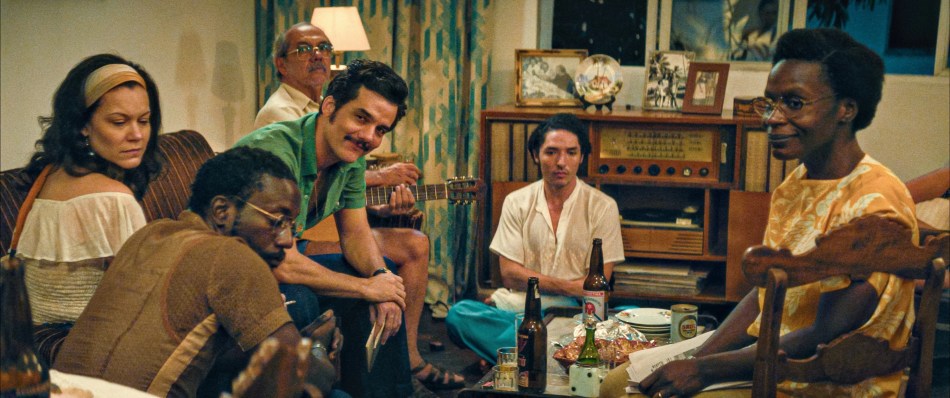
The Secret Agent is an ambitious work with Filho’s control of this vast array of material always impressive. It is not just a film about Armando’s attempts to reunite with his son and to leave the country, but one that tries to paint a larger picture of Brazil in 1977, then tying that into the present. Filho, like his influence Robert Altman in films like Nashville, introduces a variety of characters, taking the time to develop each separately, building them and their role in the film before finally bringing them into conflict and contact with one another in the climax. The theme of corruption and living under the thumb of such a political system are constant in each facet of The Secret Agent with Armando’s introduction coming as he is asked to pay a bribe to the local police, offering up his cigarettes because he has no money on hand. In Recife, there is police chief Euclides (Robério Diógenes) who runs the city like a Martin Scorsese-esque gangster with his men causing trouble all over town, all while doing so under the banner of a police car. A later and surreal sequence – that feels like something from a Luis Buñuel film – about the exploits of a hairy leg (used as a cover story in the newspaper of police corruption) captures the attention of the populace while also exemplifying the lengths the police will go to cover their trail.
Elsewhere, Filho follows businessman Henrique Ghirotti (Luciano Chirolli) who runs an influential company and uses that influence for his own gain. It is also Ghirotti who will later issue the death warrant on Armando. There are many reasons why, intrinsically tied to Brazilian identity and culture with the gap between the Northerner Armando and Southerner Ghirotti, the socioeconomic gap, and simple masculine insecurity and pride, all serving to draw the ire of Ghirotti and his influence in the Brazilian government on Armando. The hit men that Ghirotti hires, Augusto (Roney Villela) and Bobbi (Gabriel Leone), make up their own portion of The Secret Agent. An ex-soldier living on the fringes of society, Augusto is Bobbi’s stepfather and the two men further exemplify the moral rot that has taken hold in the forces entrusted with Brazil’s protection and future.
The Secret Agent offers great production design and costume design that brings to life the look and feeling of the era, while also using the cinematic language of the 70s to make it feel like a film from that era. It is a mechanism that allows the film to feel like an echo as if it were a lost film from 1977 Brazil that offers a warning and message for today. In addition to the aforementioned Altman and Scorsese, Filho has further referenced Brian De Palma and Steven Spielberg as influences, which are felt in the cinematography, editing, score, and mood. De Palma’s fingerprints are all over the suspense in The Secret Agent with plenty of Hitchcockian influence as well in this “man on the run” narrative. Cinematographer Evgenia Alexandrova, and editors Eduardo Serrano and Matheus Farias brilliantly utilize many of De Palma’s favorite cinematic flourishes: the split-screen, elaborate tracking shots, and split diopters. De Palma’s Blow Out feels like a vital touchpoint for The Secret Agent, especially in regards to how Filho expands the narrative from 1977 to 2025, showcasing young university students, including Flavia (Laura Lufési), listening to old recordings of Armando and the dissident network that he interacted with under the leadership of revolutionary “Elza” (Maria Fernanda Cândido).
Spielberg’s impeccable use of music in Jaws (which plays a key role in The Secret Agent) and Close Encounters of the Third Kind carries a heavy influence with Tomaz Alves Souza and Mateus Alves’s score perfectly utilized in building suspense and tension, especially in the climax. As heavy as The Secret Agent can be, it maintains a Spielberg-esque sense of wonder, especially around the cinema. The influence Jaws carries in Armando and Fernando’s life, the way people gather and are entranced by seeing The Omen in theaters, and the way in which Filho leans on his influences speaks to a timelessness and cultural power of cinema, of how it transforms and is capable of altering one’s view and interpretation of the world around them. The Secret Agent strives to do the same, especially in regards to its sociopolitical themes.
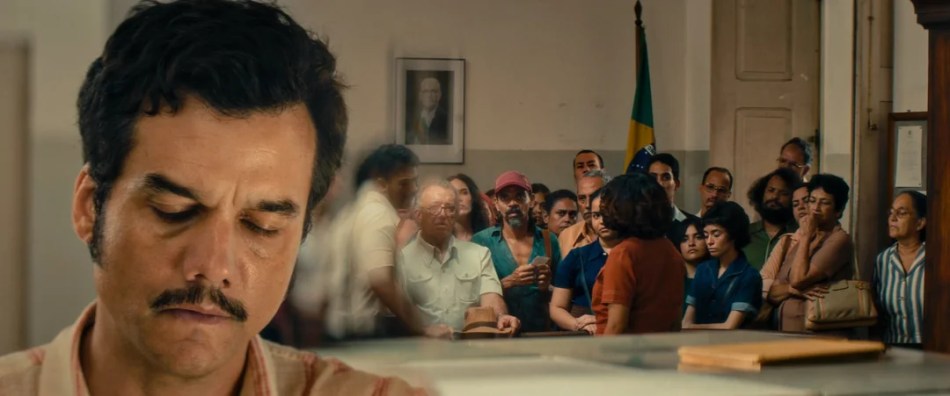
The Secret Agent’s main focus, Armando, allows Filho to further introduce numerous themes. There are the themes of memory and of identity, both in young Fernando confessing to have largely forgotten his mother, Fátima (Alice Carvalho), who allegedly died of an illness. Elder Fernando (Wagner Moura) will admit to having forgotten his father Armando, as well, but he remembers seeing Jaws in theaters. In fact, he works in a clinic that now occupies the building where the theater once stood. Armando, while working in a job at an identification agency as part of his cover at the refuge, searches endlessly for his mother’s identification papers. He has nothing of her, as she was indigenous and practically enslaved by the wealthy family for whom her mother served as a housekeeper. He has plenty of information on his father, who was that family’s son, but Armando wants something physical from his mother to remember her by. There is a frailty to memory and an impermanence to even how a city and a world that one occupies looks. One can forget a parent’s voice or role in their life. One can watch a city skyline change. The phone booths that Armando and many others used on a daily basis in 1977 are gone by 2025. The Secret Agent offers a snapshot of life in 1977 and through it brings to life again the circumstances of Armando and Elza’s work, which are still present and relevant in 2025. It is still being suppressed, as the students’ research is stopped by the government, for fear of sensitive information being on these tapes. History repeats itself. Through a film such as this or through recordings, something physical, their memories can be preserved and offer a timeless representation that enables future generations to remember.
Kleber Mendonça Filho’s The Secret Agent exemplifies the long reach of corruption and the lengths one must go to in order to simply survive under that corruption. Dona Sebastiana’s refuge is the center of it all with people from all corners of the world and of Brazil brought together to hopefully find new beginnings. But, this is a tragic story, of the inability to simply put one’s nose down and forget about the corruption around them because that corruption will eventually find ways to infiltrate one’s life. Filho expertly uses the cinematic language of 1970s films and the feeling of 1977 Brazil, tying it together with modern-day circumstances to show the ways the world changes and the ways it does not. Anchored by a brilliant Wagner Moura and a wonderful supporting cast, The Secret Agent makes this crisis feel alive and never out-reaches Filho’s impressive grasp in its ambitious scope and scale.
Discover more from Cineccentric
Subscribe to get the latest posts sent to your email.
 Cineccentric
0 comments on “The Secret Agent ★★★½”