
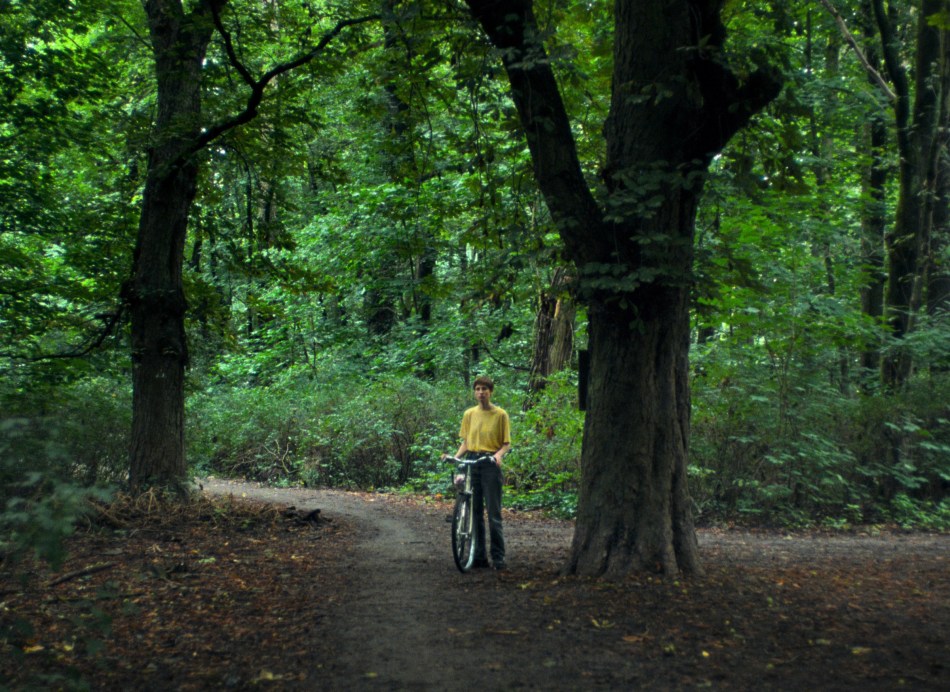
To anyone who made it through the roughly one and a half hours of Angela Schanelec‘s contrived conversation piece, it might seem preposterous that this is still a relatively bearable sample of the German director-writer’s vacant work. Said oeuvre is a permanent presence at the Berlinale, where she has had more than half a dozen films, half of them in competition. Thereto she returns with her new feature which plays out in a series of deliberately stilted set pieces, following the emotional fallout of a domestic quarrel. Evoking Schanelec’s characteristic attribute of deadpan dialogue delivery, the title refers to a crucial event in the marriage of her main characters who are literally and figuratively speaking different languages.
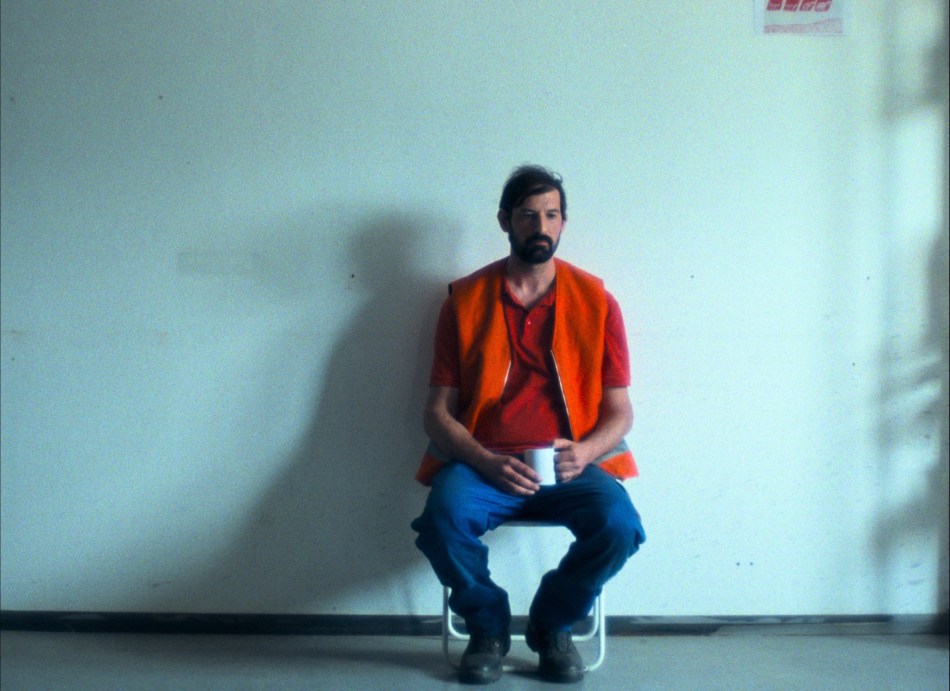
The rudimentary story begins in an office where construction worker Thomas (Vladimir Vulević) has a drawn-out conversation with two office workers. For the whole ten minutes this scene lasts, the rigid camera remains fixed on Thomas while the presence of the female figures can only be assumed from the sound of their voices. Then the camera position changes to continue the conversation looking at the office workers while Thomas is outside the frame. When the camera cuts away to show one of the women rinsing out a coffee cup, this is already something close to a visual spectacle in Schanelec’s distinctively anti-cinematic universe.
Waiting games like this might have a certain novelty appeal or symbolic subtext when used economically and thoughtfully. If used perpetually for every scene in every film, they quickly become pointless, pretentious, and tedious. Psychological depth and narrative development are repeatedly deferred in favor of formal rigor. Minimal camera movement, prolonged takes, and purposefully monotonous conversations stifle any semblance of action or emotion. However, as the actors seem unable to go fully through with the apathetic artifice, traces of tension slip through the conformist cracks. Though the story is paper-thin, it still offers more substance than Schanelec’s prior Berlinale Competition entries Music and I Was at Home, but… .
Thomas receives a call to pick up his wife Carla (Agathe Bonitzer) from the hospital. There he finds her, crying. As she later tells him, she was in an accident with a young man whom she met at a dance class which she had originally started with Thomas. Since he didn’t want to continue, she found a new dancing partner and apparently fell in love. What could have become a new start in life was literally killed by the accident. Ironically, Schanelec is not interested in human drama and tragedy, but solely the limits of communication. Misunderstandings and the inability to talk are repeatedly shown and pointed out with blunt metaphors.
Vulević is Serbian, Bonitzer is French; both speak German with different accents. It’s an almost funnily simplistic symbolism for men and women struggling to find a common language. If this sounds clichéd, it gets worse: Carla wants to talk on and on, Thomas doesn’t want to listen. So the emotional distance between them grows. Marius Panduru‘s images, largely shot on 35mm, occasionally achieve a picturesque prettiness, but never actual beauty or atmosphere. Every moment is extended beyond narrative necessity, turning even the most mundane things, like pausing on a park bench, into a test of patience. Self-indulgent in its stylized stupor and dramatically vapid, My Wife Cries dwindles in the very emotional distance it pretends to probe.
Discover more from Cineccentric
Subscribe to get the latest posts sent to your email.
 Cineccentric
0 comments on “My Wife Cries ★”