
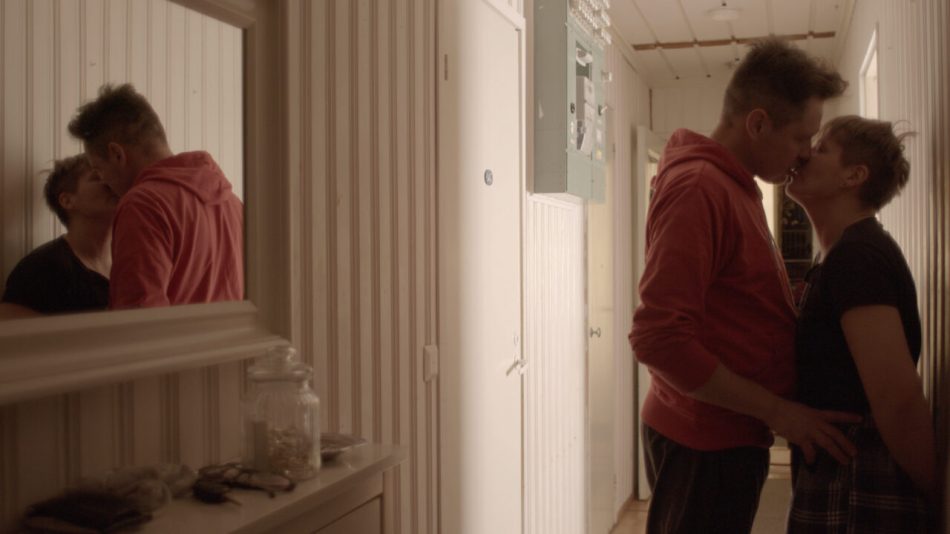
Ideology and intimacy, social norms and sexual self-realization are set up as a dramatic dichotomy in Markku Heikkinen‘s thematically wavering documentary The Arctic Circle of Lust, premiering in the Nordic Dox slate of Copenhagen’s CPH:DOX festival. Still, the Finnish director fails to clearly define both the communal realities as well as the psychological pressure and integrative impact of the moral prejudice his male protagonists supposedly struggle with. This lack of social-analytical sharpness is especially frustrating as it would be equally critically relevant and collectively constructive to probe into possible layers of intolerance hiding within a supposedly accepting social setting. The latter is Finland’s picturesque province where longtime lovers Petri and Anu live their seemingly happy-ever-after as farmers.
Their heteronormative haven is threatened when Petri comes out as bisexual. No big deal these days, one would assume, at least not in the director’s home country which ranks as one of the most LGBTQ+-friendly nations in the world with long-established queer rights and high political and popular support rates for gay marriage and adoption (both passed in 2014). But somehow it is for the middle-aged couple, whose trust in themselves and each other appears fundamentally shaken. This is in part because Petri’s revelation affects not only his past but his present. He has fallen in love with another man with whom he finds something that Anu can’t give him.
Still, he doesn’t want to give up the life and lasting relationship they have built together over the years. Honesty has always been the foundation of their love, says Anu as the camera quietly watches. But while she acknowledges the courage it takes for her husband to come out in his 50s, integrating his newfound desires into their romantic routine is a whole different issue. The thought of being somehow not enough for her husband is emotionally tough on her, as scenes of her frustrated loneliness, intercut with Petri’s gay trysts, suggest. Unfortunately, and likely unintentionally, this juxtaposition perpetuates a normative narrative of queer love as a threat to traditional heterosexual unions.
While the patient observation of the couple’s renegotiation of romantic and sexual terms is a welcome divergence from sensationalist soap opera, the structural simplicity combined with the reserved perspective fails to reveal anything of more than personal relevance. Questions about loyalty and desire might be essential for the main characters, but Heikkinen can’t establish why it should all matter to a larger audience. Said audience might well end up asking themselves what all the fuss is about as Anu and Petri discuss the same subjects over and over. Deeper social questions, such as whether traditional marriage and monogamy are outdated or even an obstacle to emotional and erotic fulfillment, are never explored.
The non-confrontational approach rarely looks beyond the couple’s personal sphere. Most scenes are set in their home and the beautiful landscape surrounding it, creating a sense of intimacy that is also limiting. Finland’s rural gay subculture and dating networks remain largely obscure, as do provincial attitudes toward gay men, especially among an older generation. How much of Petri’s awkwardness with his sexuality is based in his own internalized inhibitions and how much in actual disapproval of his surroundings? Is social acceptance more image than reality? As questions like these go unanswered, the title becomes a metaphor for a meditation on the evolution of long-term love that refuses to evolve itself.
Discover more from Cineccentric
Subscribe to get the latest posts sent to your email.
 Cineccentric
0 comments on “The Arctic Circle of Lust (documentary) ★½”