
With a title and premise equally fitting for an ancient fairy tale or horror, Ankur Hooda‘s devastating debut feature The Calf Doll could be read as either one. The allegorical account of an old farmer’s desperate attempt to make his last cow give milk could even be seen as a nihilistic comedy, though any laughter about the cruel joke fate deals the lonesome protagonist would ring hollow given the scenario’s crushing sense of hopelessness. The latter is likely the most authentic aspect of one of the most fictionalized stories at Copenhagen’s CPH:DOX festival, where it premieres in the Next Wave section for young and first-time directors.
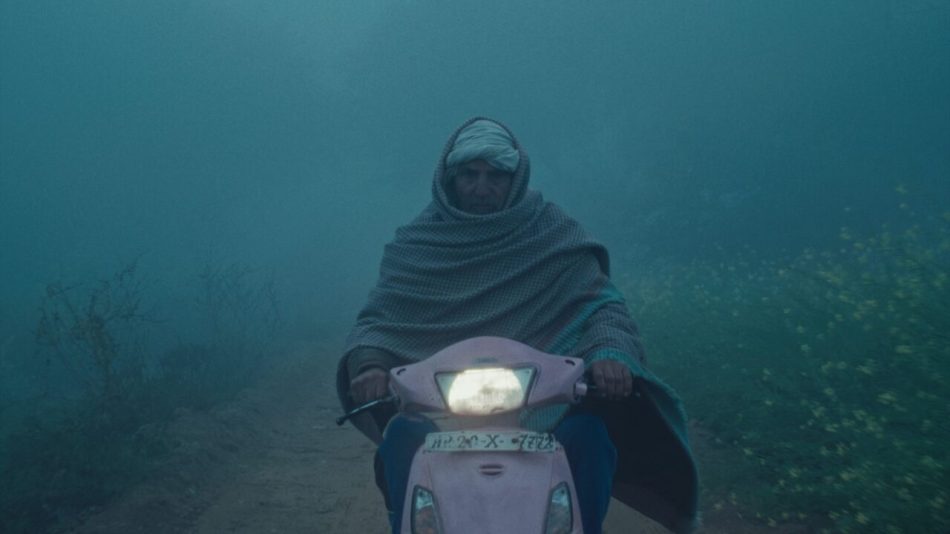
Scenes are reenacted but inspired by actual experiences and the life circumstances of the characters, who play alternative versions of themselves. An eerie fog surrounding the dilapidated village in the Indian countryside where the emblematic events unfold suggests that this tale is not only lingering on the blurry border between documentary and fiction, but also in the liminal space of reality and myth. While the setting in the small village of Dayalpur is captured in somber images of rural disintegration, the handful of characters are closer to archetypes. A retired professor is eking out a living with his wife, holding on to their small plot of land and last cow.
A glimmer of hope in these visually and spiritually equally gloomy circumstances is the calf she expects. However, in the early morning hours, his only remaining farmhand informs him that the calf is stillborn. Seeming almost heartbroken at this message, the professor implores him to look after the ailing animal, but the young man goes off to the city where he has a better job offer. The professor’s wife tries to convince him to move to the city close to their grown children who then could support them, insisting the dead calf is a bad omen. Instead of listening to her, the professor keeps the little corpse.
With her help, he stuffs it to create the titular doll, hoping it will make the cow lactate. As he is far from a master taxidermist, the doll looks only sad and slightly scary. It’s a morbid metaphor for a way of life that is inevitably disappearing and the literally moribund attempts to reinvigorate a romanticized past that is long dead. When it seems as if it couldn’t get more depressing, Hooda proves the opposite. Soon enough, neighbors complain about the smell and mock the old man, while the stray dogs can’t wait to tear the poor doll apart.
As a symbol of belonging and closeness to nature, its destruction signifies a loss that can’t be mourned and a grief that is spurned rather than consoled. With a background in poetry and biographically tied to rural Haryana, Hooda approaches his subject with anthropological sensitivity and lyrical tenderness. The omnipresent haze renders the houses and bare fields tangible and dreamlike, as it encodes the encroachment of urbanization and ecological decay. As the atmospheric images imbue this bizarre tragedy with subtle dignity, the hybrid style reinforces the crumbling of lived reality. The landscape becomes a place of metaphorical magic, where birth brings forth death and a lifetime of building leaves nothingness.
Formal austerity, modest pacing, and reduced narrative development align Hooda’s striking debut with a lineage of slow cinema at its most melancholy. Like the suspended temporality of mourning, it feels monumental without much happening and lingers like an uncanny shadow from the past.
Discover more from Cineccentric
Subscribe to get the latest posts sent to your email.
 Cineccentric
0 comments on “The Calf Doll (documentary) ★★★”