
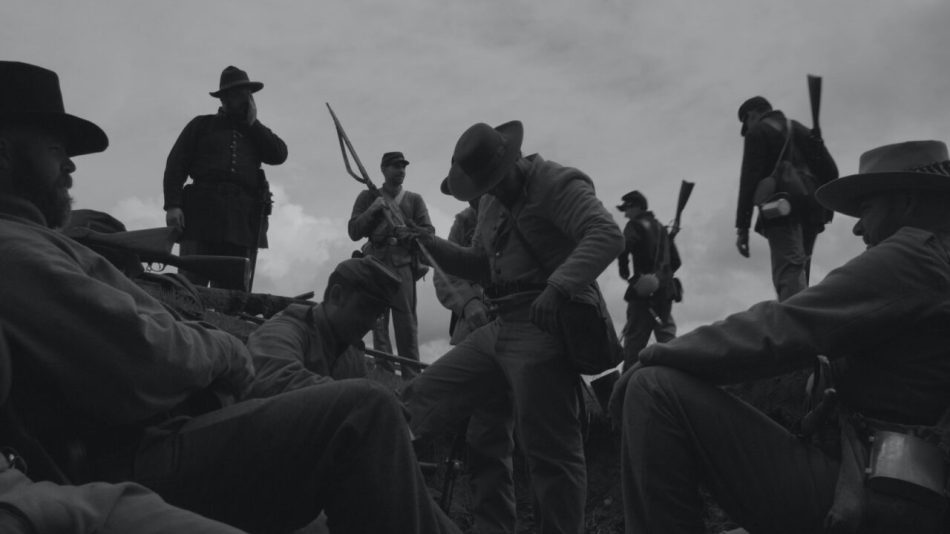
George Washington once in a letter referred to the establishment of democracy in the USA as “the last great experiment for promoting human happiness.” The quote inspired the title of Stephen Maing and Eric Daniel Metzgar‘s monumental meditation on the current results of said experiment at a time of social division, escalating populism, and growing geopolitical instability. After its world premiere at the True/False Film Fest in Columbia, the comprehensive collage of black-and-white scenes shot between the first Trump term and the present just had its European debut at Copenhagen’s CPH:DOX. An unsentimental mosaic of a nation seemingly on the brink of autocracy, the loose structure tries to connect the demographic dots between seismic political shifts.
The most infamous of these is the attack on the Capitol on January 6, 2021, when one of the directors gets dangerously close to becoming a collateral target of mob aggression. One of the aggressors threateningly asks what press he is with, but then appears to be somewhat calmed by the answer “freelancer,” adding: “If you were with CNN, it would be a different matter …!” A seemingly insurmountable polarization among the people, violent protests, the rapid erosion of human rights, aggressive scapegoating of vulnerable minorities, and a near-universal tolerance for demagogic phrases and totalitarian gestures among an extreme right-wing elite openly flirting with fascism: these are the overt symptoms of the socio-political currents and contradictions the camera tries to catch.
The opening scenes follow a young BIPOC gay man and his partner at a pro-Trump rally where they are repeatedly stopped by disbelieving counter-protesters while being skeptically ogled by their pro-Trump fellows. There is a bizarre altercation between white right-wing protesters flanking a Confederate monument, a Black passerby who removes one of their flags, and a Black cop whom the protesters angrily urge to arrest the passerby. When he refuses an arbitrary arrest, a MAGA woman starts screaming at him that she is Jewish, as if that were some kind of ultimate argument in any given debate. Various situations like these underline the conflicts and polarizations, not only between specific groups of people, but within these groups and their individual members.
Creating a distancing effect that stylizes recent historical events as archival material, the monochrome aesthetic becomes in itself a filmic metaphor of another prominent quote: William Faulkner’s “The past is never dead. It’s not even past.” What has hardly settled in memory can already be excavated and enshrined, looking different depending on the angle from which it is presented. The temporal ambiguity underlines the sense of instability regarding a present about to become the subject of contested historiography. Keenly aware that their filmic time capsule is itself part of that historiography, Making and Metzgar strive for an impartial perspective. Their decentralized narrative without narrator commentary, filled with fleeting encounters, formally contains the dissonances it projects.
While this constant movement between social strata and geographical locations forces the audience to listen closely to the discussions on screen to determine a person’s political stance, the lack of identifiable thematic focus and continuous storylines also diffuses any synoptic social-political view. Meticulous visual composition and rhythm underscored by an ambient soundscape immerse the audience in an experience that, despite and just because of its persons, political positions, and places, ends up being more aesthetically impressive than analytical.
Discover more from Cineccentric
Subscribe to get the latest posts sent to your email.
 Cineccentric
0 comments on “The Great Experiment (documentary) ★★½”