
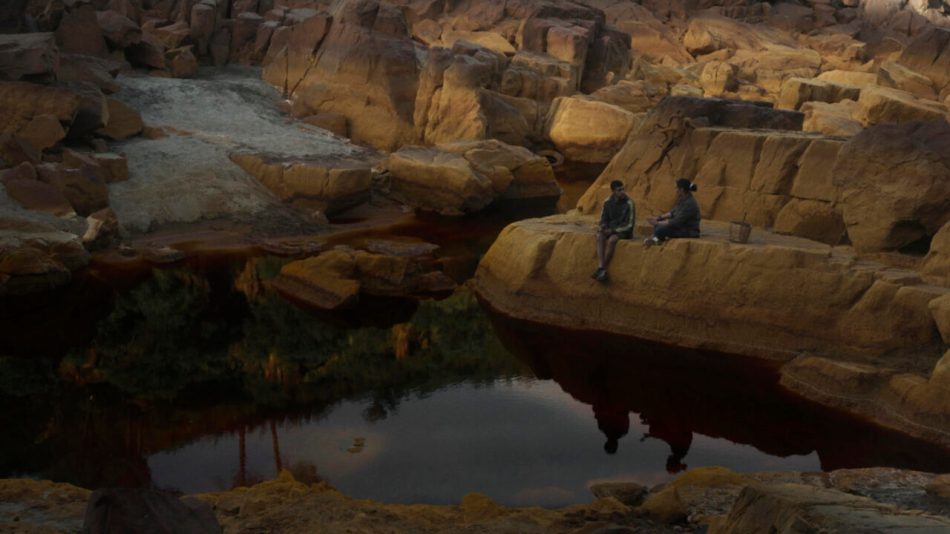
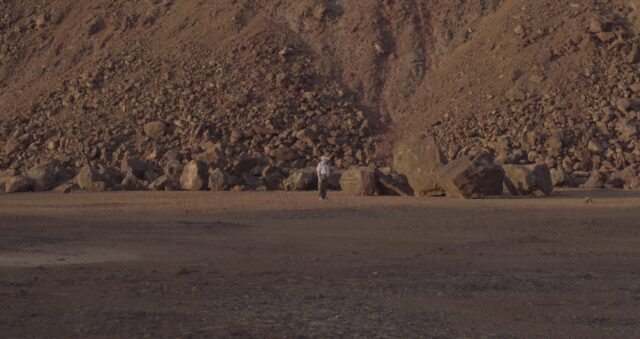
Mars and Spain seem not so far from each other after all, in María Molina Peiró‘s philosophical documentary hybrid that aligns the Rio Tinto’s mining enterprises in Andalusia with the arid landscape of the red planet. Its lifelessness becomes a dystopian window into a dismal future where all of Earth’s treasures have been as ruthlessly extracted as the metals from the Iberian Pyrite Belt. Halfway between imagination and a harsh reality, the dreamy imagery follows a little robot on its solitary explorations on Mars and Andalusian locals on their search for traces of their former homes, buried under tons of interlaced waste.
Hovering between speculative fiction and capitalist critique, the Spanish director constructs a cinematic capsule where different searches for traces of life are intertwined. One of these is the search for a dark biosphere that challenges the idea that life depends on the sun. It’s a hidden ecosystem of microorganisms living in hard rocks and pore water without oxygen or light. They generate their energy by consuming minerals with chemosynthesis. Otherworldly scenes of lithic landscapes under a dark sky could be either on earth or another planet, placing fantastical futurism and faith alongside empirical investigation. Both the imaginary and scientific appear as attempts to bring some light into the darkness, just like the locals do with candles and prayer.
A strong focus on atmosphere and aesthetics points towards the core of the narrative which is less interested in specific discoveries than their outer conditions. Marked by its mining landscapes and layered colonial histories, the Andalusian setting becomes a crucial site of inquiry. Different terrains of industrial exploitation are connected to broader concepts of an exploration about to become indiscernible from imperialist expansion. Earth’s many histories of colonialism, displacement, and ecological destruction morph into a disillusioned prediction of the ideas and outcome of the tech billionaires’ contemporary fantasies of space conquest. An insatiable drive for domination, appropriation, and profit leaves nothing but the wasteland that the Andalusian protagonists comb for remains of their living land.
Observational footage underscored with conversations of the scientists and locals seamlessly blends into the minimalist fictional constructions of Mars. Though mechanical, the Mars robot evokes an existential isolation that finds its terrestrial counterpart in nightly shots of the diggers in the mining area. Placing the individuals in Andalusia alongside the proposed grandeur of space travel and the cosmic at the same time erodes and reinforces an anthropocentric perspective. There is a vague suggestion that searching for life in space and stone while being oblivious to the very present lives of other individuals says less about scientific facts and more about the human condition. But such interpretations might also be half-imagined.
Long takes and a deliberately slow pacing lend these images the distant beauty of hyperrealist painting. Without a conventional storyline, the associative structure relies on motifs like the starry night sky hovering over all, as thematic anchors. This pattern of repetition and juxtaposition places the contemplative conceptual work between film installation and documentary. Visually refined but in its line of argument often opaque, Like Any Other Mortal becomes itself a filmic allegory of the night sky to which it repeatedly turns: a dense web of beaming ideas, scattered into darkness.
Discover more from Cineccentric
Subscribe to get the latest posts sent to your email.
 Cineccentric
0 comments on “Like Any Other Mortal (documentary) ★★½”