
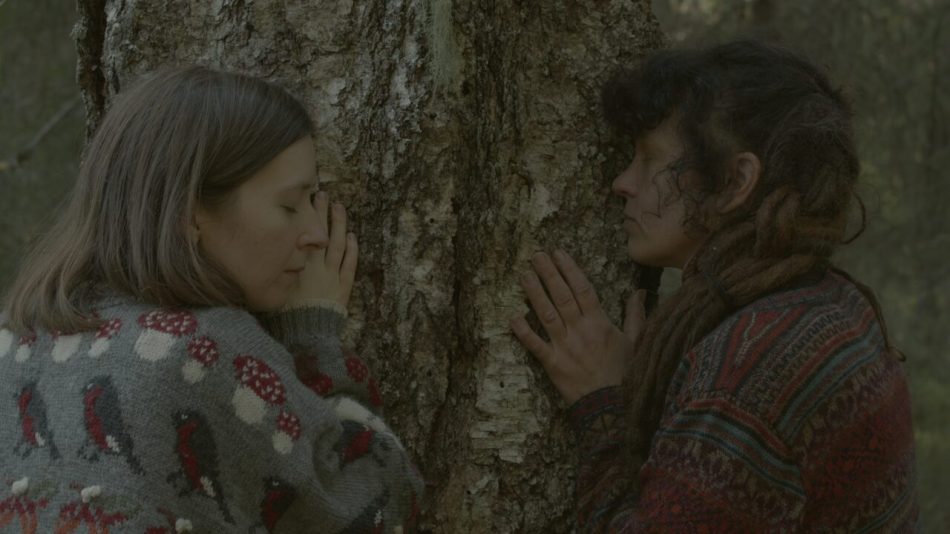
In an age of devastating wars and alarming climate change, Irene Kaltenborn‘s pensive documentary takes inspiration from the classic sci-fi stories of Ursula K. Le Guin for its theory of a peaceful evolution. It stands as a counter-model to a belligerent evolutionary theory, “dating back to the dawn of humanity,” according to the synopsis from CPH:DOX where The Mother Age premiered. The proposed purpose of Kaltenborn’s sensual study of the human relationship to nature is to challenge “the idea that the knife was the first tool made by humans.” On a wistful walk through the beautiful nature of Norway and Finland, the director listens and looks for evidence that human evolution isn’t defined by violence.
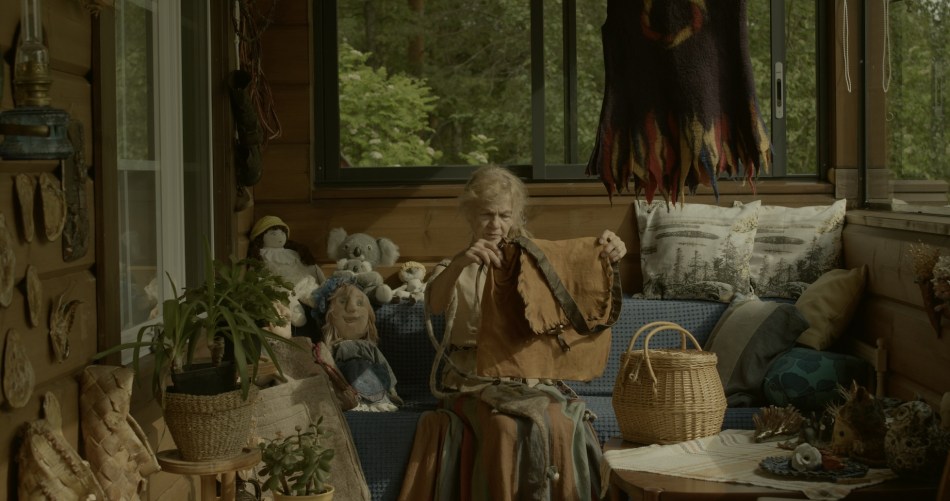
With watchful eyes and exhibited attention, she listens to researchers, cultural theorists, and artists as they walk together through deep forests and vast meadows, weaving baskets from leaves, picking berries, and humming old melodies. “People were happier back then, before clocks were invented,” says an elderly protagonist, musing how humans would have been attuned instead to nature and living with its rhythms. This quaint vision is exemplary of the anthropological naivety of the halcyon scenarios that too often lose sight of science. This starts early on, as there is no theory of the knife being the first human-made tool. Sticks and stones are widely considered to have been the first tools, with some contention about which was picked up first.
Ironically, one of the protagonists comes close to this fact as he talks about the crucial role of durability in anthropological concepts. A stick, wicker basket, or seashell would decay if not preserved by rare, ideal conditions. Even then, it might not be recognized as a tool. It is also a well-established theory that the earliest primitive tools were used to crack shells of nuts and crustaceans or to reach things. Nevertheless, it’s telling what the narrative omits. One protagonist points out that even a potentially harmful object like a knife could have been used to cut cloth and plants instead of as a weapon. While this is an important point often overlooked in popular science, sticks and stones can break bones as well.
Conspicuous and surprising, given the title, the emphasis on gathering and foraging, and the connection to Le Guin’s feminist novels, is that another evolutionary theory is never brought up. This popular theory is inseparably tied to the idea of human evolution as fueled by violence: the hunter-gatherer myth. Though scientifically proven false, there is still a widespread belief in men being naturally conditioned to hunt, fight, and kill, and therefore more highly developed than women: weak, childbearing, vulnerable, and unable to bring home that Paleolithic bacon. The hunter-gatherer myth has served as justification of the gender binary and patriarchal structures, which in turn are fundamentally connected to concepts of humans as violent by nature. But Kaltenborn never goes there in her attempt to excavate an alternative history.
The director, who shares cinematography credit with Margo Peegel, lingers on moss, leaves, and bark, some of which are repurposed into surprisingly robust items. Visually, sensorially, and practically, their focus is on textures, smells, and spectacular landscapes. This emphasis on the organic and ephemeral serves as a silent reminder of both the riches and fragility of nature. Folk songs and old tunes sung or hummed encourage immersion in the mythic aura of the scenic locations. In a moment of ecological crisis and fears of war, this aestheticized critique of an exploitative modernity is a beautiful cinematic vessel but contains few substantial arguments and new insights.
Discover more from Cineccentric
Subscribe to get the latest posts sent to your email.
 Cineccentric
0 comments on “The Mother Age (documentary) ★★½”