
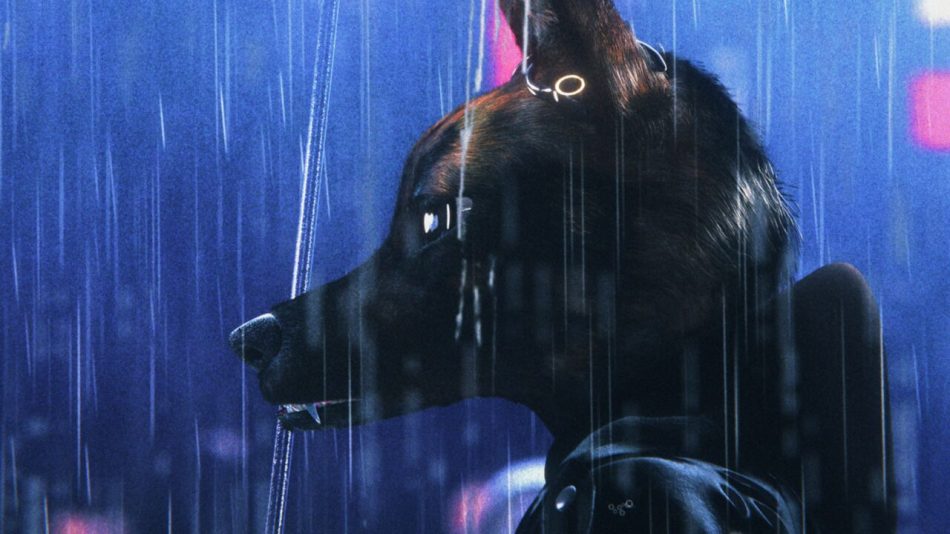
A poignant side note to Meriem Bennani‘s feature film debut, directed together with her frequent collaborator Orian Barki, is its original title, For Aicha. Under this name, the first animated movie produced in Morocco premiered in 2025 at the premises of Milan’s Fondazione Prada, which had commissioned it. While that does sound like an advanced advertising campaign, its main effect on the story seems to be that the fashion brand makes up most of the characters’ wardrobes. Considering the astronomical Prada prices, this somewhat undermines the authenticity of the story based on Bennani’s own life and current situation. Then again, all the human individuals in this autobiographical animation are anthropomorphic animals.
This playful personal trait marks the film and multimedia creations of the Moroccan artist, who pictures herself as an African wild dog, the titular Bouchra. She also speaks her own dialogue based on recorded conversations with her mother, whose animated alter ego is Aicha (Yto Barrada). The story opens with them having a tense phone call where much remains veiled in white lies. It’s been almost a decade since Bouchra outed herself to Aicha, who still lives in Casablanca where Bouchra grew up. Now she has relocated to New York, partly for work, but likely also to live more openly as a queer woman. Her parents seem to accept her, but in the way they would ultimately accept a blow of fate.
Despite her outer confidence in navigating former and potentially new girlfriends like her ex, Nikki (Ariana Faye Allensworth), Bouchra still hides her romantic life from her mother. Their phone conversation becomes the starting point—narratively and productively—of her next art project: For Aicha, or Bouchra, as it was retitled after being re-edited for its premiere at last year’s TIFF, from where it made its way to Copenhagen’s CPH:DOX. Here, it screens in the Parafictions section reserved for works which are not documentaries but are so tangled up in real experiences they aren’t fiction, either. This is certainly true for Bouchra, which becomes crucially more engaging and complex when seen with its messy production process.
It lasted for about two years filled with artistic conflicts and rewrites, palpable in a jumbled plot lacking a conventional dramatic arc. A collection of everyday emotional vignettes, Bouchra merges into a mosaic of the director’s mind, filled with ideas, ambition, insecurities, longing, and love that isn’t always reciprocated. Her inner disarray contrasts with both the slick surface of the animal characters’ ultra-stylish appearance—all that Prada ironically works to highlight this contrast—and the animation’s glossy synthetic aura. Everything looks cool in a very calculated way which could be interpreted as a critique of the same materialist structures which launched her film, originally produced as part of an art exhibition.
Its scenes often appear like sets of individual stills with characters not moving naturally but shifting from one pose to the next. Everything feels hyper-artificial, including the real-life background images of Casablanca and New York, reminiscent of the instantly identifiable background projection in old movies. Though the conflicts of a diasporic queer female experience are interesting, the overkill of artificiality creates an insurmountable emotional distance. As a window into a rising artist’s creative and commercial process, it still has a unique aesthetic appeal, especially for the queer furry community who wholeheartedly embraced it. Apart from that aspect, Bouchra never fulfills its potential.
Discover more from Cineccentric
Subscribe to get the latest posts sent to your email.
 Cineccentric
0 comments on “Bouchra (documentary) ★★”