

Being John Malkovich
By Henry Baime
 With the release of Being John Malkovich, the advent of two of modern cinema’s most original minds, director Spike Jonze (Her) and screenwriter Charlie Kaufman (Eternal Sunshine of the Spotless Mind), was announced in spectacular fashion. With a plot that centers on a puppeteer using a tunnel to enter the mind of actor John Malkovich, it’s the type of film with such a potential to be off-putting to producers for its absurdity that few would be brave enough to fund it. As such the film was, in fact, turned down by a variety of production companies, but ended up being a smartly funny drama that defies any expectations and presents surprising twists that reject conventionality up until the very final shot. Being John Malkovich is a film that exists outside of genres and is genuinely impossible to describe to someone who hasn’t seen it without seeming to describe some sort of fever dream. Even so, the film makes perfect sense while seeing as it establishes its own fantastical world and sticks to its rules, however ludicrous they may seem when taken out of context. Upon its release it was a moderate box office success and garnered a variety of awards season nominations, paving the way for more surrealist films to be made in the years since.
Rosetta
By Eugene Kang
 The documentary-like feel of all the Dardennes’ features belies their mastery of narrative. The story is simple: Rosetta (Emilie Dequenne), a Belgian teenager, must take care of her ailing mother while looking for employment in order to survive. The oppressive weight of the poverty Rosetta endures is felt in every scene, from the interior of her dimly lit house to even the unforgiving natural light that refuses to make anything look beautiful in her world. Though we spend a lot of time with Rosetta, we don’t necessarily get much insight into her character other than the weight of the world is slowly becoming too much for her. Rosetta and her situation are never romanticized, and she is allowed to appear unsympathetic and even hostile. It is this apparent neutrality that makes Rosetta more compelling than if the Dardennes had tried to get us to actively sympathize with her. The film is claustrophobic and very specific, but it puts us so intimately into Rosetta’s situation that we can feel everything that she feels, even without obvious tells. A simple but climactic scene in which she struggles to carry a full canister of gas is so devastating that you can finally understand what it was like for Sisyphus to push his boulder up his eternal hill.
Dogma
By George Morris
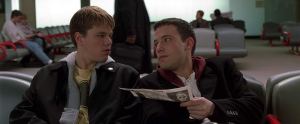 Kevin Smith’s fourth feature in his ‘View Askewniverse’ is arguably his best work thus far. By combining the asinine behaviour and moral depravity of his comedic work with his pent-up theoretical questions and theories about religion, Kevin Smith’s Dogma remains a uniquely interesting take on the mythos and cynicism of God/Heaven’s relationship with us down on Earth.
It doesn’t hurt at all that the cast is brilliant. Good Will Hunting-era Matt Damon and Ben Affleck play fallen angels Bartleby and Loki on their quest to prove God fallible by earning their way back into heaven whilst Alan Rickman’s Metatron and Chris Rock’s Rufus (a leftover disciple) team up with Linda Florentino’s sarcastic Bethany Sloane and Smith regulars Jay & Silent Bob in an attempt to stop them. It sounds ridiculous on paper but when put into practice it’s clear how much work has gone into the screenplay for Dogma. Righteously provocative and more interested in having its characters engage in a witty, quip-fuelled debate over existence than handle its plot with any real revelations, Smith’s disregard for subtlety is matched only by his inspiration here. Plus a film where Alanis Morissette plays a mute, childish God deserves repeat viewing.
Toy Story 2
By Carson Schilling
 Pixar’s follow-up to their 1995 smash hit Toy Story is a nearly perfect example of how to make a compelling sequel. With John Lasseter’s direction and the entire original voice cast returning, Toy Story 2 is an excellent film with no lack of heart or originality. Its plot and character development is unmatched, as it takes everything that audiences loved about its predecessor and vastly improves upon it. Buzz Lightyear (Tim Allen) and Woody (Tom Hanks) themselves are proven to be some of the most interesting and relatable characters ever due to their character development, despite the plasticity of their faces. Furthering the stories of the characters that audiences have already adored and introducing new ones that will come to be unforgettable, Toy Story 2 provides a solid playground for these toys to begin to discover what it means to be part of a different family.
The vocal performances throughout the film are once again incredible, as Tom Hanks and Tim Allen bring back their fantastic chemistry to make two disparate characters – a cowboy and a space ranger – so compatible. Along with the additions of Joan Cusack’s vivacious Jessie and Kelsey Grammer’s evil-spirited Stinky Pete, the cast in this film continues to be pitch-perfect. Much of Toy Story 2‘s animation is also extremely superior to the first installment. It is obvious how many technological advancements were made in that period of four years, as so much more life and emotion can be seen in these characters throughout. All of these elements come together in pure, nostalgic form to continue what is arguably Pixar’s greatest and most warmhearted franchise.
Magnolia
By Henry Baime
 In Magnolia, Paul Thomas Anderson’s follow up to his 1997 hit, Boogie Nights, he traded in the golden age porn industry for an equally eclectic cast of characters searching for happiness in the San Fernando Valley. A compelling portrait of grief and overcoming trauma, the film takes fairly ordinary stories and gives them epic proportions as it charges through a more than three-hour runtime without ever losing steam, culminating in a truly unexpected but entirely fitting end to its grandiose mosaic. Just as Magnolia showed that beauty can be found anywhere, the film cemented Paul Thomas Anderson’s status as one of the most exciting members of a new generation of filmmakers who embraced that idea and shirked many traditional filmmaking techniques to find new innovative ways of pushing the art form forward.
Discover more from Cineccentric
Subscribe to get the latest posts sent to your email.
 Cineccentric
0 comments on “1999 in Film”