
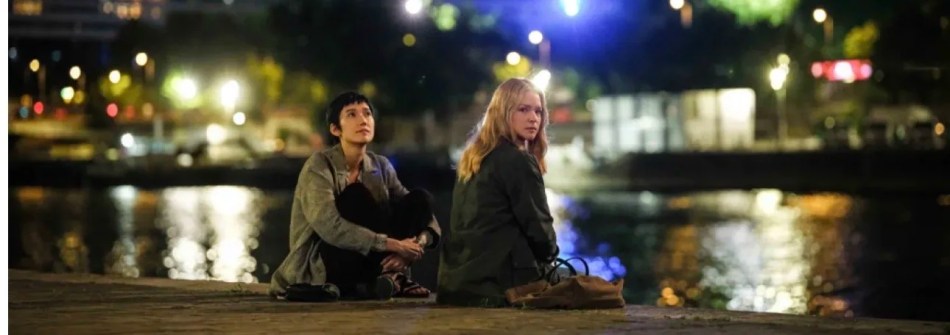
There’s a certain irony in a film of over three hours in length and as deliberately slow-paced as Ryusuke Hamaguchi’s entry into the 79th Cannes Film Festival’s competition. It’s one of many contradictions of a work that aspires to a philosophical depth that the simplistic story can barely hint at. A three-hour meditation on terminal illness, elder care, therapeutic art, and female friendship, the Japanese director’s first French-language feature struggles with a host of themes from which the didactic direction remains frustratingly detached. From the very first stylish scene, aestheticized abstraction erodes the emotional impact of the subdued story.
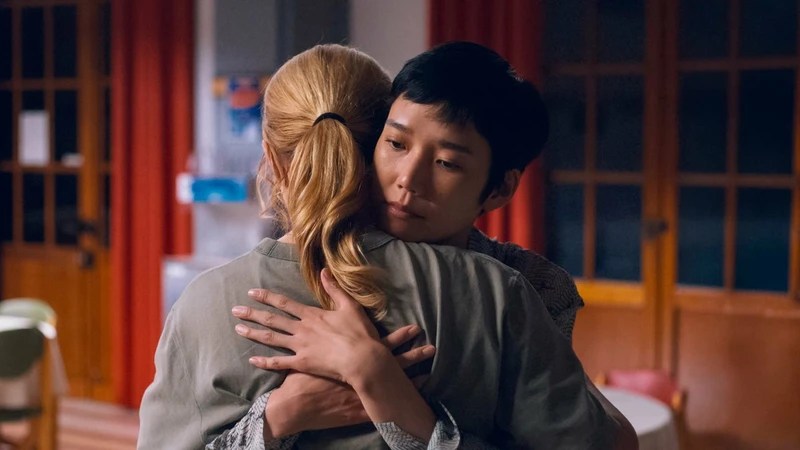
All of a Sudden is inspired by philosopher Makiko Miyano and medical anthropologist Maho Isono’s non-fiction book “You and I – The Illness Suddenly Get Worse,” in which they discuss the former’s fatal cancer diagnosis and its impact on a person’s sense of self. Miyano died in 2019, the year the book was published, and Hamaguchi leaves no doubt the same fate awaits her fictional alter ego, Mari Morisaki (Tao Okamoto). However, the theater director is only second-in-line after Virginie Efira’s Marie-Lou Fontaine, the recently appointed director of a posh Parisian care home for the elderly which she plans to adapt to a new care concept called Humanitude.
This methodology, created in the late 70s by Yves Gineste and Rosette Marescotti for patients with cognitive limitations and dementia, involves intense communication with constant eye contact as well as slow and soft speech and touches. Lengthy laudations on the Humanitude method and the many scenes purely dedicated to illustrating it threaten to turn the drama into an educational video for aspiring Humanitude nurses. While the latter can look forward to a whole lecture on the deplorable state of the care system, complete with diagrams and chalkboard, everyone hoping for a nuanced discussion on the ethics of care will likely be frustrated.
As veteran nurse Sophie (Marie Bunel) criticizes the impracticability of Humanitude, which is time-consuming, not always effective, and puts immense strain on the already overworked staff, Marie-Lou talks down to her. The only character with a working-class background, Sophie ends up as the sole antagonistic character of a cloyingly positivist plot that patronizes her even as it grants her a touch of humanity. Ironically, the implementation of a system cherishing the dignity of the affluent patients utterly disregards the needs of the staff. Marie-Lou even suggests they move into newly-provided staff quarters in the facility, since “not everyone wants a separation of private life and work.”
Just as the skeptical reactions she faces both from staff and the care facility’s owners seem to strike a spark of doubt in her own intellectual superiority, she meets Mari. This encounter happens through autistic teenager Tomoki (Kodai Kurosaki), whom Marie-Lou sees in a public park. She stays at his side until Mari and Tomoki’s grandfather Gorô (Kyōzō Nagatsuka), her close friend and professional collaborator, turn up. The women strike up an instant friendship; they have the lengthy and lofty conversations which make up the book, and thanks to Mari’s and Goro’s artistic input, the care home finally lives up to its somewhat pretentious name, “Garden of Freedom.”
Hamaguchi frames Marie-Lou’s actions as unequivocally caring and commendable, which paradoxically only highlights their ambivalence. Her entitlement and academic assumptions literally know no boundaries. The whole film is wrapped up in the same intellectualist superiority, laced with classist undertones manifesting in a complete absence of anyone lower than middle class, apart from narrow-minded nurse Sophie. Cinematographer Alan Guichaoua’s long takes cast the care home and the characters in soft, flattering light, creating an idealistic idyll as illusory as it is ignorant. The reality of dementia and the final stages of cancer isn’t pretty, but exactly that is what it looks like on screen.
Spoken like recited prose, the clunky dialogues are far from any natural conversation. Underneath the elevated exterior, drenched in sugary sentimentalism, hides the idea of an intellectual elite that knows better than any ordinary person, including those with extensive practical experience. Exhaustingly slow and shallow despite its haughty humanist air, the placid portrait of intellectual kinship and humanity in action turns mental and physical decline into decoration.
Discover more from Cineccentric
Subscribe to get the latest posts sent to your email.


0 comments on “All of a Sudden ★½”