
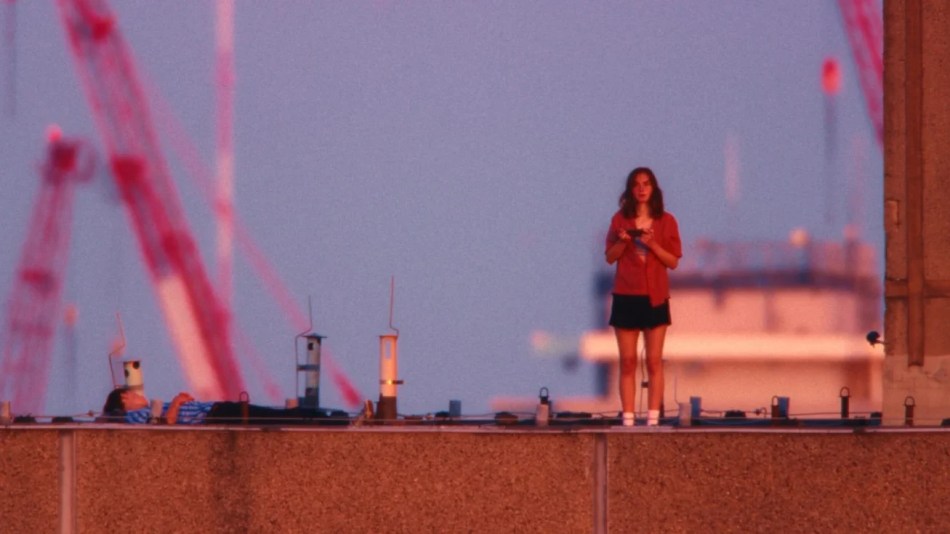
A sunrise casts a strangely beautiful light on a row of drab apartment towers from one of which something suddenly tumbles into the depths. The déjà vu vision of a toddler girl playing in a hallway, like a ghost from a painfully distant past. Words of cruel reproach softly spoken during a comforting embrace. And then, at crucial moments of the unsettling story, everything appears to freeze in an existentialist emptiness that leaves the surroundings eerily depopulated and prevents the sun from setting. These moments of sudden terror, illusionary comfort, and contradicting emotions creating an insidious grip, give Sandra Wollner‘s daring psychological portrait a strange fascination.

Underneath its facade of everyday interactions, the drama of a family paralysed by a terrible loss hides a spectral vision of the near insurmountable power of grief. Even the laws of physics seem suspended when the pain of regret, guilt, and desperate longing distorts time and space. The intimate becomes cosmic as every sense of certainty disappears with the loved one suddenly taken away. Memories transform the present and obliterate the future that now lacks the person to whom it should belong. Wollner leaves her audience willfully in the dark about the encroaching tragedy that hits them as bluntly as the protagonists.
It’s an ordinary Berlin summer for divorced Ella (Birgit Minichmayr) and her two daughters, teenager Jessie (Carla Hüttermann), her little sister Melli (Lotte Shirin Keiling), and Jessie’s longtime boyfriend Lux (Tristán López) who is like an older brother to Melli. A serene morning after a night of partying culminates in a fatal accident that happens so quickly and abruptly that the disorienting camera and calm narrative themselves seem unable to grasp it. The open questions regarding the event, which could also have been suicide, add to the aura of ambiguity engulfing those left behind. A leap one year forward shows Ella and Melli living in a limbo of grief.
As Lux, who was with Jessie that fateful morning, returns from a year abroad, the absence of the daughter, sister, and girlfriend becomes even more palpable. Sun-drenched scenes of uncanny beauty underline the emotional isolation of the trio whose world is constantly overshadowed by gnawing pain. Psychological realism and metaphysical allegory morph into a cinematic chimera completely immersed in its characters’ feelings. The plot seems to develop intuitively from these sensations, like a spontaneous vacation on which Ella takes the kids. Captured with an increasingly dreamlike gaze, their destination has all the familiar conveniences of every all-inclusive holiday, yet the hotel is engulfed by an otherworldliness, signaling Ella’s eroding sense of reality.
Slow-paced, inscrutable, and occasionally contradictory, Wollner’s elegiac character portrait studies the empty space carved out by death and the fairy tales and lies people tell themselves to go on. Intense performances, especially from Minichmayr, and Gregory Oke’s languorous cinematography add to the haunting atmosphere of the disorienting story. Past and present overlap in the blazing sunlight—evoked repeatedly and manifest in the Latin meaning of Lux’s name—transfixing the protagonists until they lose their moral compass as well. Topography echoes mental states as empty hotels become monuments of absence. Despite its demanding themes and dramatic opaqueness, Everytime traps the audience within its hypnotic flare, like staring into the blinding sun that hides more the brighter it shines.
Discover more from Cineccentric
Subscribe to get the latest posts sent to your email.


0 comments on “Everytime ★★★”