
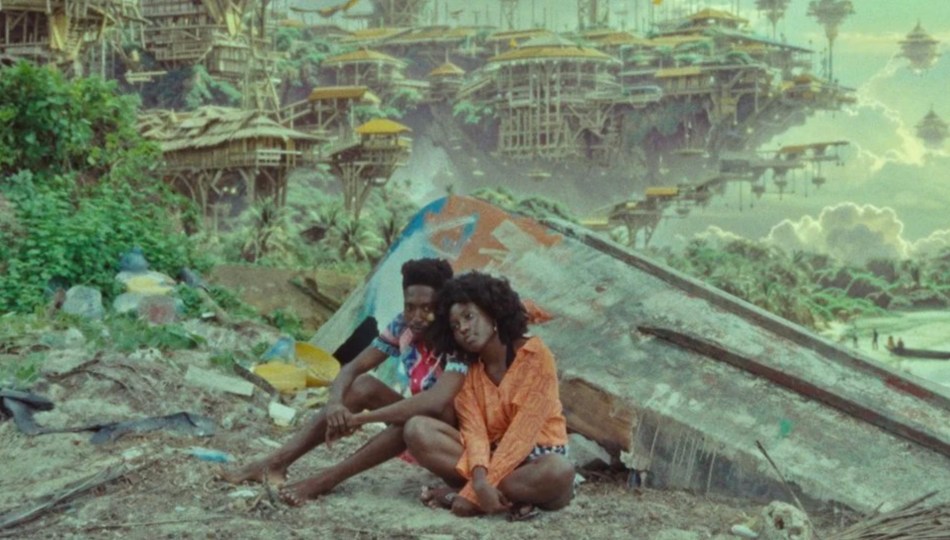
Financial limitations, production challenges, as well as the tropes and pitfalls of the mise en abyme, become part of the very essence of Damien Hauser‘s evocative experimental feature Memory of Princess Mumbi. Its futuristic setting before the turn of the next century imagines a world fundamentally altered by a global war on technology, which has been banned as an addictive and contagious source of collective depression. This re-evaluation of global powers has given rise to retro-futurist African kingdoms, reminiscent of myth-enshrouded places like Kush, the Aksumite Empire, and Great Zimbabwe’s Stone City. This emblematic evocation alone is already a monument to the past grandeur of different African cultures, historically denied and erased.
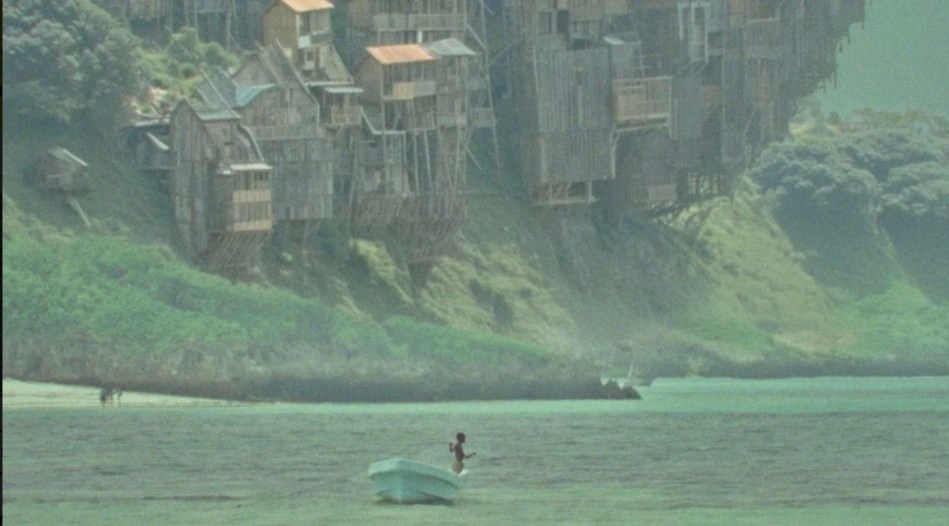
One of these sites born from mythology and memory is Umata, birthplace of the titular heroine. Princess Mumbi (Shandra Apondi) is an aspiring actress whom the filmmakers Kuve (Ibrahim Joseph) and Damien (a fictional alter ego of director Hauser) meet while shooting a documentary about depression among Umata’s population. Said citizens, however, don’t seem dejected at all, feeling proud to have won the war and hopeful for the future. Confronted with this dilemma, the duo decides to change the facial expressions of the interviewed participants through AI. This manipulation of footage, and thereby both of their human subjects and prospective audience, is one of several motifs pointing towards the plot’s deeper concern with filmmaking itself.
Mumbi remains critical of their approach, her resistance ultimately the first serious confrontation with the contemporary ethics of cinematic representation. From there, Hauser’s project keeps peeling back its own layers. Mumbi pushes the filmmakers toward transforming the fake documentary into a romantic tragedy in which she and Kuve become the leads. Their growing attraction develops into something close to genuine love. Yet, Mumbi is approaching her twenty-first birthday, when she is expected to marry a royal heir. Together the couple escapes to a sci-fi Switzerland called Nordanien where their liaison starts to unravel. It all culminates in a bizarre betrayal, artistic and personal, and ironically sends Mumbi into the depression the original documentary wanted to see everywhere.
In his uneven attempt to connect psychological struggles to media oversaturation, Hauser implies that cinema itself can participate in the same manipulative mechanisms. Then again, his mise-en-scène is itself filled with artificial images. Its fantastical environments have an obvious synthetic feel. Additionally, AI is used to overcome some of the micro-budget constraints. Hence the proposed question, what is left of artistic invention when algorithms replace actual creativity and ingenuity, seems oddly performative and perfunctory. Mixing media collages, musical passages, film-historic references, animation, and theatrical elements, the deliberately eccentric vision stumbles over its own proposed principles. While the sheer density becomes occasionally exhausting, the visual exuberance and narrative playfulness are a welcome diversion from formulaic interrogations of the possibilities and predicaments of technology.
With her natural charisma, Apondi’s character anchors the erratic storyline in a way that the more constructed elements of amour fou and disillusionment struggle to achieve. His questions—who controls images, whose memories become cinematic history, and whether technology can reproduce the emotional texture of lived experience—are as interesting as they are relevant, but the answers remain disappointingly indecisive. Its optimism regarding cinema’s survival in an age of artificial dumbness relies too much on the predictability of human sentiment. Through its visible flaws, Hauser’s uncompromisingly personal endeavour still makes a worthwhile case for experimentation over eclecticism.
Discover more from Cineccentric
Subscribe to get the latest posts sent to your email.


0 comments on “Memory of Princess Mumbi ★★½”