
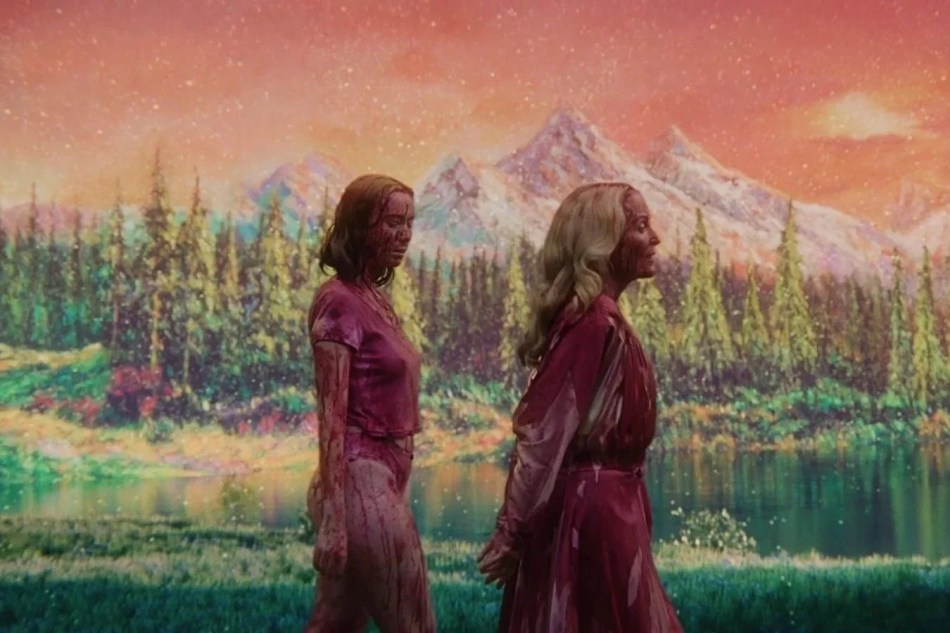
Teenage Sex and Death at Camp Miasma is a journey of self-discovery and self-acceptance. It is rapturously entertaining and gaudy at times, an ode to the slashers of the 1980s while also being a fun and gory slasher on its own terms and a reckoning with the ills of those films. Director Jane Schoenbrun takes on a meta approach, deconstructing the genre as it follows film director Kris Williams (Hannah Einbinder) who, after receiving praise for her debut feature film at Sundance, is working on a remake of the fictional slasher Camp Miasma. The film sparked a series of sequels and half-baked entries that for fans of the franchise, like Kris, were all guilty pleasures even if the quality had fallen off from the original. Trying to find a way into the material, Kris ventures off to the home of the original film’s final girl, Billy Presley (Gillian Anderson), hoping to convince Billy to return to acting and star in the new film.

Teenage Sex and Death at Camp Miasma is an ambitious work, but at its core, it is a very personal journey. Kris is stuck in her own head. When asked about herself, she talks about her films instead. She hides behind her work, the films she loves (like Camp Miasma), and the snacks she eats, using them as a mask with which she confronts the world. These are the avenues in which she feels comfortable expressing herself and being vulnerable, never quite able to get there when she is simply being Kris. Schoenbrun’s examination of this is quite tender, while Einbinder’s performance and growth from this repressed and internalized version of Kris into a very liberated and more expressive version of Kris by Teenage Sex and Death at Camp Miasma’s final, audacious act is remarkable. Her physicality completely shifts, her posture and style change – the costume design shift is a highlight in this regard – with Kris growing increasingly confident within her own body as her story progresses.
Key to this is her relationship with Billy. As the pair talk about Camp Miasma and the ideas Kris has for the film, they try to get to know one another. Kris, by her own admission, struggles with sex. She cannot get there mentally and physically because she is stuck in her own head, usually in a fantasy world she creates connected to the films she loves. “I watched too many films and they fucked me up,” Kris says to Billy at one point after the pair have a sexual encounter that is interrupted by Kris drifting into a vision of Camp Miasma’s killer “Little Death” (Jack Haven) stalking her. Every scene with Kris and Billy together is fraught with sexual tension, often playful and flirtatious. Even a KFC meal shared with Billy, in an exaggerated Southern drawl (Gillian Anderson is remarkable here, that twang is something special), talking about fried chicken and dipping sauce carries with it a charged sexual energy that can make one blush.
Teenage Sex and Death at Camp Miasma is all about the visual pleasure of cinema, the eroticism and thrill of voyeurism. Kris had her “queer awakening” seeing Billy in Camp Miasma. She idealized Billy as the final girl there, particularly the look in her eye as she orgasms while “Little Death” closes in on Billy and her lover in the original film’s climax. However, that feeling is “other” from Kris. She desires to re-create it in Billy’s eyes in her new film, but has no conception of creating it in herself. She is unable to see herself as that final girl running from the killer as a slow-mo shot emphasizes her breasts bouncing in a scantily clad outfit. She is unable to see herself as a sexual entity. As such, her relationship with Billy feels like a sexual liberation, another awakening, and a shedding of the insecurity, fear (of being “bad at sex”), and shame that Kris carries with her, leaning into her love of film and the fantasies she creates around them to allow Kris to see herself as that object of desire, that “young and nubile” character ogled at by the camera and desired by the viewer and killer alike.
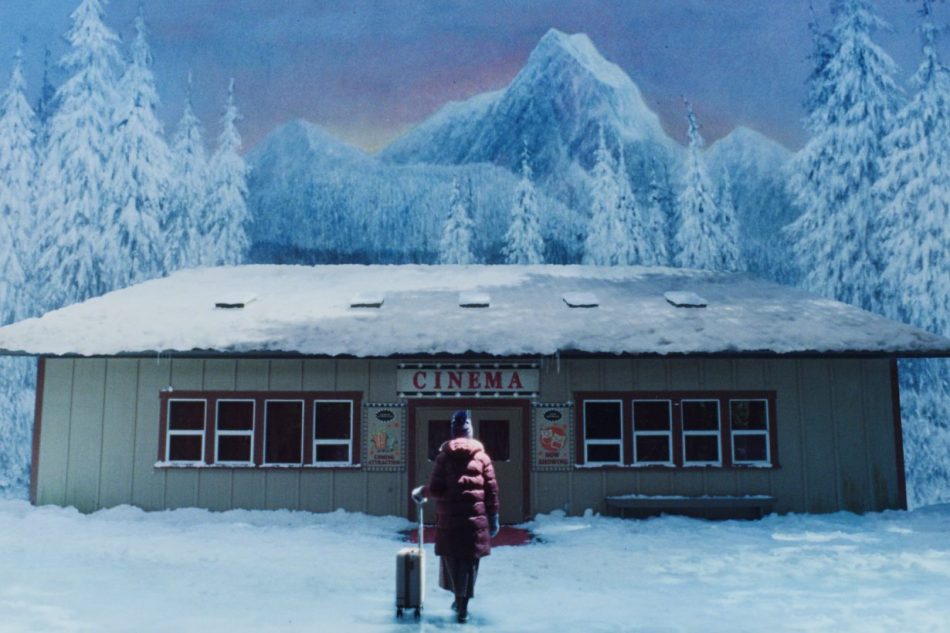
As Teenage Sex and Death at Camp Miasma leans into the fantasy, Schoenbrun’s approach to the film’s look is especially vital. The usage of glass matte paintings as backdrops to real locations gives everything the appearance of hyperreality. The works are stunning, remarkably detailed and transformative, while feeding into the film’s often postmodern bend. This is a self-reflexive, highly formalistic work with Schoenbrun not only having the characters frequently discuss the themes and concepts which the film is chewing on, but also the shots, tropes, and styles of the slasher genre that Teenage Sex and Death at Camp Miasma will also embody and replicate. That hyperreal feeling that the production design creates adds to the overall metatextuality of Teenage Sex and Death at Camp Miasma. As Kris is brought further into the fantasy and psychosexual world she created around Camp Miasma, the look and feel of the film follows her, drifting from the high-def digital reality to the colorful and stylized setting of “Camp Miasma” and film grained world therein. The production design is also remarkable when it comes to Little Death’s lair at the bottom of Lake Miasma, a David Cronenberg and especially Videodrome-esque concoction of VHS, body horror, and flesh that is as beautifully rendered as it is disquieting.
Early in their conversations, Kris tries to explain what she thinks Camp Miasma was about to Billy, only for Billy to retort that it was about “flesh and fluids” and nothing more. As Schoenbrun reckons with the subtextual readings of the genre, Teenage Sex and Death at Camp Miasma manages to be a fun and gory slasher on its own terms. Scenes of Little Death creating carnage mimic the often goofy and campy special effects of 80s slashers, while a particularly striking scene set to a Counting Crows needle drop has Little Death shown via long take steadicam carving through campers before stopping, revealing their eyes from behind their TV-shaped head. This is a film after a re-contextualization and, as Kris tries to reckon with the problematic elements of trans portrayal in slasher films, Schoenbrun does the same. Little Death is not “othered” here with their story of trauma and tragedy centered. While the metaphor around the name is quite literal (as Schoenbrun has pointed out, “Little Death” is “la petit mort” in French or orgasm), the usage of Little Death as not a force for sexual repression and conservativeness as was often the case in classic slasher films but as a force for sexual expression and pleasure is a smart twist while allowing Schoenburn to expand upon and further Teenage Sex and Death at Camp Miasma’s larger conversation with and about slasher films, their relationship to the viewers, and social mores.
As Schoenburn has done before, Teenage Sex and Death at Camp Miasma is an often very direct and didactic work. It is perhaps too literal at times with its metaphors and ideas, bogging down some of its fun along the way in the need to explain, elaborate, and muse, but this does not stop Teenage Sex and Death at Camp Miasma from being a lot of fun, playing in the sandbox of slashers to find a lot of poignancy and ingenuity about art, consumption, and sexuality. Hannah Einbinder and Gillian Anderson are fantastic here, their genuine chemistry and sensuality make their relationship into a delight to watch, while the stellar production design, cinematography, and effects make Teenage Sex and Death at Camp Miasma equal parts appealing to the eyes, senses, and mind.
Discover more from Cineccentric
Subscribe to get the latest posts sent to your email.


0 comments on “Teenage Sex and Death at Camp Miasma ★★★”