
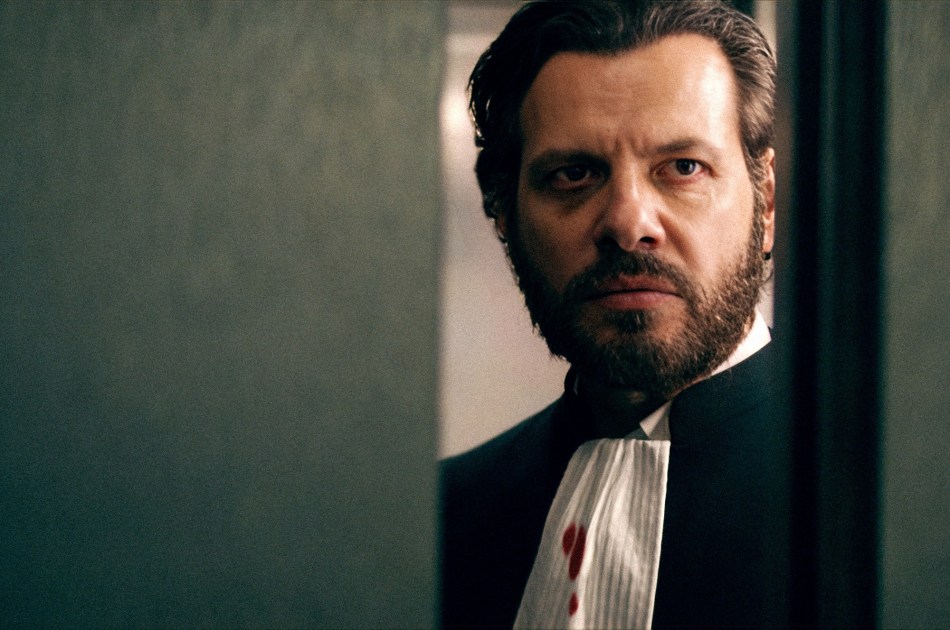
Despite the lack of intentional humour in Tristan Séguéla‘s overwrought courtroom affair, its title almost seems like an in-joke. “Bad Lawyer” would be more suitable for the shrill portrait of criminal-defence attorney Léonard Landry (Laurent Lafitte). His antics in court, where he finds himself as the defendant after a disastrous double-deployment in two concurrent trials, have the absurd hyperbole of the unruly behaviour from supposedly well-adjusted people, like Bad Teacher, Bad Santa, or Bad Moms. Though Landry’s actions, which never hindered his sweeping successes as a legal professional, are hardly more realistic than those of the characters in the mentioned ‘Bad’-films, either the director-co-writer or one of his three co-writers, Marcia Romano, Simon Jacquet, and Stéphane Sebag, wanted more serious material.
So Landry collapses after a long night of partying in front of the judge during two of his trials, which he accidentally scheduled at the same time and tries to win simultaneously by scurrying forth and back between two courtrooms. Packages of cocaine – which besides alcohol is his main physical fuel – fall out of his pockets as he passes out. Only three weeks later he is out of obligatory rehab and back at his profession, if solely due to an accused’s right to defend themselves. To continue his job, he has to win his own trial, something he hopes to achieve with the help of his colleague and ex Iris (an always reliable Mélanie Laurent).
Iris is understandably reluctant but might just change her mind. After all, Landry has essential information in a politically charged case of a young Congolese witness to corporate corruption related to war crimes, which she is currently heading. Equally pragmatic is his hiring of naive intern Noé (Anthony Bajon) whose main qualification in Landry’s eyes is driving a car. Landry vows to everyone around him to do better, but is he serious? Lafitte enjoys himself far too much to believably convey any true will to change in his character, whom Séguéla frames as a charismatic anti-hero. But within the story and as a character on screen, the egomaniac protagonist is just incredibly obnoxious. Seeing him scheme and fight his way back to the top is rather depressing, at least for those in the audience who don’t share the protagonist’s privileges.
With a bit of satirical sharpness, his story could have been another example of a brand of white, straight, middle-class man who never has to face any consequences for his toxic behaviour. But the slick aesthetic, flashy editing, and ostentatious soundtrack stylise his transgressions as something cool and daring. His flamboyant arrogance seems justified by his professional brilliance. The latter never appears credible, as Landry lacks the psychological depth necessary to plausibly integrate his contradictory qualities. Both the lead and the scenario become exhibitionist in their excessiveness. Despite bordering on self-parody, they still demand to be taken seriously, but lack the dramatic arguments.
Discover more from Cineccentric
Subscribe to get the latest posts sent to your email.


0 comments on “The Good Lawyer ★”