
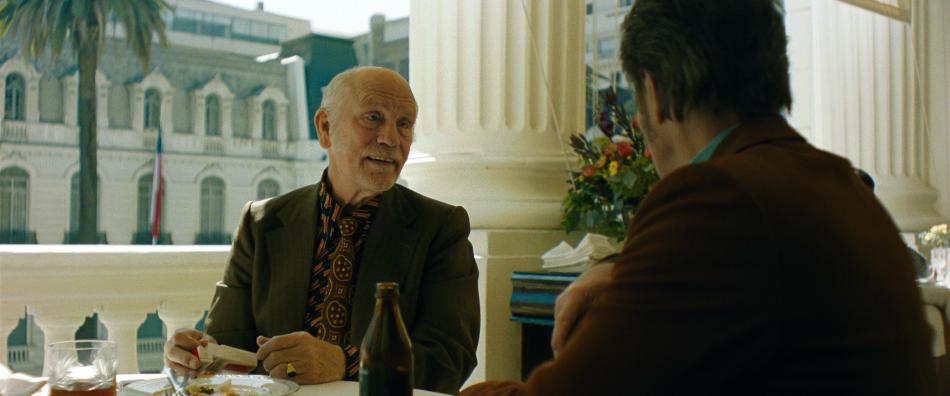
Chris Carlisle (John Malkovich) is a CIA officer at the tail end of his career. Late in his life after being diagnosed with cancer, he is preoccupied with the idea of heaven, musing about the topic to his fellow officer Lee Chesterfield (Sam Rockwell). Chris wonders if moths can go to heaven and if his acts of protecting moths from their death plays into any consideration of whether he will go to heaven. Chris’ gentleness towards the moths, and later horses, is contrasted with the nature of his work. Chris has been involved in the CIA’s 1954 destabilization of Guatemala’s democracy (“a success” he says), the CIA’s conspired involvement in the assassination of JFK (he is a little more reticent but, in his view, “a success”), and the Bay of Pigs (“not a success”). With a career like Chris’ and the progression of his cancer, his preoccupation with heaven is not unfounded.
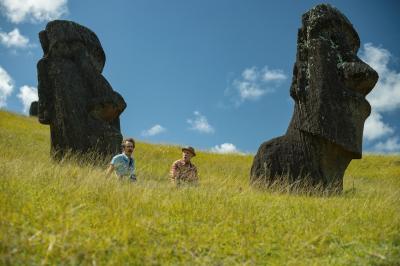
Lee accompanies Chris to Easter Island, but there is more to this trip than what meets the eye. It is not a vacation, despite Chris’ interest in the “giant heads”, and they are being monitored by MJ (Steve Buscemi), the CIA operative who oversees Chris and Lee’s work. Chris is talkative to a fault, his prognosis and question over the morality of his work weighing on him, and MJ believes there’s a risk that some secrets won’t die with Chris. Chris is interested in writing a tell-all memoir, a ludicrous idea for someone with his knowledge, and MJ is very motivated to ensure that Chris won’t complete his memoir. You can imagine the violent extent that MJ is willing to go to prevent this.
As Chris’ closest friend, Lee should be the person who Chris can trust, but Chris’ relationship with MJ has soured and all communication between them goes through Lee. Chris is skeptical of who he can trust and is determined for his death to be on his own terms. Chris’ saviness and his slightly unhinged behavior (he tells a story about a briefcase with a picture on it of a dwarf playing basketball) along with the secretive nature of CIA operations make for an unpredictable second act of Wild Horse Nine. Lee can never truly be sure if Chris is messing with him or is being forthcoming about his intentions, and Chris is skeptical if he can trust Lee. Opposite of Chris, Lee plays the straight man and is a proxy for audiences’ reactions to Chris’ absurdist banter. The two illustrate the buddy dynamic observed in a number of director Martin McDonagh’s films. Rounding out the cast are two leftist Chilean students who are also traveling to Easter Island and cross paths with Chris and Lee. Chris can’t resist informing them of the CIA’s plan for the 1973 Chilean coup later that year to their disbelief and horror, and this becomes the first incident that Lee has to correct for Chris’ behavior and babysit Chris on MJ’s behalf.
Set in the 1970s, Wild Horse Nine has the same interest in themes of paranoia and surveillance that 1970s cinema did, but also has the benefit of hindsight of knowing what has happened since. McDonagh is willing to poke fun at things that should be uncomfortable, but have since been normalized. In a present where there are cameras around every corner and an internet that is never truly private, the future that the 1970s envisioned has largely been realized. Similarly, history books and documentaries have since pored over the US’ role in destabilizing countries in the mid-20th century, and the US’ involvement in these countries’ turning points is now more evident than it was at the time, contributing to comedic and ironic dialogue in Wild Horse Nine. When Chris explains to the Chilean students that their political marches also function as a means to enable mass surveillance of a group of people supporting a cause, the students are disturbed by Chris’ nonchalant statement and his dismissal of the political marches’ effectiveness. Wild Horse Nine is effective in its dark political humor, and Malkovich’s Chris walks the line between being hilarious in his off-color humor and being a public nuisance (he goes out of his way to tell a British tourist couple that he supports the Irish). Still though, John Malkovich is disarming in his acting as an antihero, and we are drawn to care for the fate of his character. Even though Chris doesn’t hesitate to say the quiet part out loud, he experiences empathy for the Chilean students even though he is doubtful whether compassion holds a place in a contentious and cynical world.
Those familiar with McDonagh’s filmography will find much they recognize within Wild Horse Nine’s black comedy, buddy dynamic, and banter. Five films into his career, McDonagh has established himself as an auteur and his directorial presence is felt in Wild Horse Nine. Even though audiences will find similarities between Wild Horse Nine and McDonagh’s films, there is enough distance between its characters and setting from that of (the godforsaken) Bruges, Ireland, or America to feel derivative. Malkovich in particular delivers a nuanced, weighty yet comedic performance as Chris that alone distinguishes the film from its McDonagh counterparts. Chris’ wonder and offbeat humor in experiencing the “giant heads” of Easter Island also grant the film levity where it is desperately needed, and Wild Horse Nine’s grim subject matter is countered by cinematographer Ben Davis’ photography of the beauty of Easter Island. The idyllic setting is effective in Chris’ desire to find peace despite living a troubled life, and might just provide the opportunity for redemption that Chris needs to earn his way to heaven.
Discover more from Cineccentric
Subscribe to get the latest posts sent to your email.


0 comments on “Wild Horse Nine ★★★”