

There comes a time when every high schooler is forced to consider the future. Perhaps they’ll even get the privilege of taking a career aptitude test. The results of my test told me I was suited to be a detective, which was certainly a career path I’d never really considered. For better or worse, by the time I was in high school I was on a tunnel-visioned path toward the art life.
The question you often hear of, “Who do you want to be when you grow up?” is similar, but not quite the same as, “What do you want to do when you grow up?” As young adulthood approached, I didn’t really know what I wanted to do, but I knew who I wanted to be: someone who lived a right-brained kind of life; someone who spent their days chasing creative pursuits. Throughout high school I was heavily involved with theater groups, putting on plays, building sets, acting, directing a botched production of “The Monkey’s Paw” – I even earned a varsity letter in my sophomore year and, when my family moved back to Massachusetts in the summer of 1992, a few months after the Los Angeles riots, I went on to be the president of the Bedford High drama club.
Bedford offered something my previous under-funded school in San Bernardino, California never could: a photography class, complete with an oversized dark room and enlargers. I loved that photography class, but in just about every other subject my grades were average at best. At the same time, perhaps not unrelated to my middling academic achievements, my pop culture obsessions were only growing, with most of my time being spent watching movies or listening to music. When high school finished, and my mediocre SAT scores were in, my parents were separated and all too willing to let me figure it out on my own. But I was at a loss of where to go and what to do. I had a job at a crappy local video store for a while, and then a gig working at a Tower Records in a nearby town. It took a year or so to realize that art school was perhaps my best option, so I dove into a film program at The Academy of Art in San Francisco, a school that would take just about anyone who was willing to pay the tuition.
I certainly wasn’t alone in this film school pursuit. The early 90s were an inspiring time for movie mad kids like me. An exciting new sensibility was taking hold. It was aggressively present in late 80s movies like last month’s topic, Heathers, as well as next month’s topic, Do the Right Thing. It was also apparent in the films of Jim Jarmusch, Quentin Tarantino, Whit Stillman, and the man I’d like to talk about this month, Hal Hartley. Suffice to say, once again, in the early-to-mid-90s, there was a coolness to moviemaking, and many undergrads were heading out to learn the ropes.
For anyone looking to make an impactful low-budget movie, Hartley is one of the best examples you can point to. But aside from his unique writing and visual style, he initially stood out to me for other reasons. Much like Heathers – and many of the other movies we’ll go on to talk about – there was a convergence of music and film going on. Gen X cinema is simply inextricable from the music scene that was going on at the same time, both indie rock and hip-hop’s growing popularity (and you could say that the excitement around all of these things ended in the early 2000s when they were fully absorbed and co-opted by the mainstream). So when Hartley’s Amateur came out in 1994, with its soundtrack featuring Pavement, Jesus Lizard, Yo La Tengo, and PJ Harvey, nothing could have been more curated toward my own interests as these were all bands I was already obsessing over and basing my own meticulously curated mixtapes around. Really though, it was his previous film, Simple Men, and its lo-fi, choreographed dance scene to a favorite Sonic Youth tune that forged a lifelong allegiance between me and Mr. Hartley.
We don’t have the space to talk about all of Hartley’s work here, but since we’re moving somewhat chronologically in this series, and we’re at the point where adolescence turns to young adulthood, I see it as a perfect time to talk about the movies that established Hartley’s career – his first three features – which are now known as the Long Island Trilogy: The Unbelievable Truth (1989), Trust (1990), and Simple Men (1991). These are movies about trying to get out from under your parents and your hometown, all while navigating the many unappealing aspects of modern life – particularly, making a living without corrupting yourself. On top of that, Hartley is also the perfect guy to showcase the new postmodern sensibility that defines a lot of the Gen X cinema that was to emerge.
Hal Hartley’s name may not be as readily recognizable as some of his contemporaries, but he was a vital part of the second wave of film school directors that were following in the wake of the New Hollywood auteurs like Martin Scorsese, Francis Ford Coppola, and Brian De Palma, many of whom were hitting hard times in the 1980s. In some cases, like Michael Cimino with Heaven’s Gate, they were bringing entire studios down with them.
There are some interesting similarities between the late 1960s, when the first Gen Xers were being born and the old Hollywood system was struggling to adapt to a changing culture, and the late 1980s, when the studios were turning into unwieldy corporate conglomerates. In both scenarios, independent filmmakers found an opening – a way around the gatekeepers through smaller outfits that proved there was an audience hungry for the more personal or eccentric filmmaking that Hollywood is often too risk adverse to support. This appeared to be especially true in the 1980s, when studios were getting gobbled up by global companies like Coca-Cola and decisions were based more upon shareholder interests than the idiosyncratic whims of a studio head.
From the vantage point of 2026, the corporatization of Hollywood seems inevitable and something that offers very few silver linings. But in the late 80s and 90s this arrangement led to a new landscape of deferred risk, where the major studios found a willingness to invest and distribute smaller movies through subsidiaries and transactional partnerships. A lot of it can be traced back to foreign film distribution. Throughout the 80s there were a number of upstart outfits like Cinecom, Circle Films, and Miramax that would sign small distribution deals to book foreign films for screenings in the US, which, every once in a while, earned them just enough cash to invest in an independent American film. For Circle Films, it was getting the rights to Coen Brothers’ first film Blood Simple. For Cinecom, an early breakthrough was 1984’s The Brother From Another Planet, by John Sayles. For Miramax, it was Steven Soderbergh’s sex, lies, and videotape in 1989 – a film with a savvy marketing strategy that proved there was an audience for complex, grown-up movies that weren’t genre exercises.
Soderbergh’s movie also got a boost from a surprising win at the Cannes film festival, but a lot of the American indie-film boom had more to do with the emergence of the homegrown Sundance Film Festival. In just its second edition, in 1985, Robert Redford’s ski-resort shindig bestowed awards upon the Coen Brothers, Jim Jarmusch, and John Sayles – all of whom could be considered the godfathers of the new movement – the guys that paved the way for Hartley, Spike Lee, Tarantino, Soderbergh, Stillman, Todd Haynes, and, if we’re willing to stretch the timeline a little further, David Fincher, Spike Jones, Paul Thomas Anderson, and Darren Aronofsky (all of whom we’ll talk about more as the series goes on). Getting attention at Sundance, one of the first festivals to really focus on opening a distribution pipeline for American independent auteurs, was a game changer. But arguably just as important was that the festival had a sidebar – the Sundance Institute – which also served as a talent incubator, nurturing many young filmmakers with mentorships and workshops, and helping to keep the movement alive well into the 90s.
Some of the new talents making waves in the late 80s and early 90s were, like Harltey and Spike Lee, coming from a film school background, while others, like Tarantino and Spike Jones, were springing forth from the oversaturated media landscape, where the expansion of cable television and home media served as their autodidactic textbooks. In either case, these new filmmakers were extremely movie literate, with access to a wider variety of films than any previous generation could have dreamed of. They’d soaked up the influence of the New Hollywood filmmakers of the 60s and 70s, but they also had a strong familiarization with foreign films, exploitation movies, avant-garde and underground cinema, and anything else that was sneaking out onto late-night cable channels and bootleg VHS tapes.
One of the most enduring Gen X properties that kind of sums up this opening of the cinematic floodgates is Mystery Science Theater 3000, a show that started in the late 80s and continues to exist through spinoffs and reboots to this day. If you’re not familiar, the premise is rather metatextual itself. We the viewer watch as other individuals, a kidnapped guy and his two robot friends, watch B movies and make very nerdy, hyper-literate comments about it. In any given episode they might be watching a forgotten, trashy, no-budget genre movie while making jokes that reference Stanley Kubrick, Chantal Akerman, or Ingmar Bergman. With its willingness to mix high and low art, MST3K – especially in its first seven seasons – was a perfect encapsulation of the era’s new metatextual, broad-spectrum cinematic consumption.
Likewise, the filmmaking sensibility that emerges from this unprecedented level of accessibility is itself a postmodern kind of meta-movie. When postmodernism emerges in art, it is usually around a time of great change – following an “end of history” moment – when the ongoing narrative suddenly breaks from its past and there’s this feeling that we’re now living in a new era, and that our art should reflect or embrace that. It happened after World War I, which was seen at the time as the war to end all wars. In the years afterward, modernist movements like Futurism were in vogue, which fed into avant garde art, lent music a very challenging, atonal edge, and was the kind of environment that gave birth to James Joyce’s postmodern masterpiece Ulysses.
A similar thing was taking place around the end of the Cold War and the fall of the Soviet Union, as well as with the rapid encroachment of home computers. While a lot of Gen Xers were still kids when the Berlin Wall came down, and unable to grasp the full implications at the time, it is nonetheless a defining generational moment. At that time, popular culture was already inundated with apocalyptic narratives, from Dr. Strangelove to Mad Max. But this “end of history” idea was reemerging among philosophers and academics, and coming along just as home computers and home media technology were gaining mass popularity and fueling a new brand of tech-infused nightmares. Change was happening far faster than we could process it, humanity was becoming further endangered and the future feeling less comprehensible and inviting.

One might think that liberal democracy winning over communism and fascism could only be a good thing. Even though the US still had a stockpile of between 20,000 to 30,000 nuclear weapons at the time, and the collapse of the Soviet Union may have made the threat of a nuclear holocaust seem less imminent, the perceived win over the Soviet Union came with its own existential threats. As US State Department policy analyst Francis Fukuyama described it in a 1989 essay that was later turned into an influential 1992 book entitled The End of History and the Last Man, we were in for some sad times. With passionate ideological battles having been (apparently) decided, we were now left with a future that was primarily concerned with “economic calculation, the endless solving of technical problems, environmental concerns and the satisfaction of sophisticated consumer demands.”
It was a fairly bleak outlook. Sure, you could say that liberal democracy won, but it was really neoliberal economics that had succeeded in gaining entry to new corners of the world. This was the break that had occurred just as the 1990s were getting underway, and it not only spurred on a new wave of metatextual, postmodern art that often had a cynical edge to it. It was something carried over from the messiness of the Vietnam War, but also a recognition that the West’s victory in the Cold War was dubious at best.
In the cinemas, this postmodernism was evident in how the movies flaunt their cinematic nature and have very little interest in things like naturalism or making you forget that you’re watching a movie. It’s a sensibility that runs through most of what I’m calling Latchkey Cinema. While we may have paid respect to the Gen X upbringing within Sidney Lumet’s Running on Empty a few months ago, most of Latchkey Cinema is in direct opposition to Lumet’s style of realist dramas that had been popular for so long and can be seen enduring in mainstream 80’s movies like Ordinary People, Terms of Endearment, and even the prestigious period pieces of James Ivory. Latchkey Cinema is not cinéma vérité. They’re postmodern films that, like postmodern literature, emphasize style and technique. They’re not afraid of being self-referential in acknowledging their artifice and their influences or breaking the fourth-wall, much like Radio Raheem in Do the Right Thing, or Veronica Sawyer at the beginning of Heathers.
One could also point to the influence of MTV, but I think this may have been a little overstated at the time. When you look at contemporary criticism from the late 80s and early 90s, you can often see the critics using MTV as a pejorative in trashing any film that places an emphasis on style. But it wasn’t just American movies. In France, where they specialize in naming cinematic movements, it was called cinema du look, in response to the dazzling, over-exuberant movies of Leos Carax and Luc Besson. Looking back from 2026 you can see it all as part of a new wave of postmodern cinema, made at a time when the entire Western world was breaking from the past and moving into a new, post-Cold War era. Just as it appears in the pages of postmodern authors like David Foster Wallace and Jonathan Lethem, the style of the work being made is an intrinsic dramaturgical choice – and like any choice there’s some risk involved. This kind of heightened style can create spectacular moments of technical wizardry while also creating a work that is more intellectually appealing than emotionally satisfying.
At this point, we should mention the movies of Jean-Luc Godard. There’s a famous quote from Brian Eno about The Velvet Underground: that everyone who bought the first VU album when it came out ended up starting their own band. Just as the influence of the Velvet Underground was impossible to ignore in Gen X music, the influence of Godard, and perhaps the French New Wave in general, can be seen everywhere in Gen X movies. Filmmakers like Godard, Claude Chabrol, and Jacques Demy were ahead of the game in their willingness to mix and match styles – to use and abuse the cinematic languages – to embrace the cheap thrills of genre filmmaking and turn what previous generations had tagged as low art as a crucial ingredient in their playful, formally adventurous and sophisticated style of moviemaking. Godard was arguably the most adventurous and influential, but in his ceaseless exploration of the cinematic medium he also became the most egregious in pursuing the intellectual at the expense of the medium’s emotional interests. As with the American, Gen X, postmodern authors that would follow – most famously Jonathan Franzen – Godard’s movies ended up being labeled as “difficult.”

In the 1990s, after he’d already put his stamp on the American indie movie scene, Hal Hartley was dubbed “the Godard of Long Island.” It made some sense. On the one hand, he was making postmodern cinema, and he was interested in many of the same things Godard was interested in – the politics of the personal – including the dark side of capitalism and casting a critical eye on modern society’s willingness to be corrupted in exchange for convenience. But unlike Godard, Hartley never got pedantic or ponderous. He continued to make postmodern cinema that were both intellectually and emotionally satisfying.
The secret sauce to Hartley’s movies is that he’s a blue-collar kid from New Jersey whose father was an ironworker. Yes, he’s into Godard and Wim Wenders, as well as the work of the French playwrights Molière and Victor Hugo, but he’s also got a deep fondness for working class people who get by doing wage-labor. And to balance out his European film influences, he’s crazy about the screwball banter of Howard Hawks pictures and the unpretentious satires of Preston Sturges. So while his ideas may get lofty, he always remains grounded, rooted in his interests about salt-of-the-earth characters and their trials and tribulations in a world that is often at odds with their moral compass. This was the mix that would get attention. It was unique. Add to it a production design that is extremely detailed, often containing visual palettes and wardrobes filled with bold primary colors, and you’ve got the kind of thing that would influence some key voices that emerged in the mid-to-late 90s, including Kevin Smith, Wes Anderson and Noah Baumbach.
What is especially striking is that, like the postmodern writer Thomas Pynchon, Hartley came out of the gate with his trademark sensibility almost fully intact. From the start, as a sort of low-budget special effect, Hartley knew that he could turn dialogue – the way people talk to one another – into action. So characters deliver their lines like they’re trading jabs, or sometimes they talk around each other, as a way for two characters to deliver an inner-monologue while sharing the same scene. The rhythmic verbal jousting becomes its own dizzying action set piece. It’s a kind of anti-realist, deadpan style that would bring to mind David Mamet if it weren’t so funny.
Another budget-conscious move that was turned into a signature part of his style was forgoing the establishing shot. It may not sound very radical on paper, and you may not even clock it upon first viewing, but few directors will start a movie the way Trust does, with characters in an unestablished interior environment, in the middle of an argument – or proceed the way Simple Men does, with characters bouncing from one interior scene to another interior scene – and yet it all tracks. He’s not withholding important information. The characters are in a diner or a suburban home, do you really need to know what the outside of the place looks like?
A curious thing before it screened at the 1990 edition of Sundance, Hal Hartley’s first feature film, The Unbelievable Truth was shown at Cannes in 1989, the year the Berlin Wall came down, an event that was so phenomenal it reignited an interest in the philosophical idea of “the end of history.” So much of the twentieth century narrative had been dominated by the fight for democracy – between capitalism, communism, and fascism – that the fall of the Berlin Wall was seen as a clear and obvious sign that the West had finally won. With this apparently definitive victory, an era of modern history had ended, ushering us into a new, postmodern era that was going to be dominated by a growing number of intrusive technologies.
Of the young filmmakers that were emerging at this transitional moment in history, Hal Hartley stands out for being highly attuned to the complexities swirling in the air at the time. That is immediately apparent in the opening scenes of The Unbelievable Truth, which also marks the acting debut of the luminescent, one-of-a-kind Adrienne Shelly. And when we first meet Shelly’s Audry, the high school senior protagonist of the film, she’s lying in bed under two prominent pictures: an oversized painting of George Washington’s portrait on the one dollar bill and a black and white photo of an atomic bomb explosion. Lying next to her is a book entitled The End of the World. Over the next few minutes, Audry’s character, as well as those of her parents and her soon-to-be ex-boyfriend, are presented with ruthless and hilarious efficiency.
Hugging her book, Audry slouches toward the breakfast table as her parents barrage her with questions. We learn that she hasn’t been at school all week, she’s quit her job, and she doesn’t want to go to college even though she’s been accepted to Harvard. Why not? Well, Audry doesn’t see the point. She tells her father that “history is coming to an end” and we’ll all be lucky if we’re still around in September. To which her father, incredulous that she didn’t apply to any less expensive colleges, replies with one of the funnier lines in the film, “The world’s not going to come to an end with so many people making so much money.”
We then see her walking with her boyfriend Emmet, who bears a striking resemblance to modern day Eric Trump. Emmet says he’s ready to “take the world by my teeth, chew it up, and spit it back out again.” The wheels of fortune are spinning in his direction. But Audry thinks his $185 suit looks gross while Emmet thinks Audry is being apathetic and talking like a crazy person with her concerns about nuclear proliferation and the ailing environment. Audry promptly dumps Emmet, leaving him standing in the middle of the road, literally stunned and unable to move.

For Audry, so much of life feels pointless and empty. In the previous entries on adolescence and delinquency, we talked about how disillusionment – either consciously or unconsciously – is rooted in the limited appeal of the options on offer in the American workforce. These feelings don’t really go away as the prospect of adulthood encroaches further upon you. But Audry’s plight is interesting because it’s two-fold. On top of recognizing the emptiness that’s inherent in the consumerist brand of American capitalism, she’s also left reeling by the threat of humanity’s extinction. At one point, referring to the growing variety of nuclear weapons being created, she points out that humans have never invented something they didn’t use.
This young couple who we meet right on the verge of breaking up is the late 80s, post-Cold War outlook in a nutshell. You were either like Emmet, and ready to boogie down with the expanding free market economy, or you looked out upon this landscape like Audry, and many of Hartley’s other protagonists, and saw the makings of a soulless, meaningless, technologically-driven, consumerist dystopia – one that was likely wreaking havoc on the planet in more ways than one, and one where any number of unforeseen mistakes or crises could trigger the launch of the tens of thousands of nuclear warheads tucked away on the planet. Not exactly the world one wants to rush out and be a part of.
Audry is a wonderful protagonist for this moment because, like a lot of disillusioned teenagers at the time, she’s being called apathetic even though she cares deeply about a great number of things. It’s the countercultural nature of her caring, and her general disinterest in making money for the sake of making money, that is deemed wrong or unnatural. The fact that having a strong moral compass can so easily be seen by “grown ups” as an annoying problem, or an impediment to success, is a great gag and one that has only gotten more relevant with time.
As the movie goes on Audry’s resolve is tested through a series of deals with her father, beginning with his agreement to make donations to her favorite charity if she agrees to “play the game” of being an adult, a game that is mostly made up of compromises. These include agreeing to pose for a professional photographer, which turns her into a successful fashion model but only serve to make her more disillusioned. “They paid me a thousand dollars to put on a shoe and take a photo of my foot.” The emptiness only becomes more pronounced, the compromises more insidious.
The one thing Audry is drawn to is Josh (Robert John Burke), a mysterious guy who’s just been released from prison. After some years away, Josh drifts back into town with the dark cloud of two deaths hanging over his head. Like Audry, and a lot of Hartley’s characters throughout his career, Josh is a man of principles. In his case, it’s a monk-like pledge of abstinence that’s the result of his past mistakes – those deaths he feels responsible for. Josh has returned to his hometown with nothing but a bag of tools that go along with the new talent he picked up in prison: car repair. He’s turned himself into a zen mechanic, with an intricate understanding of engines and thermodynamics and a desire for isolation.
This set up, between a disillusioned girl and a man who’s isolated by a mix of circumstances and principles is a recurring theme in Hartley’s work. In fact, it’s echoed pretty strongly in the second movie in the Long Island Trilogy, Trust. This one also stars Adrienne Shelly, this time playing Maria, a pregnant seventeen-year-old who’s dropped out of school and has scared off her jock boyfriend. Maria crosses paths with Matthew (Martin Donovan), who, rather than cars, can fix just about any electronic device.
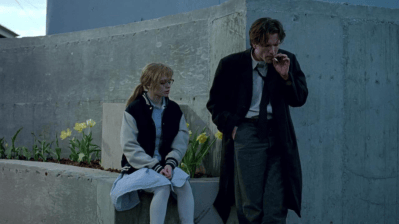
In Trust, it’s the guy who’s got the strong anti-capitalist convictions which get severely tested over the course of the story. We meet Matthew as he’s in the process of quitting his job at a computer manufacturing warehouse. He’s tired of being a cog in a machine that makes cheap electronics and puts more garbage into the world. He just can’t do it anymore. His abusive father tries to get him a new job at an electronics repair shop, but Matthew refuses to repair televisions (he believes they give people cancer). Matthew’s got standards, principles, convictions.
As in The Unbelievable Truth, those principles are appealing to Maria, but Matthew becomes so enamoured with Maria, and finds taking care of her to be such a fulfilling purpose in life, that he ends up compromising those principles and crawling back to the manufacturing job. That way, they can get married and they’ll have health care coverage. But as a result, Matthew ends up seduced by the distracting glow of the TV. He explains how it “deadens the inner of my being,” which is a good thing because it makes the daily sacrifices of subverting his principles possible.
So the job is making him boring and mean but, in Matthew’s estimation, it’s also making him a respectable person in society. It’s essentially the core dilemma in the movie: Matthew and Maria open up each other’s worlds, but the reality of the world around them isn’t exactly built to support their relationship or their wellbeing. It’s an epidemic predicament that the movie, to its credit, doesn’t pretend to solve.
While neither The Unbelievable Truth nor Trust have what you’d call a typical happy ending, the first film ends on a more upbeat note than its follow-up. Audry’s journey through the venal wringer of being a model leads her back to Josh, who’s come to terms with his past and been absolved of his crimes, allowing him to reconsider his oath of abstinence. They practically ride off into the sunset together, even though the sound of falling bombs may be trailing them. In Trust, however, Matthew fails to reconcile his desire for Maria and his desire to not have his talents be exploited. It leads to a failed suicide attempt involving an unpredictable hand grenade that does more damage to the computer factory than anything else. Matthew is dragged off by the police – the silver lining being that both he and Maria have made each other better people than they were before.

Matthew wasn’t the only guy in this situation of being a young man entering a serious relationship for the first time while trying to balance his principles against a society that is designed to keep the proletariat happy, or at least well-sated. In 1989, Lloyd Dobler gave a memorable spiel in Cameron Crowe’s debut film Say Anything…: “I don’t want to sell anything, buy anything, or process anything as a career. I don’t want to sell anything bought or processed, or buy anything sold or processed, or process anything sold, bought or processed…”
For Lloyd, the way around this (in my eyes) very reasonable desire is kickboxing. Fair enough. But there’s something that continues to be appealing about the professions of Josh and Matthew in Hal Hartley’s films. Knowing how things like car engines and electronics work – and being able to repair them and prevent them from being added to our ever enlarging and increasingly toxic mountains of garbage – is not only a noble line of work, it is future proof.
A lot of disillusionment comes from the fact that the job market is full of companies and industries making things we don’t need – or, as is the case with Matthew’s employer, they’re making potentially useful things in the cheapest possible way, with short-term corporate profits far outweighing long-term consumer benefits. That was true forty years ago when the first Gen X teenagers were looking for jobs, but it’s only more so now as much of the job market is built upon technologies and practices that are shaping up to be harmful in ways we’ve yet to fully comprehend.
To make matters worse, so much of the job market these days is tied to devices, platforms and services that are specifically designed to distract, satiate and, as Matthew puts it, “deaden the inner of my being” – to make the happy prole. Meanwhile, many of our most important jobs – the ones that involve caring for people in need and keeping our food, public sector, and service industries running – are woefully undervalued. If your job doesn’t involve helping to make someone else rich, there’s a good chance you’re barely making a livable wage.
Similar to Lloyd Dobler longing to be a kickboxer, in Running on Empty, we saw another exit strategy in this dispiriting arrangement: becoming an artist. Getting a chance to enroll at Juilliard and become a pianist and composer was something that even the most militant anti-capitalist father couldn’t deny his son. In The Unbelievable Truth and Trust, Hal Hartley shows us his blue collar roots when he points out that being a mechanic and knowing how to build and fix things is a valuable skill. It’s the kind of profession that allows you to hold your head up pretty high in this world, even if Matthew’s talents were unable to provide him with much solace.
At Bedford High School, sitting across the hall from my photography class and its darkroom was the shop class, where students could learn about car repair and how to build and fix things. This part of the school was tucked away, practically separate from everything else. Surely some students would find lasting benefit from all the algebra and social sciences, but down a corridor and off to the side were two very tangible futures: art and mechanics. Naturally, I opted for the photography class, but now, looking back, I kind of wish I’d also taken the shop class. The sad thing was that a lot of kids looked down upon the students in shop class. They were seen as “the townies,” the ones most likely to work at the local gas station after graduation – as if that was some sort of horrible fate. The irony is that much of what I learned in photography class has been made virtually obsolete in the years since, whereas one could probably still be making a good living off the skills that were taught in a 1990s shop class. They say it’s never too late to learn a trade, and I may be naively romanticizing things, but it’s hard not to look at the life of a carpenter, electrician, mechanic, or a bespoke upholsterer with the distant longing of a road not taken – not unlike my unpursued profession as a detective.
In Hartley’s Long Island Trilogy, we’re never far from the goings on at the local gas station, perhaps the one place where honest work is being done. Audry’s father, Vic Hugo (Christopher Cooke, yes, playing a character named after the French poet), owns the one where Josh ends up fixing cars in The Unbelievable Truth. The other employee is Mike, who, when he’s not pumping gas, is in his jumpsuit playing blues riffs or arena-ready solos on his electric guitar. Hartley obviously has a lot of fondness for both of these characters, and Vic and Mike appear again in the last episode of the trilogy, Simple Men.

With his third feature, Hartley swerves away from the young love/girl-meets-boy thematics of the first two movies and takes an exploratory step into adulthood. It should be noted that in between Trust and Simple Men was Hartley’s hour-long American Playhouse production Surviving Desire. It’s notable for a number of reasons. Aside from being top shelf Hartley, and a work that does and says more into 55 minutes than most two hour films accomplish, it’s a work that heightens his style even further, putting into play many of the techniques he’d carry forward into Simple Men and beyond. Primarily, the way the actors move or position themselves within the frame, even if they’re not necessarily doing anything.
Hartley emerged knowing how to make dialogue function like action, but between Trust and Simple Men there’s an increased attention on having the characters not just speak in a stylized way but move, stand up, sit down, etc., in a way that is purposefully choreographed. Again, like the dialogue, it’s not a natural, realistic way of moving, but it adds to the dramaturgy of the picture by adding tension in some scenes, humor in others. Sometimes it’s like a ballet, with the movements expressing an inner aspect of the character, other times it is just a way of keeping the movie crackling with energy, with people getting pulled in and out of frame. But, perhaps more than anything else, it’s a way for a filmmaker who loves deadpan line delivery to add both motion and emotion to his scenes.
The most obvious thing that sets Surviving Desire apart is its short but lovely and surreal dance sequence. After its main character, again played by Martin Donovan, gets a kiss from the girl he’s infatuated with, he walks off into the evening and is joined by a few other random dudes in an elegantly staged but comically lo-fi dance routine which nicely choreographs everything that Donovan’s character is going through. It’s a significant and ecstatic moment of Hartley breaking fully away from the realm of realism and embracing the cinematic form for all its worth, and it’s not only that spirit which is carried into Simple Men, but he also manages to stage another dance sequence that is, for my money, absolutely iconic.
The other theme that needs to get tracked as we head into Simple Men is the subject of desire itself. Obviously, Surviving Desire is interested in the subject. When Donovan’s character is in pain and wondering if he’s falling in love, he’s told that all pain stems from desire. And in Simple Men, when the brokenhearted Bill McCabe (Robert John Burke, back again) is giving advice to Ned, a hapless romantic, he warns him that life isn’t about adventure and romance, “there’s only trouble and desire… when you desire something you immediately get into trouble, and when you’re in trouble you don’t desire anything at all.” When Ned suggests that this is ironic, he’s corrected, “It’s a fucking tragedy, is what it is, Ned.”
Of course, the fact that life is often both ironic and tragic is what gives us so many stories, and in Simple Men, we have the story of two brothers looking for their father who’s on the run from the law. William McCabe was once an all-star shortstop, but like the parents in Running on Empty, he’s wanted by the police after a bombing of a government building – in this case the Pentagon. McCabe’s two boys, Bill and Dennis (Bill Sage), are a bit messed up, in part because of their father’s abandonment. Bill says he can’t stand the man, and if they find him, he’s going to “give him a piece of my mind!” But in actuality, as we see when they finally do come face to face, Bill has become the spitting image of his dad. Add to that the fact that both Bill and William, like their father, are being chased by the police.
But the broader ironic theme is more of the can’t-live-with-it-can’t-live-without-it variety. The movie opens with Bill getting dumped by his girlfriend as the two are in the middle of robbing a computer warehouse in New York City – hence why Bill is a wanted fugitive. When Bill then meets with his brother Dennis to track down their father, he’s so distraught over this breakup he vows to mistreat the next woman he meets – make her fall in love with him, use her up, and then toss her aside. Bill is of course drunk when he comes up with this vengeance plot, but his romantic distress is playfully reflected in the sheriff who is on his trail, played by Damian Young, who is also in a post-break up, existential pit of despair that has him contemplating some dark, misogynistic ideas. This policeman is stuck, barely able to function, under the impression that “life is one big endless quagmire of futility, broken dreams and smashed hopes. You give your heart and soul to people and they just stomp it to pieces!”
When the brothers track their father’s whereabouts to Long Island, they encounter two women, Kate (Karen Sillas) and Elina (Elina Löwensohn). Kate is fearful because her ex, who’s possibly psychotic, has recently been released from prison. Elina, it turns out, is the current girlfriend of William McCabe, and she’s wondering if the old man has left her behind or not. They also meet Martin (Martin Donovan, naturally), a fisherman who also knows the father in question and is hopelessly infatuated with Kate.
In typical Hartley fashion, the brothers fall for these women – Bill enamored with Kate, Dennis with Elina – because of their principles. Bill likes that Kate is a strong, independent woman who refuses to lie, runs her own small, seaside restaurant, and dreams of starting a tree nursery. Dennis is taken by Elina’s dedication to her father’s anti-establishment crusade and her proud, defiant feminist streak.
Hartley sums up Elina’s character in that iconic dance I was alluding to earlier. In an homage – and I would say slight improvement to – Godard’s dance scene in Bande à part, Elina, bearing a none-too-subtle resemblance to Anna Karina, leads Dennis and Martin in a choreographed dance routine to “Kool Thing,” Sonic Youth’s feminist boot-stomper, where Kim Gordon purrs about women’s liberation and man’s “fear of a female planet.”
This remains a breathtaking moment of cinema for me, no matter how many times I see it. Granted, it’s boosted by the brilliance of the scene that follows, when our five drunken newfound friends start talking about the exploitation of women in pop music and what it means to suggest that an artist like Madonna can exploit her sexuality on her own terms. It’s not only funny to hear Bill say that you can learn a lot from pop music, and for pop-adverse Martin to include Grand Funk Railroad and “Hot ‘fuckin’ Tuna” in his list of favorite bands, but the argument about whether the nature of exploitation has ever improved or merely changed is one that has only become more relevant with time.
One of the connecting themes to all three of these movies, and something that I’m sure will continue to come up when talking about Gen X cinema, is the idea of selling out. Now, if you were to make a list of the major differences between Gen X and Millennial and Gen Z concerns, selling out would have to be near the top. Being considered a sell-out was deadly in the 90s. Artistic integrity and staying true to your values was important – a defining characteristic. No one wanted their likeness or their music used for advertisements. “Being corporate” was a terrible slur, akin to selling your soul to the devil.
In The Unbelievable Truth and Trust, both Audry and Matthew pay a price for making exceptions to their principles. They believe that they’re doing the right, or at least responsible, thing by becoming part of an exploitative system. Maybe they could, like Madonna, do it on their own terms. But no. By the end of the movies they find their way back to why those principles were so important in the first place. Their resistance to conformity and mediocrity was what made them appealing, likeable, if not lovable, individuals in the first place.
In Simple Men, Bill wants to make the right decision and give up his life of crime to be with Kate, but the police are literally on the doorstep, ready to arrest him for the robbery. This crucial moment comes down to Kate. Bill asks her to protect him by lying to the police, but she isn’t willing to do it, even for the man she loves. This time around, we don’t go through the business of a virtuous character compromising and learning from their mistake. Instead, we see Bill’s love and admiration for Kate, even as the police are dragging him away. We already know what Bill knows: that lies are used to make things easier in the short term, but they make things more difficult in the long term.
Everyone else is heading off with William McCabe aboard Martin’s boat. And there’s little doubt they’re on the virtuous path because the old man lays it out for us:
“We do not know when the revolution will triumph, but we know that the revolution is with us. And there is no doubt that if the revolution is crushed, it will be crushed because, on this occasion, we have been defeated; and never because we believed it useful to compromise. We will have on events the kind of influence which will reflect our numerical strength, our energy, our intelligence, and our intransigence. Even if we are defeated, we will have performed a worthy task. For human progress is measured by the persistence and regeneration of selflessness, and a willingness to see beyond the limits of our own time. And if today we fall without compromising, we can be sure of victory tomorrow.”
We’re never that clear on what William McCabe’s cause is, but it doesn’t really matter. The point is clear: so long as we don’t compromise, we will be victorious. Maybe we’ll lose a battle or two, but we’ll win the war if we remain true and selfless – if we don’t sell out.
For a while, this attitude was something of a generational north star. The music and the movies that mattered in 1992 were the independents, the iconoclasts, the irreverent, uncompromising auteurs. We cheered when Tom Waits sued corporations for using advertising jingles that only sounded like his music and we hung our heads in shame when the first John Lennon song popped up in a Nike commercial.
Of course not all of us are in a position to decline the clarion call of corporate advertising money, but we are in a position to opt out of exploitative systems that offer little in return. If one were to try and pinpoint the time when a generation decided that not selling out was an overrated principle, it would probably be around the time of the first smartphones, which offered a cool, relatively easy-to-obtain status symbol, and a lot of convenience, in exchange for more abstract costs like privacy and access to personal data. But putting a value on convenience is a slippery slope, one that takes its toll in many other ways like declining cognitive functions, rising social anxieties, increased loneliness, and newfound levels of ADHD. It all leads to AI-powered personal assistants that are taxing the planet in ways that make the Dead Kennedy’s sentiment from 1988, “give me convenience or give me death,” seem eerily prescient.
What’s really eerie is that one gets the feeling that most people know that smartphones, social media, and the massive amounts of energy and water being sucked up by AI are all bad for us. We understand that we’re doing harmful things to ourselves and to our future selves and others. In the recent documentary My Undesirable Friends: Part II, the Russian journalist Elena Kostyuchenko observes that the inordinate amount of power granted to Vladimir Putin, which made the invasion of Ukraine possible, had been all about maintaining a certain level of comfort that people had gotten used to. It speaks to what took place in post-Soviet Russia, but the same thing happened all over the world. We could have avoided so many of the problems we now face, but time and time again we’ve chosen comfort as the more important value. In other words, we’ve sold ourselves out.
You could also say that, as Bill learned in Simple Men, we’ve lied, or accepted the lies that we knew weren’t true, because it was easier in the short term, even though it causes far bigger problems down the line. Trouble and desire. Trouble and desire…
In an effort to end this on a more positive note, all of this brings to mind one of the central questions in Harltey’s Surviving Desire. Martin Donovan’s character, Jude, is standing in a bookstore, lost in confusion. He thinks of himself as a smart guy, and yet wonders if his intelligence is really doing him any good. He wonders aloud: Shouldn’t learning be helpful? Shouldn’t it be making my life better? What good is all this reading and knowledge if it doesn’t provide solace?
For Jude, and a lot of the characters in Harltey’s movies, it comes down to action. Knowledge and intelligence is only good if you take what you’ve learned and actively apply it. It’s not as easy as it sounds, which is why it’s one of those essential stories, of someone having to step out of their comfort zone and into the unknown. In the Long Island Trilogy, Hartley is telling us to take action without placing too much concern in the outcome. It might not work out, but the glory is in the doing.
Surviving Desire underlines this with its opening by having Jude quoting Fyodor Dostoyevsky to a deeply frustrated class of college kids.
He says, “… I believe that you are sincere and good at heart. If you do not attain happiness, always remember that you are on the right road, and try not to leave it. Above all, avoid falsehood, every kind of falsehood, especially falseness to yourself. Watch over your own deceitfulness and look into it every hour, every minute. Avoid being scornful, both to others and to yourself. What seems to you bad within you will grow purer from the very fact of your observing it in yourself. Avoid fear, too, though fear is only the consequence of every sort of falsehood. Never be frightened at your own faint-heartedness in attaining love… love in action is a harsh and dreadful thing compared with love in dreams. Love in dreams is greedy for immediate action, rapidly performed and in the sight of all. Men will even give their lives if only the ordeal does not last long but is soon over, with all looking on and applauding as though on the stage. But active love is labour and fortitude… [and] just when you see with horror that in spite of all your efforts you are getting farther from your goal instead of nearer to it – at that very moment I predict that you will reach it and behold clearly the miraculous power of the Lord who has been all the time loving and mysteriously guiding you.”
There you go. No one other than Dostoyevsky will tell you to stay on the path, do the difficult thing, choose love and action. Don’t sell out for the easy rewards, the applause and recognition. Stay true to those values and you can at least be sure you’re doing God’s work – you’re doing the right thing. Which is probably a good place to say, thanks for reading, and that we’ll pick up this thread next month with Spike Lee’s Do the Right Thing.
Discover more from Cineccentric
Subscribe to get the latest posts sent to your email.


0 comments on “Latchkey Cinema – Selling Out (ft. Hal Hartley)”