

Realizing that Wes Anderson has been plying his trade for over thirty years came as a minor shock to me when the director debuted The Phoenician Scheme at the Cannes Film Festival. I can clearly recall watching Bottle Rocket when it first showed up at the video store back in 1996, and then marveling at how his ambitions and his craftsmanship steadily grew in the years and decades that followed. Has it really been so long? And is it just me, or does Anderson still look the same as he did fifteen years ago?
Existential issues aside, some have touted The Phoenician Scheme, his thirteenth feature, as a return to form for Anderson. But a more accurate way to put it is that, for the first time in a while, the director can be seen as taking his foot off the pedal and easing up on some of those ambitions. The Grand Budapest Hotel, The French Dispatch and Asteroid City all reveled in creating increasingly heady, meta structures – a character’s off-screen fate might be revealed as a theater production, or a televised making-of documentary about a stage play might serve as the framing device for what is otherwise a filmed adaptation of said play. For better or worse, The Phoenician Scheme dispenses with the Russian nesting doll story structures and sticks to telling the relatively straightforward story about a few days in the life of a wealthy industrialist named Anatole “Zsa-Zsa” Korda (Benicio del Toro) and his estranged daughter Liesl (Mia Threapleton).
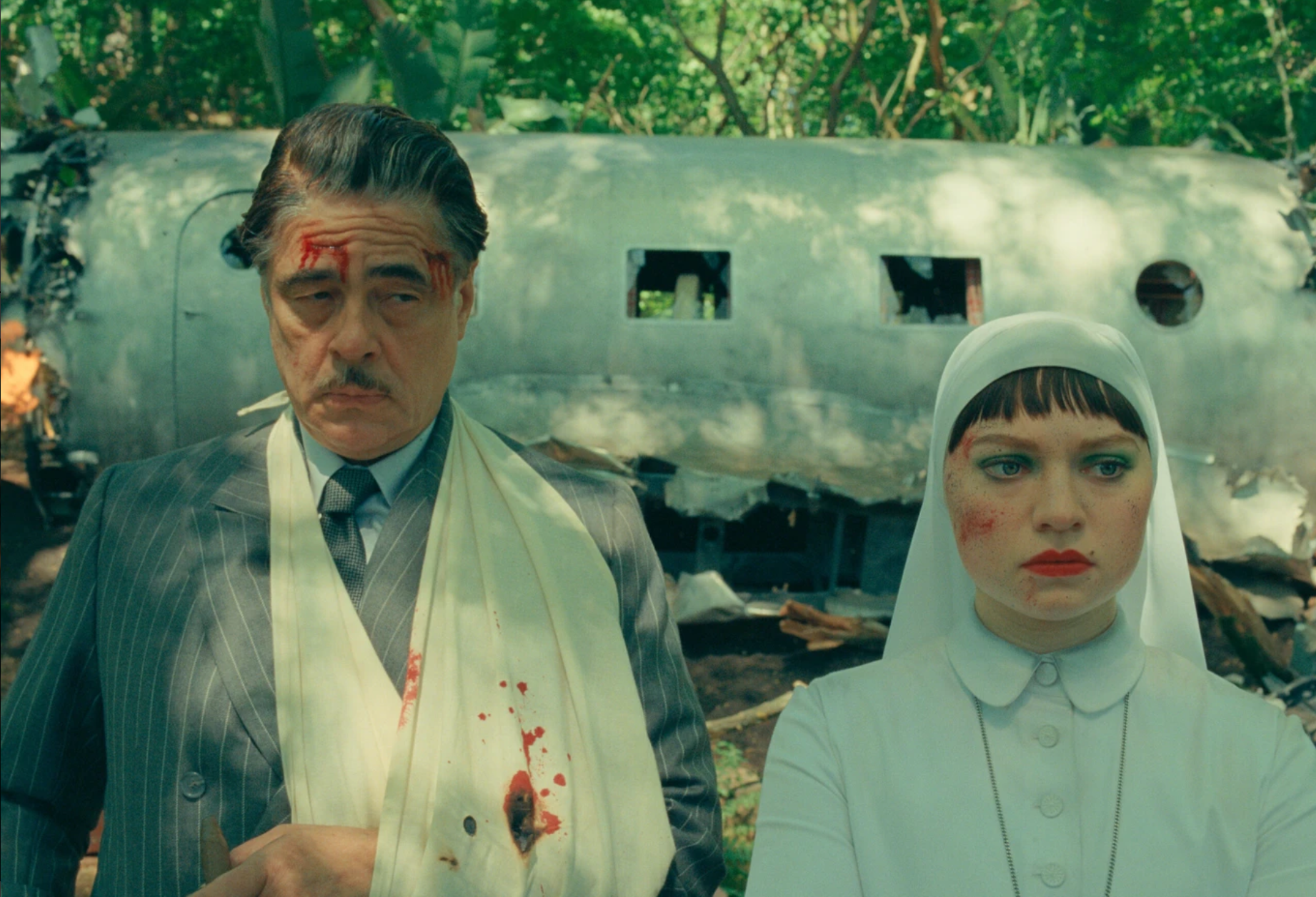
There is a warm sense of familiarity in this story because Korda shares a lot of traits with past Anderson protagonists such as Royal Tenenbaum, Steve Zissou and Monsieur Gustave – all of whom start out as tough SOBs but eventually open up and become more humane after reconnecting with their offspring (or in the case of Gustave, a young bellhop) and learning to become a lovable father figure. Such is the case with Zsa-Zsa Korda, who, after yet another near-fatal assassination attempt, reaches out to his adult daughter in order to prepare Liesl for taking over his business. At the start, Korda is a cold and calculating businessman, not above using slave labor and creating a famine if it benefits his bottom line. Liesl grew up in a convent and is preparing for a life of devotion as a nun but agrees to indulge her father, at least on a trial basis. In classic screwball comedy fashion, these two opposites learn from each other and come away changed in small but profound ways.
Of the utmost importance to Korda is an ongoing, multi-faceted project in the nation of Phoenicia that involves the building of a dam and putting a railway line through a mountain, among other ventures. This is, as he explains to Liesl, his life’s work – a final testament to his industrial prowess. In perhaps the most Wes-ian touch, the four facets of this scheme are represented by shoeboxes, each containing all the necessary details on the project and its investors. It feels especially appropriate since, as Korda and Liesl fly off to visit the investors, each of the locations is like a shoebox diorama – immaculately designed with their own unique details and color palate.
Complicating matters – aside from the fact that potential assassins continue to lurk around every corner – is an international consortium of competitors who are at work fixing the prices of building materials, as well as the fact that Liesl has set terms to her cooperation that includes no slave labor and no famine. As a result, Korda has a lot of work to do to fix “the Gap” in his funding, which means convincing all of his investors to change their contracts and chip in more money. This appealing storytelling device – hopping from to one new set to another, meeting Tom Hanks, Bryan Cranston and Riz Ahmed in the mountainous train line, popping in to see Mathieu Amalric at his French-themed nightclub, then going to visit Jeffrey Wright on his ocean liner, before checking in with Scarlett Johansson at the construction site for the dam – serves as a strong engine for the movie and makes The Phoenician Scheme one of Anderson’s most propulsive films.
Adding to the film’s considerable charm offensive is a newcomer to the Anderson Players, Michael Cera. He plays Bjørn Lund, initially hired to be a tutor in entomology (one of Korda’s many interests) but quickly turned into an administrative assistant when news of the price fixing sends Korda on a desperate run for his money. Like all of Anderson’s best creations, Cera’s character may appear somewhat thin at first, but opens up in a way that catches you off guard in its poignancy. Cera is a natural fit for Anderson’s world, a master of subtle, comedic mannerisms, and the movie is generous in giving him a lot to do. All of Anderson’s movies basically demand a rewatch in order to appreciate all the details, but for The Phoenician Scheme, the thing I’ll be most eager to rewatch is Cera’s performance.
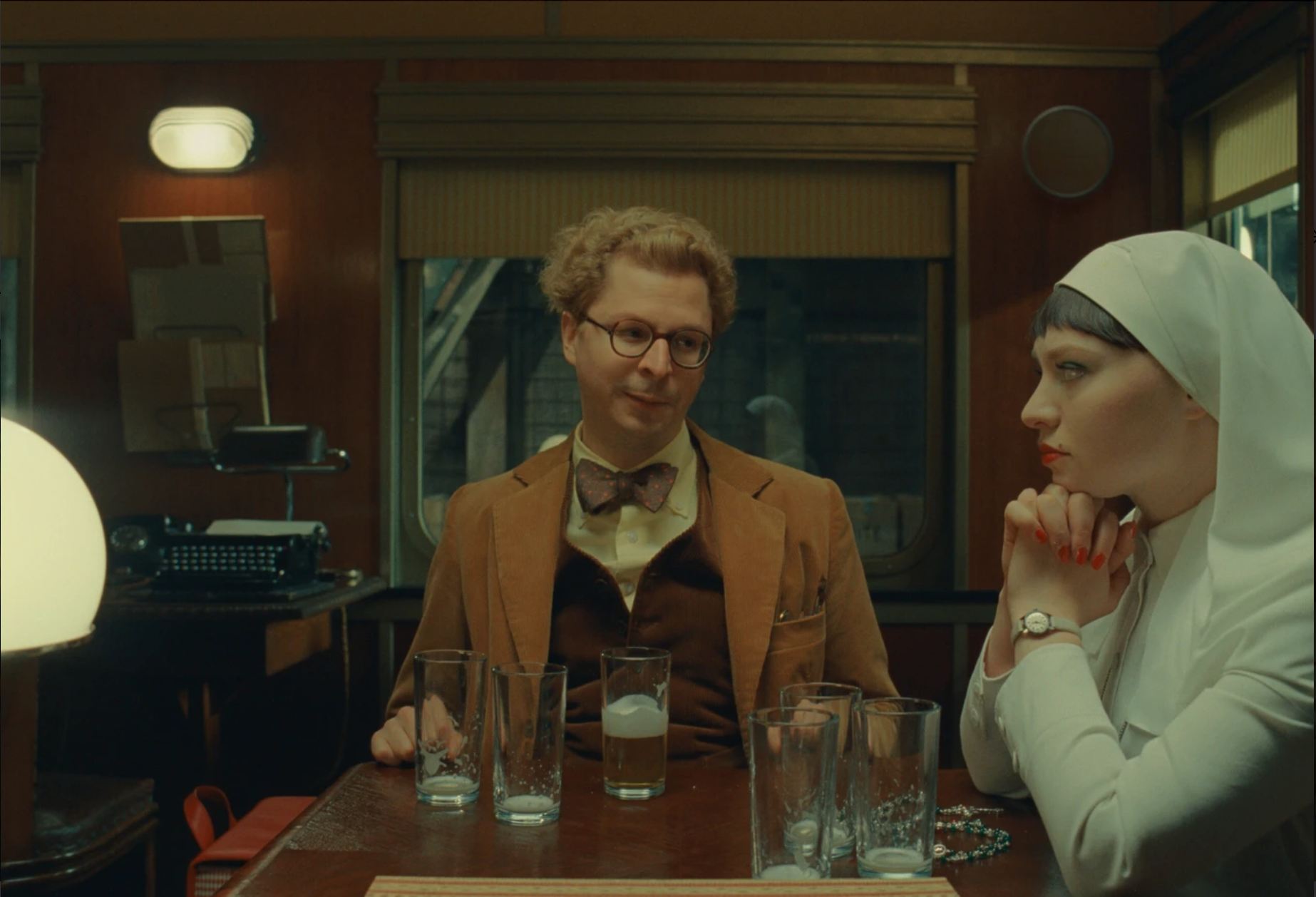
I’ll also be interested in how Benicio del Toro’s performance ages, because he’s an unusual choice for this kind of role. With Bill Murray, Gene Hackman, and Ralph Fiennes, you have a natural kind of warmth under the gruff exterior that’s always accessible right from the beginning even when they’re being bad dads. Del Toro was a perfect pick for the crazed artist in The French Dispatch because he always brings an unpredictable edginess to his roles. So in a way, Anderson is taking a chance in giving del Toro this kind of role. In the end, I think they both make it work, but they’re still asking you to do a little more work than usual in warming up to Zsa Zsa Korda.
It doesn’t take long to warm up to Mia Threapleton, who is an inspired bit of casting. The talented daughter of Kate Winslet, Threapleton brings a captivating intensity from the very first moment she appears. But it’s a fun kind of heightened performance – the kind that Anderson often gets from actresses ranging from Gwyneth Paltrow to Frances McDormand. Threapleton’s Liesl is as much the lead of the film as del Toro, and it’s a joy to watch her get whisked away into a crazy adventure – as much as it is touching to see her discover how she ended up motherless, as well as fatherless, all those years ago.
While some of the story elements are familiar, it’s not strictly business as usual in the aesthetics department. This is the first Anderson movie to be lensed by cinematographer Bruno Delbonnel (taking over for his usual DP, Robert Yeoman), and it feels as though Anderson is drawing with a different box of crayons – the colors both cooler and a touch more dramatic. The warm autumnal palate replaced with a chillier but no less striking assortment. It feels different, standing out from the rest.
Part of that uniqueness is the result of Korda’s many near-death experiences, which are presented in stark black-and-white photography. While these sequences represent a heavenly setting, wherein Korda is both being put on trial and working out some of his ancestral issues, it also resembles something out of the dark ages – a little touch of Bergman’s The Seventh Seal perhaps.
While Anderson’s symmetrical framing remains immaculate, keen-eyed observers will also notice more close-ups and hand-held shots. It may be that Anderson and Delbonnel found the way to get into Korda’s heart was by framing tight shots that allow you to linger on del Toro’s soulful eyes.
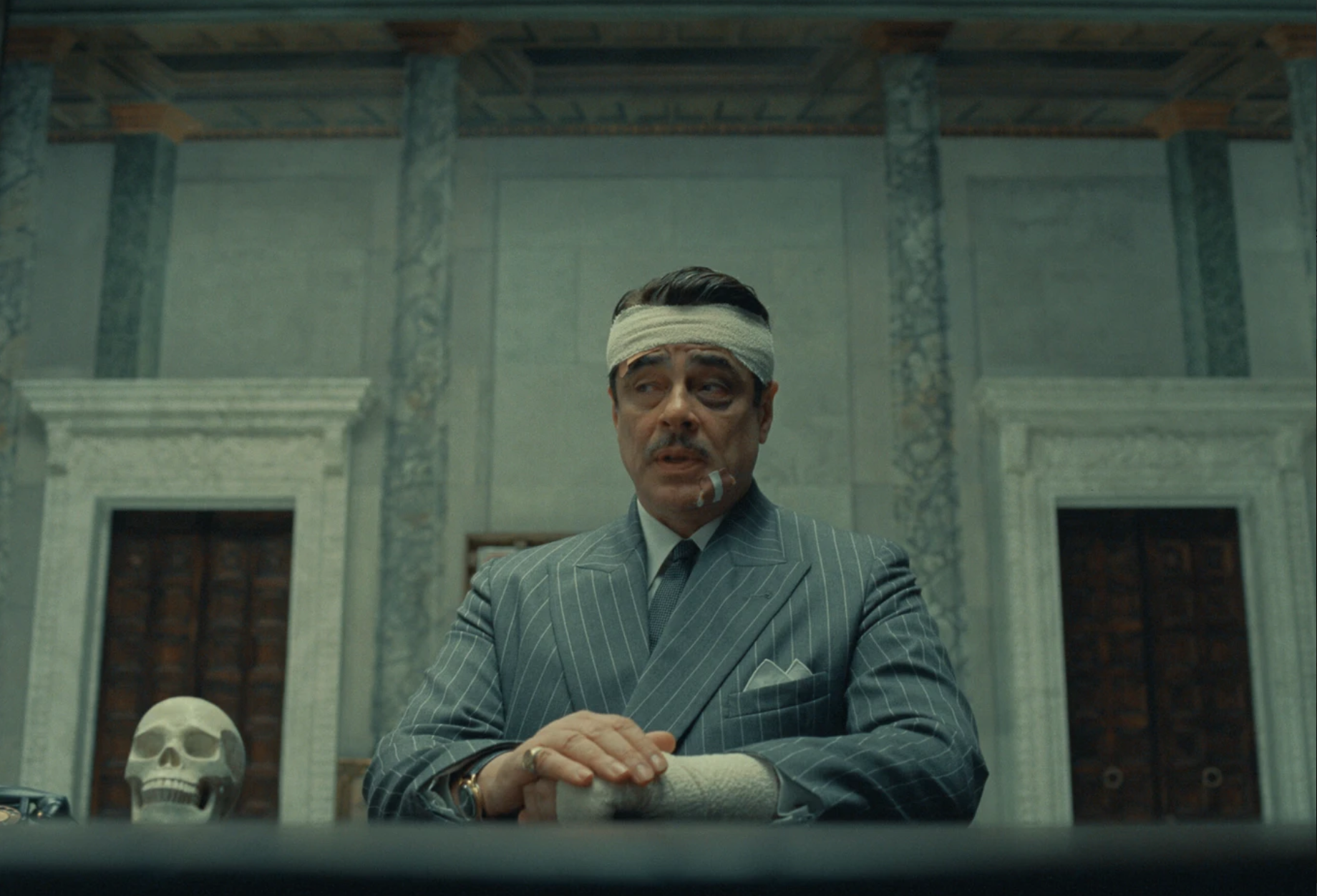
It helps to know that this is a more personal movie than usual (Anderson has the sole screenwriting credit, while frequent collaborator Roman Coppola gets a co-story credit). The Phoenician Scheme is dedicated to Fouad Mikhael Maalouf, a Lebanese businessman and the father of Anderson’s wife, Juman Malouf. To hear Anderson tell it, his dearly departed father-in-law was an intimidating figure – perhaps even a little scary at first – but also an inspirational one, a guy with plenty of amazing stories about his journey from Beirut to London. This sounds a lot like the Korda that Benecio del Toro delivers – an imposing man, not someone with immediate warmth, but a guy who can open up with a little time, patience and understanding.
The question remains, is The Phoenician Scheme a “return to form”, or a slight regression? I might be in the minority, but I was thrilled with his last few movies. I thought Asteroid City’s complex structure was extremely purposeful in exploring the art of collaborative storytelling – of how writing and acting and directing come together in complex and sometimes emotionally fraught ways. I also greatly admired the elaborate, choreographed long-takes of The Wonderful Story of Henry Sugar, which was impressively ambitious in its own right. The Phoenician Scheme may not be as bold as some of his recent efforts – there are no animated interludes or head-spinning set-pieces, but it’s hard to knock a movie for being more broadly appealing while still telling a story that’s personal and utterly true to their singular vision.
At this point in his three-decade-long career, Wes Anderson remains one of America’s greatest auteurs – a masterful visual storyteller who has perfectly melded the cinematic craft to meet his one-of-a-kind sensibility. It may feel slight in comparison, but The Phoenician Scheme is another feather in the man’s cap. A fun, funny, and heartfelt screwball adventure that adds some exciting new talents to his considerable arsenal of collaborators.
Discover more from Cineccentric
Subscribe to get the latest posts sent to your email.
 Cineccentric
0 comments on “The Phoenician Scheme ★★★”