
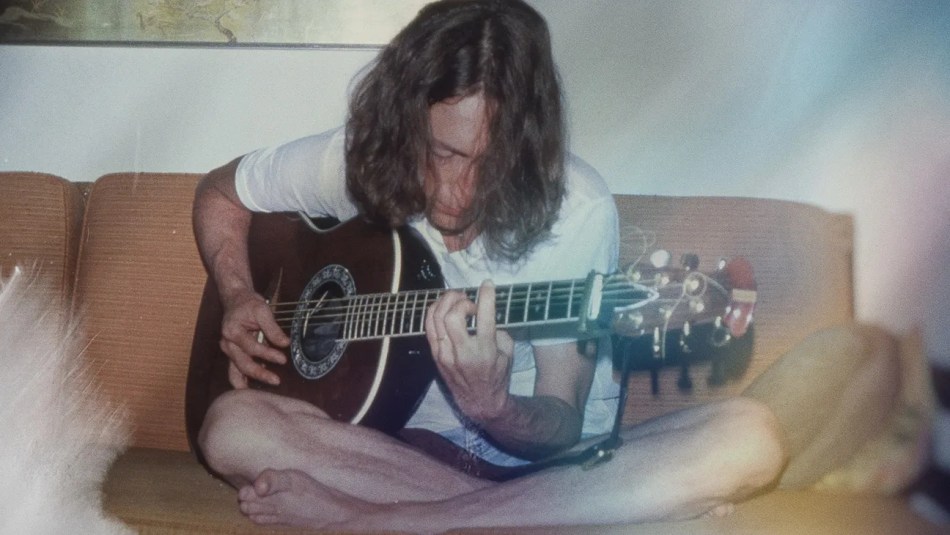
One day we will all be replaced by computers, says Yoko Ono in an ironic moment of Steven Soderbergh‘s inevitably defining documentary that sadly proves her right. Wrapped around the final extended interview that Ono and John Lennon gave at their home in the Dakota building, in front of which Lennon would be gunned down merely hours later, is a generic catalogue of archival footage and photos, pieced together with AI. Allegedly the latter was originally supposed to illustrate all of the roughly 100-minute-long conversation that the, at that point, most famous couple in pop history gave on that fateful 8th December in 1980 to journalists Dave Sholin, Laurie Kaye, and Ron Hummel.
In a meaningless but luckily short intro, the trio from San Francisco’s KFRC radio station reminisces about how excited they were to speak with the musician who had achieved a near-mythological status already in his lifetime. This fame would grow to almost saint-like worship after his death, the eerie immediacy of which hangs over every word like a dark cloud. To Soderbergh’s credit, he makes no move to exploit the macabre context, but it’s inextricably tied to the situation anyway. Just when Kaye, Sholin, and Hummel stepped outside the Dakota, an obsessive fan started talking to them. Kaye gave him a fresh copy of “Double Fantasy”, John and Yoko’s latest album, assuming a unique souvenir was all he wanted.
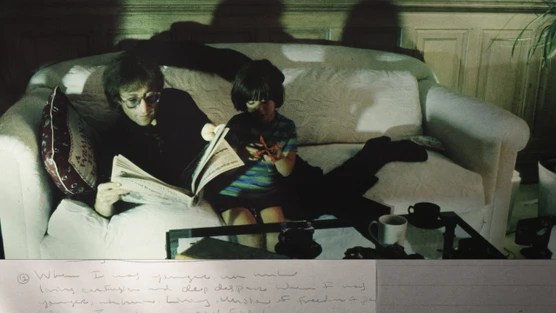
It was the same album the man later asked Lennon to sign – which he did – before shooting him. When Lennon talks about wanting to make music until the day he dies, “which will be hopefully a long, long time from now”, there is an instant emotional weight to these tragic misconceptions. Add to this the reflections of Lennon, whose thoughts on music, his career, the rise of the counterculture, and the state of the world manage to capture idealism without pretension, and it’s almost impossible not to be touched by them. At times he seems prophetically forward-thinking, as when he calls himself a househusband and talks about staying at home as a father.
One day, he suggests, men will stay at home with their children, not because equality rules force them to, but because they cherish experiencing their kids growing up. At other times, he seems counter-intuitively squarely middle-class when mentioning relying on a nanny, as if having household staff was just a given. The interview reveals him with a newfound creativity, a spark he was losing in his final years with the Beatles. Not dwelling too much on his time with the band, the journalists allow the conversation to flow naturally. This unobtrusiveness seems all the more rare in retrospect from today, when media reporters commonly foreground their own experience rather than that of the artist.
Maybe Soderbergh aimed at showing a similar understatement when foregoing his usual formal conceptualization in favor of a conventional collage of photographs, film snippets, musical outtakes, and those depressingly soulless AI bits. Their effect is one of bizarre dissociation: the voice recordings’ immediacy stands in stark contrast to the gimmicky phoniness of AI. As the antithesis of originality, artistry, and the human spirit intrinsic to both their work, the synthetic illustrations undermine the philosophical dimension of Ono’s and Lennon’s words and the very essence of their art. After all, it’s “Imagine”, not “let an algorithm produce something that fakes the original on a surface level”.
Discover more from Cineccentric
Subscribe to get the latest posts sent to your email.


0 comments on “John Lennon: The Last Interview (documentary) ★★”